
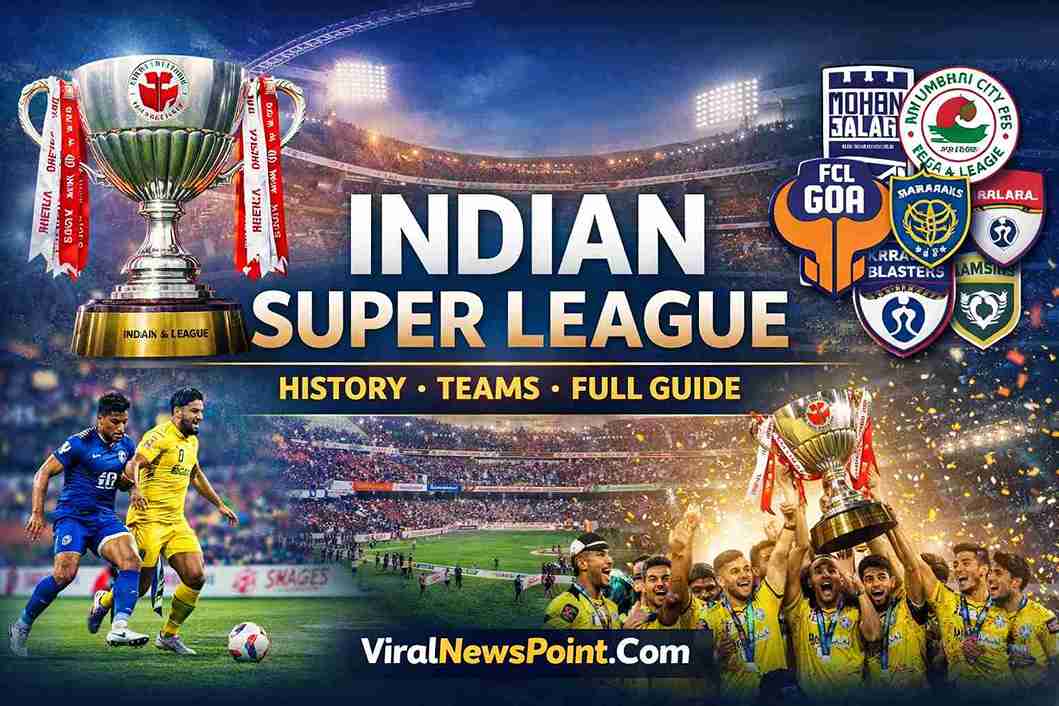
The Indian Super League (ISL) is the top-tier professional men’s football league in India. It is organized by the All India Football Federation (AIFF) and was established in 2013, with its inaugural season held in 2014. The league operates on a franchise-based model and represents the highest level of club football competition in the country. Over time, ISL has become the primary platform for professional football in India, replacing the I-League as the top division within the national football league system.
📊Introductory Highlights
| Category | Details |
|---|---|
| Founded | 2013 |
| First Season | 2014 |
| Organizing Body | All India Football Federation |
| Country | India |
| Number of Teams | 10–12 (varies by season) |
| League Level | Top-tier (Level 1) |
| Competition Format | League stage and playoffs |
| Relegation/Promotion | Limited; evolving system |
| Domestic Cup Link | Super Cup |
| International Qualification | AFC Champions League |
| Current Champions | Varies by season |
History
The establishment of the Indian Super League in 2013 was part of a broader initiative to restructure and commercialize football in India. The league was introduced with the objective of increasing the sport’s visibility, attracting investment, and improving infrastructure. The inaugural season in 2014 featured eight franchise teams representing major Indian cities. It also included participation from internationally recognized players, which contributed to early public interest and media attention.
In its initial years, the ISL operated alongside the I-League, which had historically been the premier football competition in India. This dual-league system led to structural ambiguity regarding the hierarchy of domestic football competitions. However, following consultations between stakeholders and the AIFF, a roadmap was implemented to designate the ISL as the top-tier league.
By the 2019–20 season, ISL was formally recognized as the highest level of professional football in India, while the I-League was repositioned as the second-tier competition. This transition marked a significant restructuring of the Indian football ecosystem.
Competition Format
The Indian Super League follows a two-stage competition format comprising a league stage and a playoff stage.
During the league stage, all participating teams play each other in a round-robin format, typically on a home-and-away basis. Teams earn three points for a win, one point for a draw, and no points for a loss. The standings are determined by total points accumulated over the season.
At the conclusion of the league stage, the top four teams qualify for the playoffs. The playoff stage consists of semi-finals, generally played over two legs, followed by a single-match final. The winner of the final is declared the ISL Champion.
In addition to the championship title, the team that finishes first in the league stage standings is awarded the “League Shield.” This distinction recognizes consistent performance over the course of the season and is separate from the playoff-based championship.
Competition Format
The Indian Super League follows a two-stage competition format comprising a league stage and a playoff stage.
During the league stage, all participating teams play each other in a round-robin format, typically on a home-and-away basis. Teams earn three points for a win, one point for a draw, and no points for a loss. The standings are determined by total points accumulated over the season.
At the conclusion of the league stage, the top four teams qualify for the playoffs. The playoff stage consists of semi-finals, generally played over two legs, followed by a single-match final. The winner of the final is declared the ISL Champion.
In addition to the championship title, the team that finishes first in the league stage standings is awarded the “League Shield.” This distinction recognizes consistent performance over the course of the season and is separate from the playoff-based championship.
Clubs and Structure
The ISL operates on a franchise-based system in which teams are owned and managed by corporate entities, consortiums, or private investors. Each franchise represents a specific city or region.
Prominent clubs participating in the league include Mumbai City FC, ATK Mohun Bagan FC, and Bengaluru FC. These clubs have contributed to the league’s competitive balance and fan engagement.
Over time, the composition of teams in the league has evolved. Some original franchises have undergone rebranding or restructuring, while new clubs have been introduced. Notably, the merger of ATK and Mohun Bagan resulted in the formation of ATK Mohun Bagan FC, reflecting a combination of franchise and traditional club identities.
The league has gradually moved toward a more integrated structure within the broader Indian football pyramid, including discussions on promotion and relegation mechanisms.
Players and Development
The Indian Super League has played a significant role in the development of football players in India. One of its defining features is the inclusion of foreign players, who bring international experience and technical expertise to the competition. Regulations typically limit the number of foreign players in matchday squads to maintain opportunities for domestic players.
The presence of experienced international players and coaches has contributed to improvements in training standards, tactical awareness, and overall professionalism. Indian players benefit from exposure to diverse playing styles and higher levels of competition.
Additionally, ISL clubs have invested in youth development programs and academies. These initiatives aim to identify and nurture young talent, providing structured pathways from grassroots football to the professional level. Such efforts are aligned with long-term objectives for strengthening the national team.
Media and Broadcasting
The ISL has received extensive media coverage since its inception. Matches are broadcast through television networks as well as digital streaming platforms, ensuring accessibility to a wide audience. The league has leveraged digital media to engage viewers through live streaming, highlights, and interactive content.
The involvement of prominent stakeholders and strategic marketing initiatives has contributed to increased visibility. Over successive seasons, viewership figures have indicated growing interest in football among Indian audiences.
Economic and Cultural Impact
The introduction of the ISL has had measurable economic implications for Indian football. Investment from corporate entities and sponsors has enhanced financial stability within the sport. Clubs have benefited from improved infrastructure, including upgraded stadiums and training facilities.
The league has also contributed to job creation in areas such as sports management, marketing, broadcasting, and event organization. Sponsorship deals and partnerships have further strengthened the commercial viability of the competition.
Culturally, the ISL has played a role in expanding the popularity of football across India. It has attracted new audiences, particularly in regions where football was not traditionally dominant. The league has also fostered local fan bases, contributing to the development of club-based football culture.
International Participation
Clubs participating in the ISL have opportunities to qualify for continental competitions organized by the Asian Football Confederation. The league stage winners typically earn qualification to the AFC Champions League, which is the premier club competition in Asia.
Participation in such tournaments provides Indian clubs with exposure to higher levels of competition and facilitates international recognition. It also contributes to the overall development of players and coaching staff through experience against stronger opponents.
Criticism and Challenges
Despite its growth, the Indian Super League has faced criticism and challenges. One of the primary concerns relates to its franchise-based structure, which differs from the traditional club model used in many footballing nations. This has led to debates regarding long-term sustainability and alignment with global football systems.
The transition from the I-League to ISL as the top-tier competition has also been subject to scrutiny. Critics have argued that traditional clubs have been adversely affected by changes in league hierarchy.
Financial sustainability remains another area of concern. While investment levels have been significant, questions persist regarding revenue generation and profitability for franchises.
Final Thought
The Indian Super League represents a major development in the evolution of football in India. Since its inception in 2013, it has contributed to increased visibility, improved infrastructure, and greater professionalization of the sport. The league has established itself as the top-tier competition under the governance of the AIFF and continues to evolve within the national football framework.
While challenges related to structure and sustainability remain, the ISL has created a platform for both domestic and international players and has played a central role in shaping the contemporary landscape of Indian football.
