
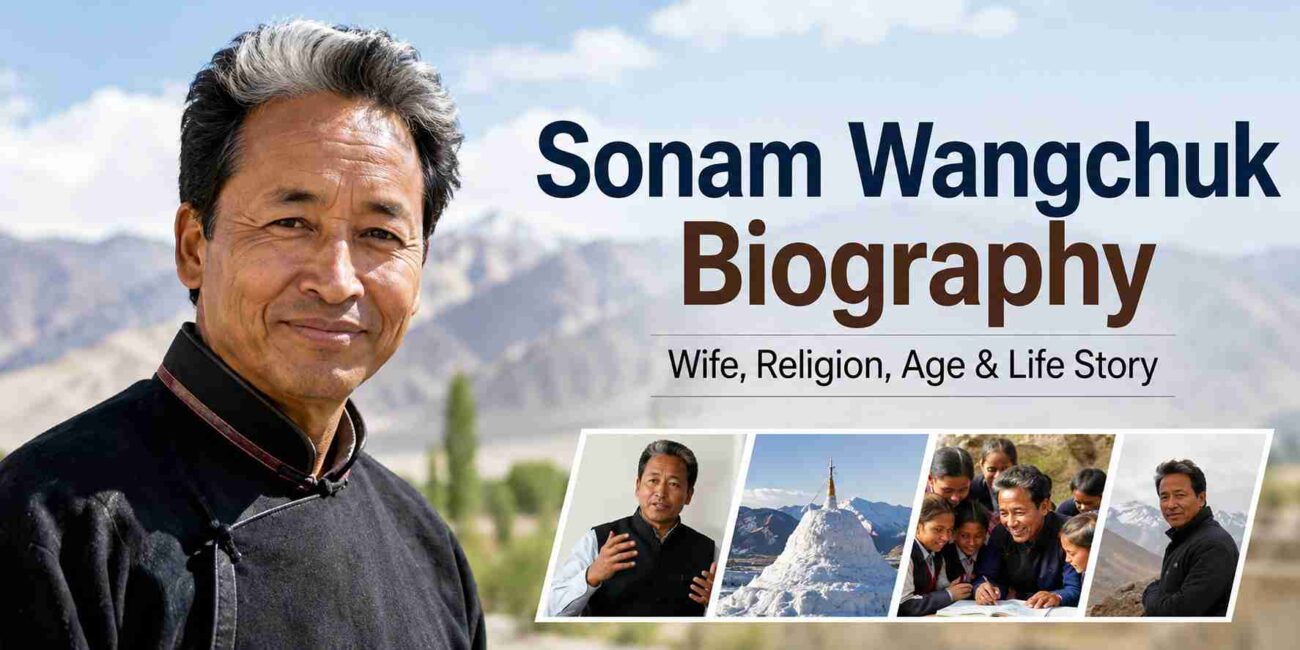
Sonam Wangchuk is an Indian engineer, education reformer, innovator, environmentalist and activist from Ladakh who has spent decades challenging conventional ideas about education and sustainable development. From helping transform education in Ladakh to developing the famous Ice Stupa technology, his work has attracted recognition across India and around the world.
For many people, Sonam Wangchuk first became a familiar name because of his association with the character Phunsukh Wangdu from the Bollywood film 3 Idiots. However, his real-life journey extends far beyond that popular comparison. His work includes the establishment of the Students’ Educational and Cultural Movement of Ladakh (SECMOL), educational reforms through Operation New Hope, experiments in sustainable architecture, the development of Ice Stupas and the creation of new models for experiential education.
In later years, Wangchuk also became a prominent public voice on environmental protection and issues concerning Ladakh. His hunger strikes, protests and detention brought another dimension to a public life that had previously been known primarily for education and innovation.
This detailed Sonam Wangchuk biography explores his early life, family, education, wife, career, inventions, major projects, awards, public activism and other important chapters of his life.

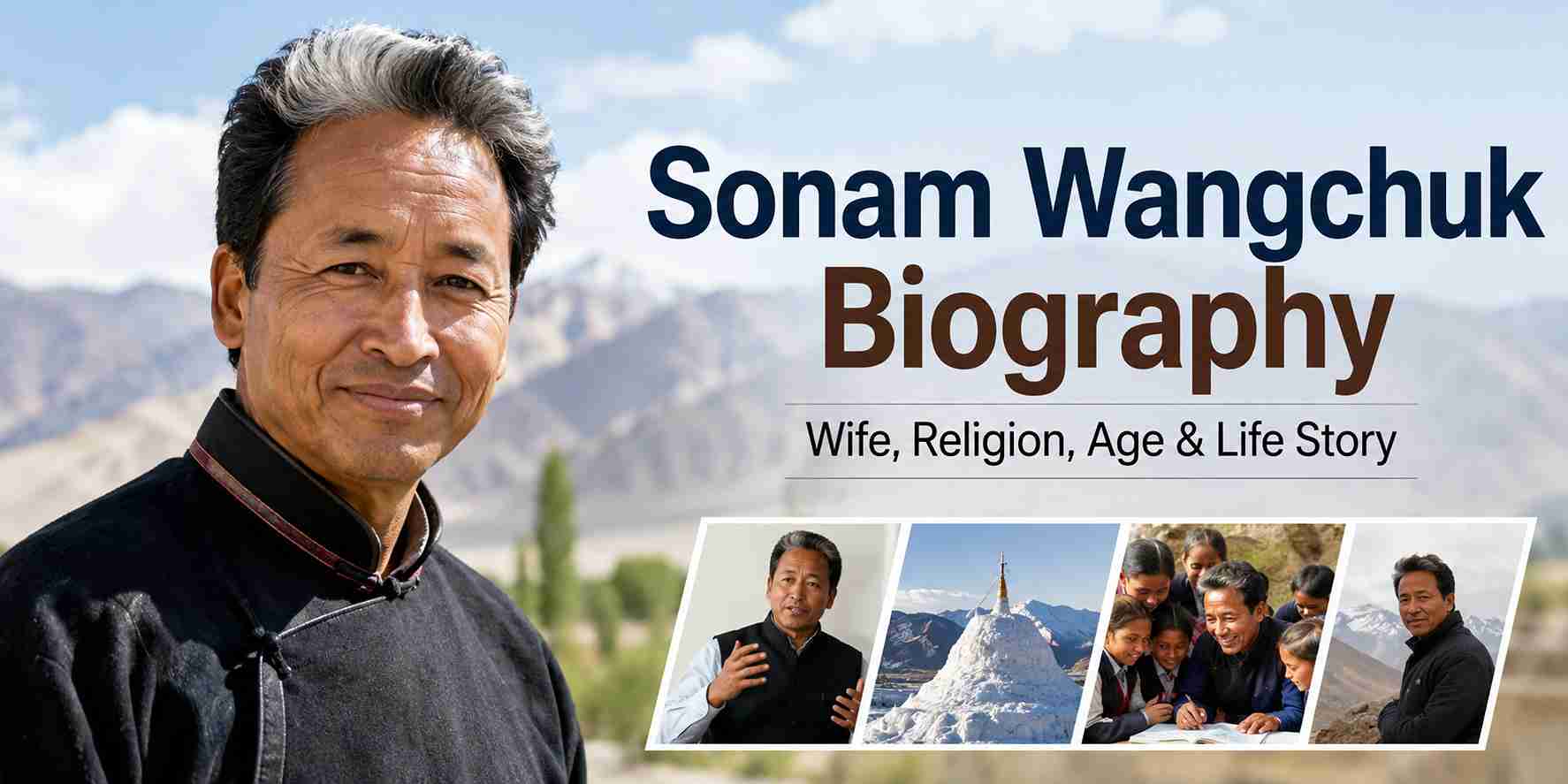
Who Is Sonam Wangchuk?
Sonam Wangchuk is best known as an education reformer and innovator from Ladakh. Born on 1 September 1966, he trained as a mechanical engineer but chose to devote much of his professional life to solving problems affecting students and communities in the Himalayan region.
One of the defining characteristics of Wangchuk’s work is his emphasis on finding solutions suited to local conditions. Whether dealing with an education system that disadvantaged Ladakhi children, buildings that needed to remain warm through extremely cold winters, or farmers facing water shortages in spring, his approach has generally combined engineering with practical experimentation.
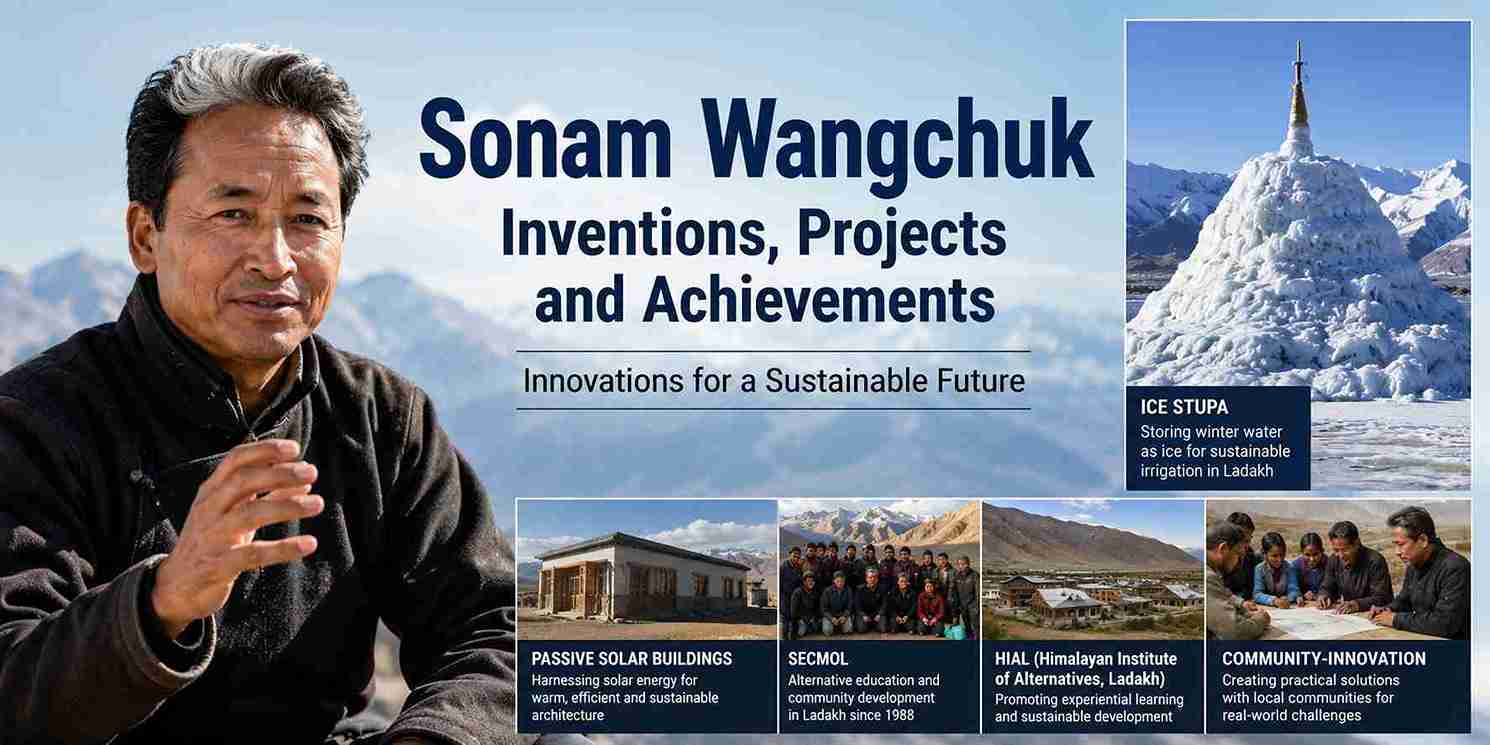
In 1988, after completing his engineering education, Wangchuk became a key founder of SECMOL. The organization initially worked with students who struggled in the conventional education system before becoming involved in broader educational reforms. His work later expanded into sustainable architecture, artificial glaciers and alternative higher education.
Wangchuk received the Ramon Magsaysay Award in 2018 in recognition of his work in education and innovation. The award’s official profile highlights his role in creating locally relevant approaches to education in Ladakh and documents the growth of the reform movement associated with SECMOL and Operation New Hope.
Sonam Wangchuk Biography at a Glance
| Particular | Details |
|---|---|
| Full Name | Sonam Wangchuk |
| Date of Birth | 1 September 1966 |
| Age | 59 years, as of July 2026 |
| Birthplace | Ladakh, India |
| Nationality | Indian |
| Profession | Engineer, education reformer, innovator and environmentalist |
| Engineering Field | Mechanical Engineering |
| College | Regional Engineering College Srinagar, now NIT Srinagar |
| Father | Sonam Wangyal |
| Wife | Gitanjali J. Angmo |
| Known For | SECMOL, Ice Stupa, education reform and sustainable innovation |
| SECMOL Founded | 1988 |
| Operation New Hope | Launched in 1994 |
| Major Innovation | Ice Stupa |
| Major Award | Ramon Magsaysay Award, 2018 |
| Other Major Recognition | Rolex Award for Enterprise, 2016 |
| Associated Institution | Himalayan Institute of Alternatives, Ladakh |
| Current Age | 59 years (as on July 2026) |
Some details about Wangchuk’s personal and family life are not extensively documented in authoritative public records. Where information is uncertain or inconsistently reported, it is better to avoid presenting speculation as biography.
Sonam Wangchuk Age and Date of Birth
Sonam Wangchuk was born on 1 September 1966. As of July 2026, he is 59 years old and will turn 60 on 1 September 2026.
He was born in the trans-Himalayan region of Ladakh, an environment that would have a profound influence on his later work. The region’s harsh winters, limited resources, unique cultural environment and educational challenges eventually became the setting for many of the problems he sought to address.
His life story is therefore closely connected to Ladakh itself. His educational experiments responded to the needs of Ladakhi students, his sustainable buildings were designed for the region’s extreme climate, and the Ice Stupa concept emerged from the seasonal water challenges faced by mountain communities.
Sonam Wangchuk’s Childhood and Early Life
Sonam Wangchuk’s childhood provides important context for understanding why education became such a central part of his life’s work.
Growing up in a remote part of Ladakh, his earliest educational experiences were different from those of children attending conventional urban schools. Biographical accounts describe him as initially learning at home before entering the formal education system.
His later experiences exposed him to one of the fundamental problems that would shape his career: children can appear unsuccessful when the education system itself does not reflect their language, environment or circumstances.
For students in Ladakh, unfamiliar languages of instruction and a curriculum disconnected from local life could create significant barriers. Wangchuk’s personal encounters with such difficulties helped influence his later argument that students should not automatically be labelled failures simply because they struggle within a poorly suited system.
Years later, this idea would become central to SECMOL.
Rather than asking only:
“Why are these students failing?”
Wangchuk and his colleagues began asking a different question:
“Is the education system failing the students?”
That reversal became one of the foundations of his educational philosophy.
Sonam Wangchuk Parents and Family Background
Sonam Wangchuk’s father is publicly identified as Sonam Wangyal, who was involved in politics and public life in the erstwhile state of Jammu and Kashmir.
Reliable information about Wangchuk’s wider family is comparatively limited in major institutional profiles. Various online biographies publish additional names and family details, but such information should be treated carefully unless supported by authoritative sources.
His upbringing in Ladakh, however, clearly played an important role in shaping his worldview. Instead of leaving the region’s problems behind after becoming an engineer, Wangchuk eventually built much of his professional life around addressing them.
His career would repeatedly return to three fundamental questions:
- How can education become relevant to the lives of students?
- How can technology work with a difficult environment rather than against it?
- And how can local communities become active participants in solving their own problems?
These questions eventually connected his work in education, engineering and environmental sustainability.
Sonam Wangchuk Education and Qualification
Sonam Wangchuk studied mechanical engineering at the Regional Engineering College in Srinagar, which is now known as the National Institute of Technology Srinagar.
He completed his engineering studies in the late 1980s, with 1987 widely documented as his graduation year.
His time as an engineering student also exposed him directly to the educational difficulties faced by young people from Ladakh. According to his official Ramon Magsaysay Award profile, while studying engineering he began tutoring students to help finance his own education.
The tutoring experience became unexpectedly significant.
Many students needed help with fundamental subjects, revealing to Wangchuk that poor examination performance was often the final symptom of much deeper weaknesses in the schooling system.
Instead of treating tutoring merely as a way to earn money, he began looking at the structural problem behind students’ struggles.
That realization helped set the stage for the creation of SECMOL.
From Mechanical Engineer to Education Reformer
After completing an engineering degree, Wangchuk could have followed a conventional technical career. Instead, he turned his attention toward education.
This decision would define the next several decades of his life.
The problem he and other young Ladakhis confronted was substantial. According to the official Ramon Magsaysay Award account, approximately 95% of Ladakhi students were at one stage failing government matriculation examinations.
Wangchuk and his colleagues did not believe this meant that an entire generation of Ladakhi children lacked ability.
They saw a system that needed reform.
This led to the establishment of the Students’ Educational and Cultural Movement of Ladakh, popularly known as SECMOL, in 1988.
Founding of SECMOL in 1988
SECMOL is one of the most important chapters in Sonam Wangchuk’s biography.
The organization was founded in 1988 by a group of young Ladakhis, with Wangchuk becoming one of its leading figures. It emerged in response to educational challenges affecting students across the region.
Initially, the movement worked with young people struggling to pass conventional examinations. However, Wangchuk and his colleagues soon recognized that helping students after they had already failed was not enough.
The education system itself needed attention.
Their work gradually expanded toward:
- Teacher training
- More locally relevant education
- Community involvement in schools
- Child-friendly teaching methods
- Curriculum reform
- Practical learning
- Greater recognition of Ladakhi language and context
SECMOL therefore evolved beyond the idea of a conventional coaching centre.
It became part of a larger experiment in rethinking what education in Ladakh could look like.
Operation New Hope
A major development came in 1994 with the launch of Operation New Hope.
The initiative expanded educational reform through cooperation among civil society, local communities and government institutions. According to the Ramon Magsaysay Award Foundation’s profile of Wangchuk, the programme developed from earlier school-reform efforts and sought to make education more relevant and effective.
Its approach included initiatives such as teacher training, community participation through Village Education Committees and efforts to adapt learning to Ladakh’s cultural and linguistic circumstances.
The programme demonstrated a recurring principle in Wangchuk’s work: a solution becomes more sustainable when communities participate in it rather than merely receive it from outside.
The Ramon Magsaysay Award Foundation reported substantial improvement in matriculation success rates over the following decades, although educational outcomes should be understood as the result of a wider collaborative movement rather than the achievement of one individual alone.
The SECMOL Alternative School
In 1998, the SECMOL School emerged as another important stage in this educational journey.
The school became particularly known for working with young people who had struggled in the conventional system. Instead of treating examination failure as proof that a student lacked potential, the programme focused on rebuilding confidence, developing practical abilities and creating opportunities for experiential learning.
Students could participate in the actual functioning of campus life.
This approach reflected a radically different idea of education: a school did not have to be only a place where students memorized information for examinations. It could become a living laboratory where they learned through responsibility, experimentation and solving genuine problems.
The campus also became a demonstration ground for sustainable technologies and architecture appropriate to Ladakh’s climate.
In this way, two strands of Wangchuk’s career began to merge.
Education met engineering.
That combination would later help produce the work for which he became internationally famous, including passive-solar buildings and the Ice Stupa.

Sonam Wangchuk Inventions, Projects and Achievements
The next chapter of his life would take him from reforming classrooms to experimenting with how entire communities could respond to some of the Himalayas’ most difficult environmental challenges.
Sonam Wangchuk Wife: Who Is Gitanjali J. Angmo?
Sonam Wangchuk is married to Gitanjali J. Angmo, an educationist and social entrepreneur who has been associated with the Himalayan Institute of Alternatives, Ladakh (HIAL).
Angmo has her own professional identity in the field of education and sustainable development. She has been publicly involved with HIAL and has also spoken on issues concerning Wangchuk during important periods of his public activism and detention.
Because the couple largely keeps their private life outside the spotlight, reliable public information about their marriage is limited. Details such as their wedding date and other aspects of their private family life are not consistently documented by authoritative sources.
For this reason, readers should be cautious about personal details circulated by generic celebrity-biography websites without reliable sourcing.
Does Sonam Wangchuk Have Children?
There is limited authoritative information publicly available about Sonam Wangchuk’s children and immediate private family life. Rather than relying on unverified biography websites, it is safer to say that Wangchuk and Gitanjali Angmo have generally kept much of their personal family life private.
What Is Sonam Wangchuk’s Religion?
The question “What is Sonam Wangchuk’s religion?” is frequently searched online. However, religion is a personal matter, and a person’s faith should not be inferred simply from their name, ethnicity, birthplace or the religious traditions of their region.
Sonam Wangchuk comes from Ladakh, a region with a strong Tibetan Buddhist cultural heritage alongside other religious communities. His Ice Stupa innovation also takes its name from the traditional stupa-like shape of the ice structures.
However, cultural background and personal religious belief are not necessarily the same thing.
Unless Wangchuk has explicitly and reliably identified his personal religious beliefs in a public statement, it is more accurate to avoid making an unsupported declaration about his religion. Some online biographies identify him as Buddhist, but such claims should be treated cautiously when they are not supported by a direct or authoritative source.
What is much more clearly documented is the influence of Ladakh’s environment, culture and Himalayan way of life on his work.
Sonam Wangchuk and Sustainable Architecture
Long before the Ice Stupa became internationally famous, Wangchuk was already experimenting with ways to make buildings better suited to Ladakh’s extreme climate.
Winter temperatures in the region can fall far below freezing. Heating buildings using conventional fuels can be expensive and environmentally demanding, particularly in remote mountain areas.
One alternative is passive-solar architecture.
Instead of depending entirely on mechanical heating systems, passive-solar buildings are designed to capture, store and retain heat from sunlight. Building orientation, insulation, windows, thermal mass and construction materials can all contribute to keeping indoor spaces warmer.
The SECMOL campus became an important demonstration of this philosophy.
Its sustainable approach showed how architecture itself could become part of the educational process. Students were not merely taught abstract lessons about sustainability. They lived and studied in an environment designed around those principles.
This combination of practical engineering and education became one of the defining characteristics of Wangchuk’s work.
Sonam Wangchuk and the Ice Stupa
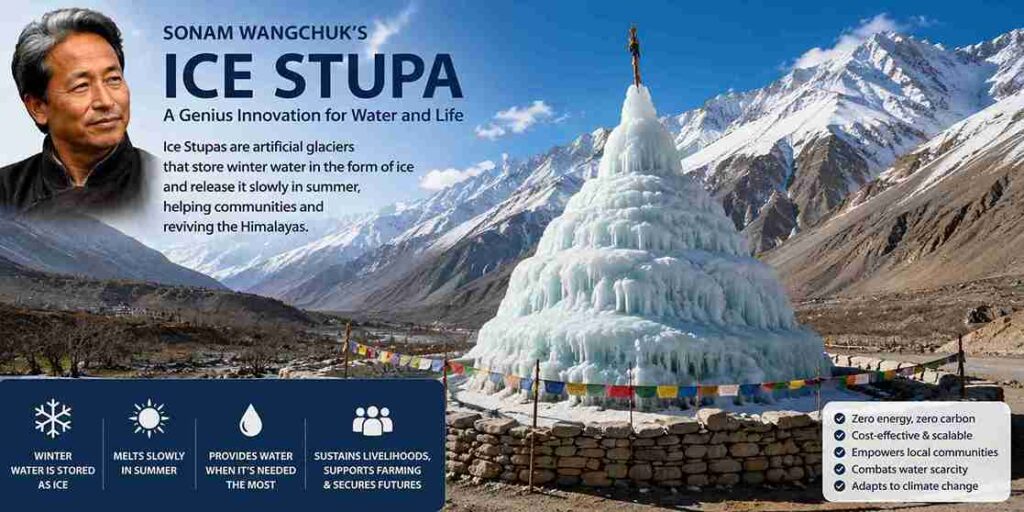
The Ice Stupa is probably Sonam Wangchuk’s most internationally recognized technological innovation.
It was developed as a response to a deceptively simple problem faced by farmers in cold desert regions such as Ladakh:
Water can be available when farmers do not need it and scarce when they need it most.
During winter, water from mountain streams may flow when agricultural demand is low. By spring, however, farmers need water to prepare fields and support young crops, while natural glacier melt may still be insufficient.
The Ice Stupa concept attempts to bridge this seasonal gap.
Winter water is redirected through pipes and released into freezing air. Under suitable conditions, it freezes progressively and forms a large vertical cone of ice.
When temperatures rise, the structure gradually melts and releases water that can be used during the agricultural season.
The idea is essentially a temporary frozen water reservoir created during winter and consumed naturally through melting.
Why Is It Called an Ice Stupa?
The name comes from the structure’s distinctive shape.
As the sprayed water freezes, it can form a tall conical structure resembling a traditional Buddhist stupa.
The vertical form also has an engineering advantage.
Compared with a broad, shallow sheet of ice containing a similar volume of water, a compact cone can expose relatively less surface area to direct warming. This helps slow melting and allows part of the stored ice to survive further into the warmer season.
The memorable shape consequently serves both a practical and cultural purpose.
How Does an Ice Stupa Work?
The basic Ice Stupa system can work largely through gravity where suitable terrain is available.
Water is taken from a source at a higher elevation and carried downhill through a pipe. The difference in elevation creates pressure.
When the water reaches a lower point and is released upward through a vertical pipe or sprinkler arrangement, it sprays into the freezing winter air.
The droplets freeze as they fall and gradually accumulate around a supporting structure.
Over time, the frozen mass grows into a large cone.
The process can be summarized as:
High-altitude water source → gravity-fed pipe → natural water pressure → water sprayed into freezing air → cone of ice forms → ice melts gradually in warmer weather → water becomes available for use.
The simplicity of the concept is one of its most attractive features because the basic system can reduce dependence on energy-intensive pumping.
However, its success still depends on factors such as temperature, elevation difference, water availability, pipe management and local geography.
Did Sonam Wangchuk Invent Artificial Glaciers?
This question requires an important historical distinction.
Sonam Wangchuk should not simply be described as the inventor of the entire concept of artificial glaciers.
Before the Ice Stupa project, Ladakhi engineer Chewang Norphel had already pioneered methods for creating artificial glaciers by slowing and freezing winter water in mountain areas.
Wangchuk’s contribution was the development and popularization of the distinctive vertical, cone-shaped Ice Stupa approach.
The two methods share the broader objective of storing winter water as ice, but their design and implementation differ.
Giving credit to earlier artificial-glacier work does not diminish Wangchuk’s contribution. Instead, it places the Ice Stupa within the longer history of Ladakhi innovation responding to water scarcity.
Development of the Ice Stupa Project
Early Ice Stupa experiments were carried out during the 2010s.
Wangchuk and his collaborators explored whether winter water could be frozen vertically so that a large volume of ice could survive long enough to provide useful meltwater during spring.
The concept gradually attracted attention because it combined several appealing qualities:
- It addressed a real agricultural problem.
- It used the natural cold of winter as part of the solution.
- Gravity could provide much of the necessary water pressure.
- The design could potentially be adapted to different mountain environments.
- The striking appearance helped attract public interest to the wider issue of climate adaptation.
Over time, the Ice Stupa project became internationally recognized and was tested or explored beyond Ladakh.
Experiments in European mountain regions, including Switzerland, demonstrated the international interest generated by the concept.
Rolex Award for the Ice Stupa Project
In 2016, Sonam Wangchuk received a Rolex Award for Enterprise for his Ice Stupa project.
The recognition helped bring greater international visibility to the idea and supported efforts to expand the use of artificial ice reservoirs.
The award also marked an important transition in Wangchuk’s public profile.
For years, he had been primarily known within educational and development circles for his work in Ladakh. The Ice Stupa project introduced his work to a much larger global audience interested in climate adaptation, water conservation and sustainable innovation.
Beyond the Ice Stupa: Sonam Wangchuk’s Other Innovations
Calling Wangchuk simply the “Ice Stupa inventor” captures only one part of his work.
His contributions can be divided into three broad categories.
Technological Innovation
This includes work associated with:
- Ice Stupas
- Passive-solar buildings
- Sustainable construction
- Cold-climate solutions
- Water conservation
- Experimental environmental technologies
Educational Innovation
Wangchuk’s educational work includes:
- Alternative approaches to students who struggle in conventional schools
- Experiential learning
- Practical problem-solving
- Community involvement in education
- Locally relevant learning
- Student participation in running educational environments
Institutional Innovation
His work has also contributed to the development of organizations and institutions designed around alternative approaches to learning, particularly SECMOL and later HIAL.
This broader view is important because some of Wangchuk’s most influential ideas are not physical inventions that can be placed on a table. They are systems and models designed to change how people learn and solve problems.
Himalayan Institute of Alternatives, Ladakh
The Himalayan Institute of Alternatives, Ladakh, commonly known as HIAL, represents another major chapter in Sonam Wangchuk’s educational journey.
Wangchuk is identified by the institution as its founding director.
The broader vision behind HIAL is to develop higher education suited to the environmental, social and economic realities of Himalayan regions.
Rather than relying exclusively on classroom lectures and examinations, its educational philosophy emphasizes experiential learning and solving real-world problems.
A concept strongly associated with HIAL is the combination of:
Head, Heart and Hands.
- The “Head” represents knowledge and intellectual understanding.
- The “Heart” represents values, empathy and social responsibility.
- The “Hands” represent practical skills and the ability to turn knowledge into action.
This philosophy reflects a recurring theme throughout Wangchuk’s career: education should not end with knowing something. Students should also understand why it matters and learn how to use that knowledge.
How Is HIAL Different From Conventional Education?
HIAL’s vision emphasizes learning through practical engagement.
Students may work on genuine challenges affecting Himalayan communities rather than treating every subject purely as an academic exercise.
Areas connected with the institution’s broader work include:
- Sustainable architecture
- Mountain development
- Water management
- Environmental innovation
- Tourism
- Entrepreneurship
- Experiential education
- Appropriate technology
The model builds upon many ideas Wangchuk had explored earlier through SECMOL while applying them to higher education.
SECMOL focused significantly on young people who had struggled within conventional schooling and on broader educational reform.
HIAL represents an attempt to carry experiential and locally relevant learning into higher education and professional problem-solving.
Sonam Wangchuk’s Major Achievements
It is difficult to summarize Wangchuk’s achievements through awards alone.
Some of his most significant contributions include helping establish SECMOL, participating in educational reform in Ladakh, promoting experiential learning, developing the Ice Stupa concept, advancing passive-solar architecture and helping create HIAL.
His major achievements can broadly be understood through their impact:
- Education: Challenging the idea that examination failure necessarily means a student lacks ability.
- Sustainability: Demonstrating technologies and building methods adapted to local environmental conditions.
- Water conservation: Developing a distinctive approach to storing winter water as ice for later use.
- Institution building: Helping create educational organizations designed around practical learning.
- Public awareness: Drawing national and international attention to environmental challenges facing Himalayan regions.
These contributions eventually brought Wangchuk numerous national and international honours, including two of the best-known recognitions of his career: the Rolex Award for Enterprise in 2016 and the Ramon Magsaysay Award in 2018.
Yet the next phase of his life would move beyond education and engineering. As concerns over Ladakh’s environment, constitutional protections and political future intensified, Wangchuk increasingly stepped into the role of public activist, leading to hunger strikes, mass campaigns and eventually one of the most controversial periods of his life.
Sonam Wangchuk Awards and Honours
Sonam Wangchuk’s work in education, environmental innovation and sustainable development has brought him recognition from institutions in India and abroad.
Sonam Wangchuk Awards and Honours
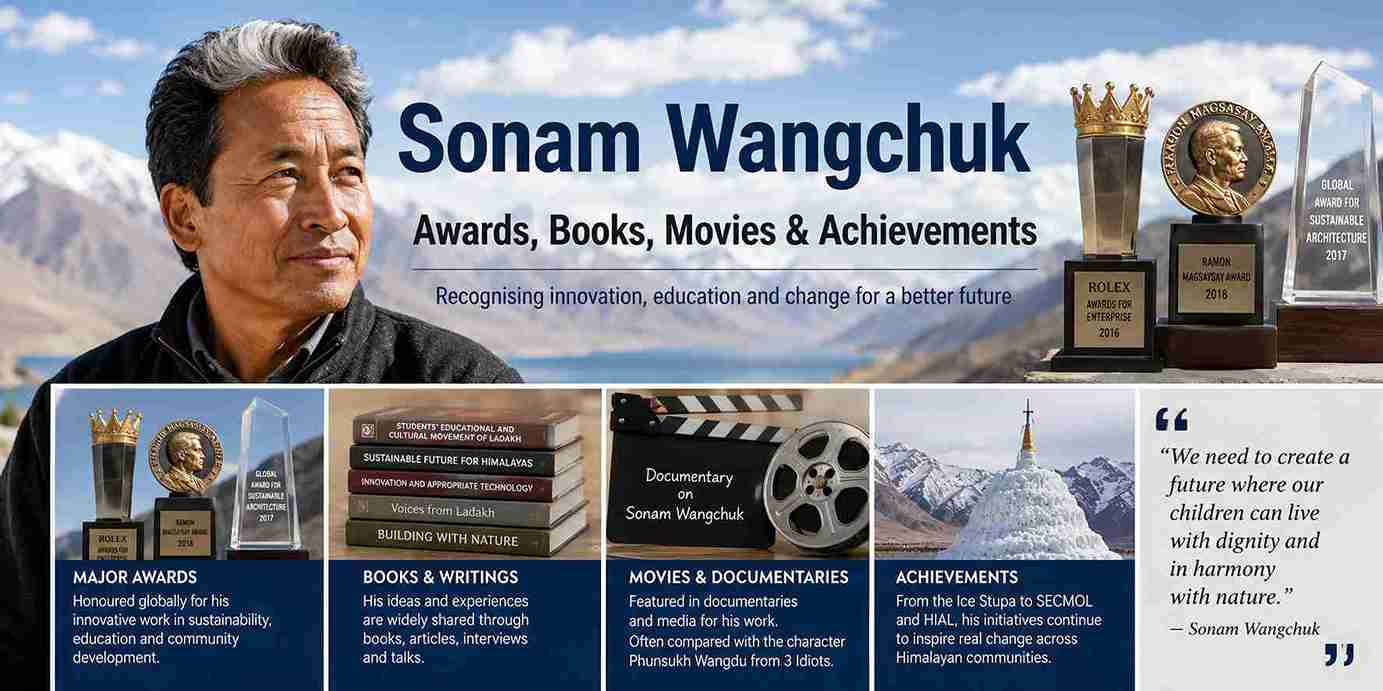
Among the most significant honours associated with his career are the Rolex Award for Enterprise in 2016, the Global Award for Sustainable Architecture in 2017 and the Ramon Magsaysay Award in 2018.
Major Awards and Recognitions
| Year | Award or Recognition |
|---|---|
| 1996 | Governor’s Medal, Jammu and Kashmir |
| 2001 | The Week Man of the Year |
| 2002 | Ashoka Fellowship |
| 2005 | Green Teacher Award |
| 2008 | CNN-IBN Real Heroes Award |
| 2016 | Rolex Award for Enterprise |
| 2017 | Global Award for Sustainable Architecture |
| 2017 | J&K State Award for Outstanding Environmentalist |
| 2018 | Ramon Magsaysay Award |
| 2018 | Honorary academic and institutional recognitions |
Some older award lists differ across online sources, so the exact titles and awarding bodies of individual honours should be checked against original institutional records when available.
Rolex Award for Enterprise
Wangchuk received a Rolex Award for Enterprise in 2016 for the Ice Stupa project.
The recognition helped expand international awareness of his attempt to address seasonal water shortages in cold mountain regions by storing winter water in the form of artificial ice reservoirs.
The award also helped transform the Ice Stupa from a locally known experiment into an internationally discussed example of climate adaptation.
Global Award for Sustainable Architecture
In 2017, Wangchuk was among the recipients of the Global Award for Sustainable Architecture.
His work demonstrated how architecture in extreme environments could respond intelligently to local climate and resources instead of depending entirely on energy-intensive conventional solutions.
Passive-solar design and environmentally appropriate construction had already played important roles in the educational campuses associated with his work.
Ramon Magsaysay Award
In 2018, Sonam Wangchuk received the prestigious Ramon Magsaysay Award.
The award recognized his contribution to educational reform and his efforts to develop practical, locally relevant approaches to problems affecting communities in Ladakh.
The recognition represented an important milestone in a journey that had begun decades earlier with students struggling to pass school examinations.
By this point, Wangchuk’s work had expanded from tutoring and education reform to sustainable architecture, water conservation and alternative models of higher education.
Has Sonam Wangchuk Written Any Books?
People frequently search for “Sonam Wangchuk books,” but this topic requires caution because online catalogues contain works written by several different people who share the same or a similar name.
At present, Sonam Wangchuk, the Ladakhi engineer and education reformer, is better known for his educational work, public talks, interviews, institutional writings and practical projects than for a large catalogue of commercially published books authored solely by him.
Books attributed to people named Sonam Wangchuk should therefore not automatically be added to his bibliography.
For example, works by authors whose names include additional identifiers such as “Sonam Wangchuk Lepcha” belong to different individuals.
Readers interested in Wangchuk’s ideas can find them extensively documented through his speeches, interviews, institutional materials and talks about education, innovation, sustainability and the Himalayan environment.
A dedicated examination of his verified publications and books written about him is more useful than presenting an inaccurate list merely to satisfy a search keyword.
Sonam Wangchuk and 3 Idiots
One of the most persistent questions surrounding Sonam Wangchuk is his connection with the blockbuster Hindi film 3 Idiots.
The film, released in 2009, features Aamir Khan as Rancho, who is eventually revealed to be an unconventional inventor and educator named Phunsukh Wangdu living in Ladakh.
Because Wangchuk is a Ladakh-based engineer, innovator and education reformer, he became widely associated with the fictional character.
This led to a popular description of him as the “real-life Phunsukh Wangdu.”
However, the relationship between Wangchuk’s life and the film is more nuanced than that phrase suggests.
Is 3 Idiots Based on Sonam Wangchuk’s Life?
No. 3 Idiots should not be described as a biographical film about Sonam Wangchuk.
The movie is a fictional story and draws significantly from Chetan Bhagat’s novel Five Point Someone. Phunsukh Wangdu is also a fictional character rather than a direct cinematic biography of Wangchuk.
Nevertheless, Wangchuk has frequently been associated with aspects of the character because of the parallels between his real-world work and the fictional inventor shown in the film.
These similarities include:
- A strong connection with Ladakh
- An engineering background
- Unconventional ideas about education
- Practical innovation
- Criticism of rote learning
- A preference for learning through experimentation
Therefore, a more accurate description is that Sonam Wangchuk has been widely associated with or described as an inspiration for aspects of the Phunsukh Wangdu character, rather than saying that 3 Idiots tells his life story.
Wangchuk himself has also sought to ensure that his identity and decades of work are not reduced entirely to a fictional movie character.
His real achievements began long before the film was released and cover education, architecture, water conservation, environmental work and public activism.
Sonam Wangchuk Movies and Documentaries
Sonam Wangchuk is not primarily a film actor, so searches for “Sonam Wangchuk movies” often reflect interest in his connection with 3 Idiots or documentaries and media programmes featuring his work.
Over the years, his educational initiatives, Ice Stupa project and environmental campaigns have been covered through documentaries, interviews, television programmes and digital media.
A dedicated list of screen appearances should distinguish between:
- Films based on his life
- Fictional characters associated with him
- Documentaries featuring him
- Television appearances
- Recorded interviews and public talks
This distinction prevents every video featuring Wangchuk from being incorrectly labelled as one of his “movies.”
From Innovator to Environmental Activist
During the 2020s, Sonam Wangchuk’s public identity changed significantly.
For decades, he had primarily been known for education reform and sustainable innovation. He increasingly became a prominent public advocate for the environmental and political concerns of Ladakh.
The Himalayan region faces a particularly delicate relationship between development and ecology. Large-scale construction, tourism, military infrastructure, water availability and climate change can all create pressures on an already fragile environment.
Wangchuk began using his public platform to argue that development in Ladakh should take environmental limits and the interests of local communities into account.
His activism also became closely connected with political demands raised by organizations and communities across Ladakh following the region’s reorganization as a Union Territory in 2019.
Why Was Sonam Wangchuk Protesting for Ladakh?
The wider Ladakh movement has raised several major demands, including:
- Statehood for Ladakh
- Constitutional safeguards
- Protection of land
- Protection of local employment
- Greater political representation
- Safeguards for Ladakh’s tribal population and culture
- Environmental protection
One of the most prominent demands has involved bringing Ladakh under constitutional safeguards associated with the Sixth Schedule.
Supporters argue that stronger protections are necessary to safeguard local communities, land, culture and the fragile Himalayan environment.
It is important, however, not to portray the entire movement as belonging to Wangchuk alone. Organizations, religious bodies, political representatives and community leaders from different parts of Ladakh have all played important roles.
Wangchuk became one of the movement’s most recognizable public faces because of his national and international profile.
Sonam Wangchuk’s 21-Day Climate Fast in 2024
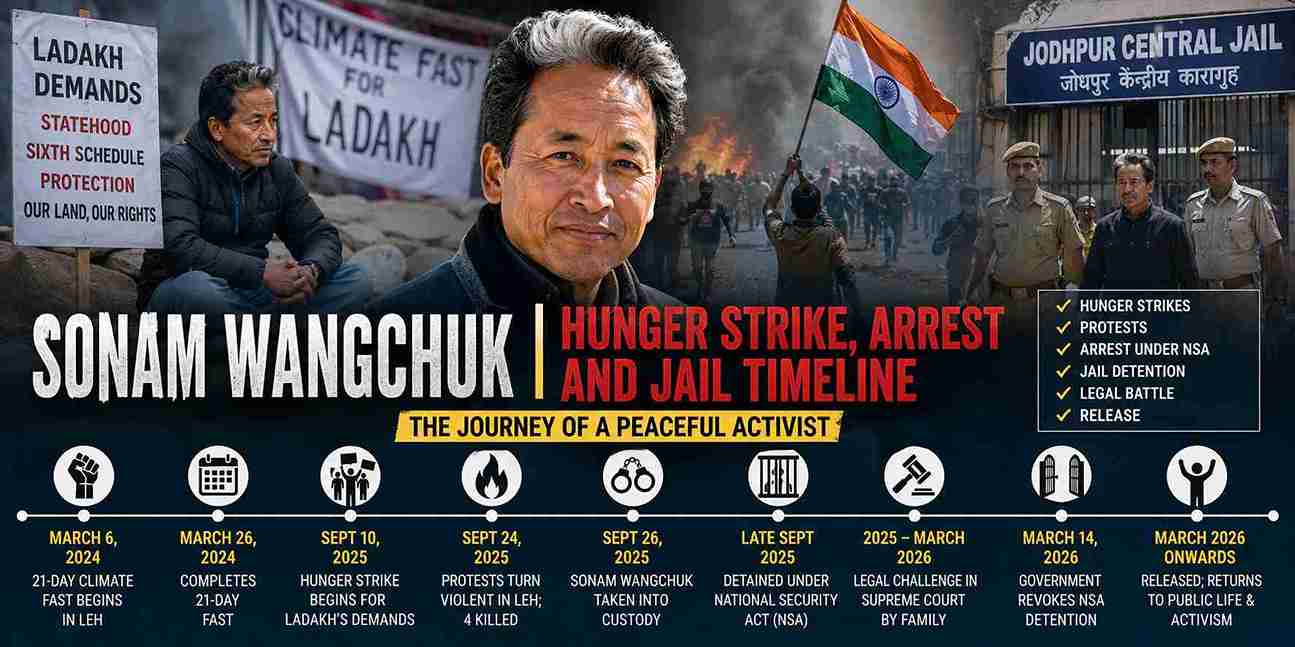
On 6 March 2024, Wangchuk began a planned 21-day hunger strike in Leh.
He described the protest as a climate fast and used it to draw attention to Ladakh’s constitutional and environmental concerns.
The fast gained significant public attention as supporters gathered in solidarity and discussions about Ladakh’s political future reached a much wider national audience.
Wangchuk completed the 21-day fast on 26 March 2024.
The end of his personal fast did not mean that the wider campaign had ended. Protest activities and public demands continued afterward.
The fast did not immediately produce the principal constitutional changes sought by the movement, but it substantially increased awareness of Ladakh’s demands across India.
The 2025 Hunger Strike and Leh Unrest
The political situation surrounding Ladakh remained unresolved into 2025.
Wangchuk again participated in a hunger strike connected with the region’s demands.
On 24 September 2025, protests in Leh turned violent. Four people were killed and numerous others were injured.
Wangchuk ended his hunger strike as the situation deteriorated and appealed for peace.
The events that followed became one of the most controversial chapters of his public life.
Government authorities accused Wangchuk of making statements that had contributed to the unrest. Wangchuk rejected allegations that he had incited violence and argued that the situation reflected deeper frustration surrounding Ladakh’s unresolved demands.
Any account of this episode should clearly distinguish between allegations made by authorities and Wangchuk’s response rather than presenting disputed claims as established facts.
Sonam Wangchuk Hunger Strike, Arrest and Jail Timeline
Why Was Sonam Wangchuk Arrested?
Sonam Wangchuk was taken into custody on 26 September 2025, two days after the deadly unrest in Leh.
He was subsequently held under the National Security Act, commonly known as the NSA.
The government defended the preventive detention on security and public-order grounds linked to the circumstances surrounding the unrest.
Wangchuk and his representatives challenged the basis of the detention.
The legal dispute eventually reached the Supreme Court of India, where arguments focused on the grounds for his detention and the interpretation of speeches and other material relied upon by authorities.
Was Sonam Wangchuk Sent to Jail?
Yes, Sonam Wangchuk was held in Jodhpur Central Jail during his preventive detention.
However, this requires an important legal clarification.
He was not serving a prison sentence after being convicted of a criminal offence in connection with the detention. He was being held under a preventive-detention law.
Preventive detention and imprisonment following a criminal conviction are legally different.
Therefore, when answering the commonly searched question “Why was Sonam Wangchuk in jail?”, the context of the NSA detention must always be explained.
Legal Challenge to Sonam Wangchuk’s Detention
Wangchuk’s wife, Gitanjali J. Angmo, challenged his detention.
The dispute reached the Supreme Court, where Wangchuk’s side questioned the legality and grounds of the detention.
His representatives also disputed the interpretation of his speeches, arguing that statements cited against him had been taken out of context and that his response during the unrest was intended to calm the situation rather than encourage violence.
The authorities defended their action based on their assessment of security and public order.
Before the court proceedings could result in a final ruling on the continuing detention, the government revoked the detention order.
When Was Sonam Wangchuk Released?
Sonam Wangchuk’s detention under the National Security Act was revoked on 14 March 2026.
This brought to an end approximately five and a half months of preventive detention that had begun in late September 2025.
Following the revocation of the detention order, the Supreme Court disposed of the legal challenge because Wangchuk was no longer being held under the order being contested.
His release, however, did not mark the end of his involvement in public activism.
Only a few months later, he became involved in another major hunger strike, this time connected with an issue different from his earlier campaign for Ladakh.
The final chapter of this biography will bring the story up to July 2026 and include his latest hunger strike, complete life timeline, key facts, frequently asked questions and a concise overview of his legacy and impact.
Sonam Wangchuk’s 2026 Hunger Strike and Latest Activities
Last updated: July 16, 2026
Sonam Wangchuk returned to national attention in June 2026 when he joined an indefinite hunger strike at Jantar Mantar in New Delhi.
This protest was separate from his earlier hunger strikes concerning Ladakh’s statehood and constitutional safeguards. The 2026 campaign was connected with youth protests over alleged examination paper leaks and irregularities in India’s examination system.
Wangchuk joined the indefinite fast on 28 June 2026.
As of 16 July 2026, the hunger strike had entered its 19th day. Reports stated that he had lost more than nine kilograms during the fast, raising concerns about his health.
The Delhi High Court directed authorities to ensure regular medical monitoring and to take appropriate action if medical intervention became necessary.
Because this situation is developing, readers should check the latest news for developments occurring after the date shown above.
Where Is Sonam Wangchuk Now?
As of the last update to this biography on 16 July 2026, Sonam Wangchuk was participating in the indefinite hunger strike with Cockroach Janta Party (Youth) in New Delhi.
His current activities should be understood separately from his earlier Ladakh-focused movement.
Over the years, Wangchuk’s public role has evolved considerably. He began his career as an engineer and education reformer, became internationally known as an innovator and environmental advocate, and later emerged as a prominent participant in public campaigns and protest movements.
For continuously updated information about his activities, readers should refer to the dedicated Sonam Wangchuk latest news page rather than relying solely on an evergreen biography.
Sonam Wangchuk Life Timeline
The following timeline provides an overview of the major milestones in Sonam Wangchuk’s life and career.
| Year | Major Event |
|---|---|
| 1966 | Sonam Wangchuk was born on 1 September in Ladakh |
| 1970s | Spent his early childhood and began his education |
| 1980s | Studied mechanical engineering |
| 1987 | Commonly documented year of completing his engineering studies |
| 1988 | Became one of the key founders of SECMOL |
| 1994 | Operation New Hope was launched as part of wider educational reform efforts |
| 1990s | Work on educational reform and sustainable campus development expanded |
| 1998 | SECMOL’s alternative educational programme entered an important new phase |
| 2000s | Received growing recognition for education and social innovation |
| 2013–14 | Early Ice Stupa experiments were developed |
| 2015–16 | Ice Stupa project gained wider international attention |
| 2016 | Received the Rolex Award for Enterprise |
| 2017 | Received the Global Award for Sustainable Architecture |
| 2018 | Received the Ramon Magsaysay Award |
| Late 2010s | HIAL became an increasingly important focus of his educational work |
| Early 2020s | Became increasingly active on climate and Ladakh-related issues |
| March 2024 | Completed a 21-day climate fast in Leh |
| September 2025 | Participated in another hunger strike amid the Ladakh movement |
| 24 September 2025 | Protests in Leh turned violent and Wangchuk ended his fast |
| 26 September 2025 | Taken into custody and subsequently held under the NSA |
| 14 March 2026 | Preventive detention was revoked |
| 28 June 2026 | Joined an indefinite hunger strike in New Delhi |
| 16 July 2026 | Hunger strike reached its 19th day |
This timeline summarizes major milestones rather than every event in Wangchuk’s life. Individual projects, awards and protest movements have their own more detailed histories.
Interesting Facts About Sonam Wangchuk
1. He is a mechanical engineer by education
Although Wangchuk is widely known as an education reformer and environmental innovator, his formal higher education is in mechanical engineering.
2. SECMOL was founded long before 3 Idiots
SECMOL was established in 1988, more than two decades before the release of 3 Idiots in 2009. Wangchuk’s educational work therefore predates his popular association with Phunsukh Wangdu by many years.
3. He did not invent the entire concept of artificial glaciers
Ladakhi engineer Chewang Norphel had pioneered earlier artificial-glacier techniques. Wangchuk developed and popularized the distinctive vertical Ice Stupa approach.
4. The Ice Stupa uses winter as part of the technology
Instead of fighting Ladakh’s freezing temperatures, the concept uses the natural cold to store water in frozen form for later use.
5. His work combines education and engineering
Many of Wangchuk’s projects are not purely technological. Students and educational institutions often become active participants in solving practical problems.
6. He received the Ramon Magsaysay Award
Wangchuk received the prestigious Asian award in 2018 for his work related to education and community-based innovation.
7. 3 Idiots is not his biography
Although Wangchuk is widely associated with Phunsukh Wangdu, the movie is fictional and should not be described as the story of his life.
8. His activism extends beyond environmental technology
During the 2020s, he became increasingly involved in public campaigns concerning Ladakh’s environment, constitutional protections and political future.
9. His 2025 detention was preventive detention
Wangchuk was held under the National Security Act, but this should not be confused with serving a sentence following a criminal conviction.
10. His educational philosophy emphasizes practical learning
From SECMOL to HIAL, a recurring theme in Wangchuk’s work is that students should learn by engaging with genuine problems rather than depending entirely on textbooks and examinations.
What Makes Sonam Wangchuk’s Work Different?
The connecting thread running through Wangchuk’s career is not any single invention.
It is his approach to problems.
When students struggled with examinations, the response was not simply to blame the students. He questioned whether the education system itself needed to change.
When conventional buildings required large amounts of fuel to survive Ladakh’s winters, he explored architecture that could make better use of sunlight.
When water was available in winter but scarce during the agricultural season, the Ice Stupa approach attempted to change when that water became available.
These projects share a common philosophy: understand the local problem first and then design the solution around the environment and people who will actually use it.
Not every initiative associated with Wangchuk has been free from challenges or criticism. His later activism has also placed him at the centre of political disputes and legal controversy.
Nevertheless, his journey demonstrates how education, engineering and environmental thinking can intersect in unexpected ways.
Sonam Wangchuk’s Legacy and Impact
It may still be too early to define Sonam Wangchuk’s final legacy because his public work remains active.
However, several areas of influence are already clear.
Education Reform
SECMOL challenged conventional assumptions about students who failed within the formal education system. Its work helped promote discussion about locally relevant, experiential education.
Sustainable Architecture
The campuses and institutions associated with Wangchuk demonstrated approaches to building and living in cold Himalayan environments with greater attention to local climate and resources.
Water Innovation
The Ice Stupa brought international attention to the possibility of using artificial ice reservoirs as a seasonal water-management technique in suitable cold mountain environments.
Alternative Higher Education
Through HIAL, Wangchuk helped advance the idea that higher education can be organized around solving real-world problems rather than separating academic learning from practical experience.
Environmental Awareness
His campaigns brought wider attention to the ecological vulnerability of Ladakh and the development pressures facing Himalayan regions.
Public Activism
His hunger strikes and political advocacy made him an influential but increasingly debated public figure, expanding his identity beyond that of an educator and inventor.
His story, therefore, is not a tidy tale belonging to a single profession.
It moves through classrooms, engineering workshops, frozen landscapes, sustainable campuses, public protests and court proceedings.
Frequently Asked Questions About Sonam Wangchuk
Who is Sonam Wangchuk?
Sonam Wangchuk is an Indian mechanical engineer, education reformer, innovator, environmental advocate and activist from Ladakh. He is best known for his work with SECMOL and the Ice Stupa project.
What is Sonam Wangchuk’s age?
Sonam Wangchuk was born on 1 September 1966. He is 59 years old as of July 2026.
Who is Sonam Wangchuk’s wife?
Sonam Wangchuk is married to Gitanjali J. Angmo, an educationist and social entrepreneur associated with HIAL.
What is Sonam Wangchuk’s religion?
Some secondary online biographies identify Wangchuk as Buddhist, but personal religious affiliation should not be inferred solely from his Ladakhi cultural background. A definitive statement should rely on a clear first-person or authoritative source.
What is Sonam Wangchuk’s educational qualification?
He studied mechanical engineering at the Regional Engineering College Srinagar, now known as NIT Srinagar.
What did Sonam Wangchuk invent?
Wangchuk is best known for developing the vertical Ice Stupa technique for storing winter water as ice. He has also been associated with passive-solar architecture and numerous educational and sustainability initiatives.
Did Sonam Wangchuk invent artificial glaciers?
Not the broader concept. Chewang Norphel pioneered earlier artificial-glacier techniques in Ladakh. Wangchuk developed the distinctive cone-shaped Ice Stupa approach.
What is SECMOL?
SECMOL stands for the Students’ Educational and Cultural Movement of Ladakh. It was established in 1988 by a group of young Ladakhis, including Wangchuk, to address educational challenges in the region.
What is HIAL?
HIAL stands for the Himalayan Institute of Alternatives, Ladakh. It promotes experiential education and practical approaches to challenges affecting Himalayan regions.
Is 3 Idiots based on Sonam Wangchuk?
No. 3 Idiots is not a biographical film about Wangchuk. However, he has been widely associated with aspects of the fictional character Phunsukh Wangdu because of similarities involving innovation, education and Ladakh.
Which major awards has Sonam Wangchuk won?
His best-known honours include the Rolex Award for Enterprise in 2016, the Global Award for Sustainable Architecture in 2017 and the Ramon Magsaysay Award in 2018.
Has Sonam Wangchuk written any books?
There is no widely established large bibliography of books authored solely by the Ladakhi engineer Sonam Wangchuk. Online book results can also be confused with works by other authors who share his name, so individual titles should be verified carefully.
Why did Sonam Wangchuk go on a hunger strike?
Wangchuk has undertaken different hunger strikes for different causes. His 2024 and 2025 protests were primarily connected with demands concerning Ladakh, including constitutional safeguards and statehood. His June 2026 hunger strike was connected with a separate campaign concerning alleged examination irregularities.
Why was Sonam Wangchuk arrested?
Wangchuk was detained following the September 2025 unrest in Leh and subsequently held under the National Security Act. Authorities defended the detention on security and public-order grounds, while Wangchuk and his representatives challenged the allegations and legality of the detention.
How long was Sonam Wangchuk in jail?
He was held in preventive detention from late September 2025 until the detention order was revoked on 14 March 2026, a period of approximately five and a half months.
Where is Sonam Wangchuk now?
As of the last update on 16 July 2026, Wangchuk was participating in an indefinite hunger strike in New Delhi. Because his situation is developing, readers should consult current news reports for the latest information.
Conclusion
Sonam Wangchuk’s life cannot be understood through the Ice Stupa alone, nor through his popular association with 3 Idiots.
His journey began with the educational realities of Ladakh and developed into a decades-long effort to rethink how people learn, build, conserve resources and respond to environmental challenges.
Through SECMOL, he became associated with educational reform. Through sustainable architecture and the Ice Stupa, he gained international recognition as an innovator. Through HIAL, he continued exploring alternatives to conventional higher education. And through his later activism, hunger strikes and detention, he became part of a much larger public debate about Ladakh, environmental protection and political rights.
Some aspects of his public life remain contested, and his story continues to develop. That makes careful sourcing particularly important when discussing his political activism, legal history and current activities.
Whatever direction his journey takes next, Sonam Wangchuk has already become one of India’s most recognizable voices at the intersection of education, innovation and Himalayan sustainability.
