
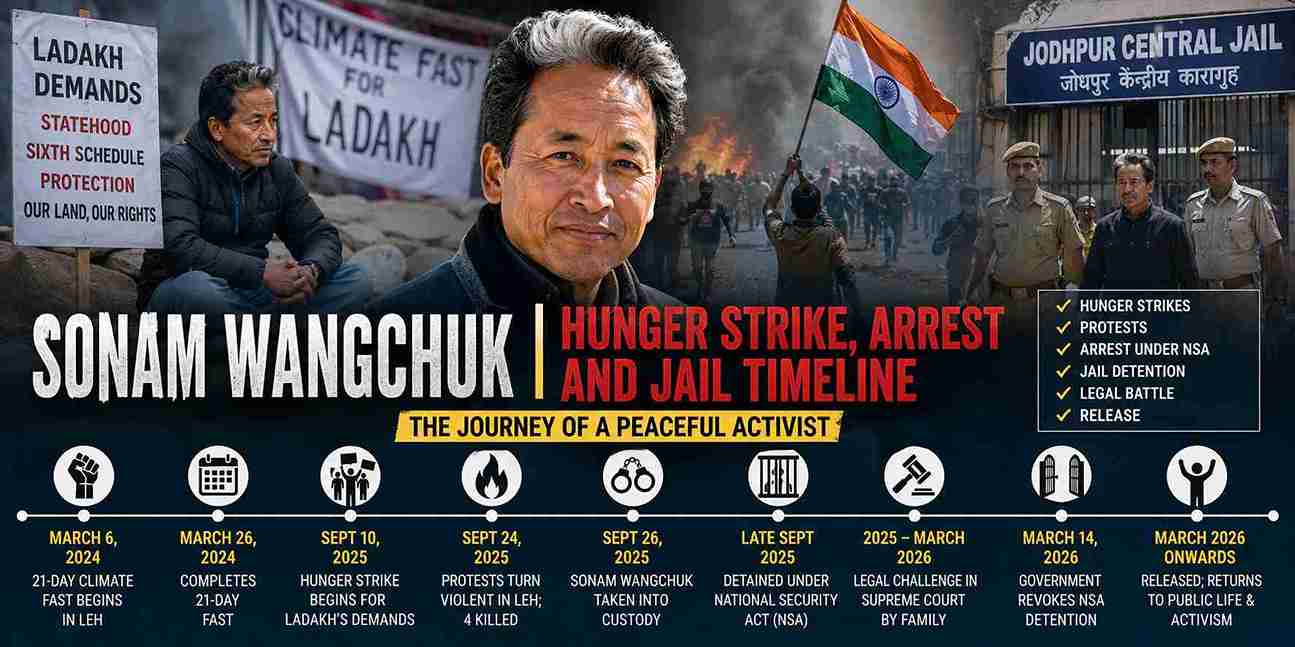
Sonam Wangchuk’s journey from education reformer and environmental innovator to prominent public activist represents one of the most dramatic chapters of his life.
For decades, he was primarily known for his work with SECMOL, sustainable architecture and the Ice Stupa. During the 2020s, however, Wangchuk became increasingly involved in public campaigns concerning Ladakh’s environment, political representation and constitutional safeguards.
His activism included prolonged hunger strikes, public demonstrations and campaigns that attracted national attention.
The situation took a serious turn in September 2025, when protests in Leh became violent and four people were killed. Two days later, Wangchuk was arrested and subsequently held under the National Security Act.
His detention lasted for approximately five and a half months before the order was revoked in March 2026.
Only a few months later, Wangchuk returned to protest action, joining another indefinite hunger strike in New Delhi. Unlike his earlier Ladakh-focused campaigns, the 2026 protest concerned alleged examination irregularities and demands for reform.
This detailed timeline explains Sonam Wangchuk’s hunger strikes, the Ladakh movement, his arrest, preventive detention, jail period, legal challenge, release and latest protest activities.
Sonam Wangchuk’s Activism at a Glance
| Period | Major Event | Main Issue |
|---|---|---|
| 2023–24 | Growing Ladakh campaign | Statehood and constitutional safeguards |
| March 2024 | 21-day Climate Fast | Ladakh’s political and environmental concerns |
| April 2024 | Proposed border march | Land and environmental concerns |
| September 2025 | New hunger strike | Ladakh’s unresolved demands |
| September 24, 2025 | Violent unrest in Leh | Ladakh agitation |
| September 26, 2025 | Wangchuk taken into custody | Aftermath of Leh violence |
| 2025–26 | Preventive detention under NSA | Public-order and security grounds cited by authorities |
| March 14, 2026 | Detention revoked | End of NSA detention |
| June 28, 2026 | New indefinite hunger strike | Examination irregularities and related demands |
| July 17, 2026 | Fast reaches Day 20 | Protest continues |
These events belong to different political contexts and should not be merged into a single continuous protest.
Why Did Sonam Wangchuk Become an Activist?
Sonam Wangchuk’s activism did not begin as a sudden departure from his earlier work.
Environmental concerns had already been central to many of his projects.
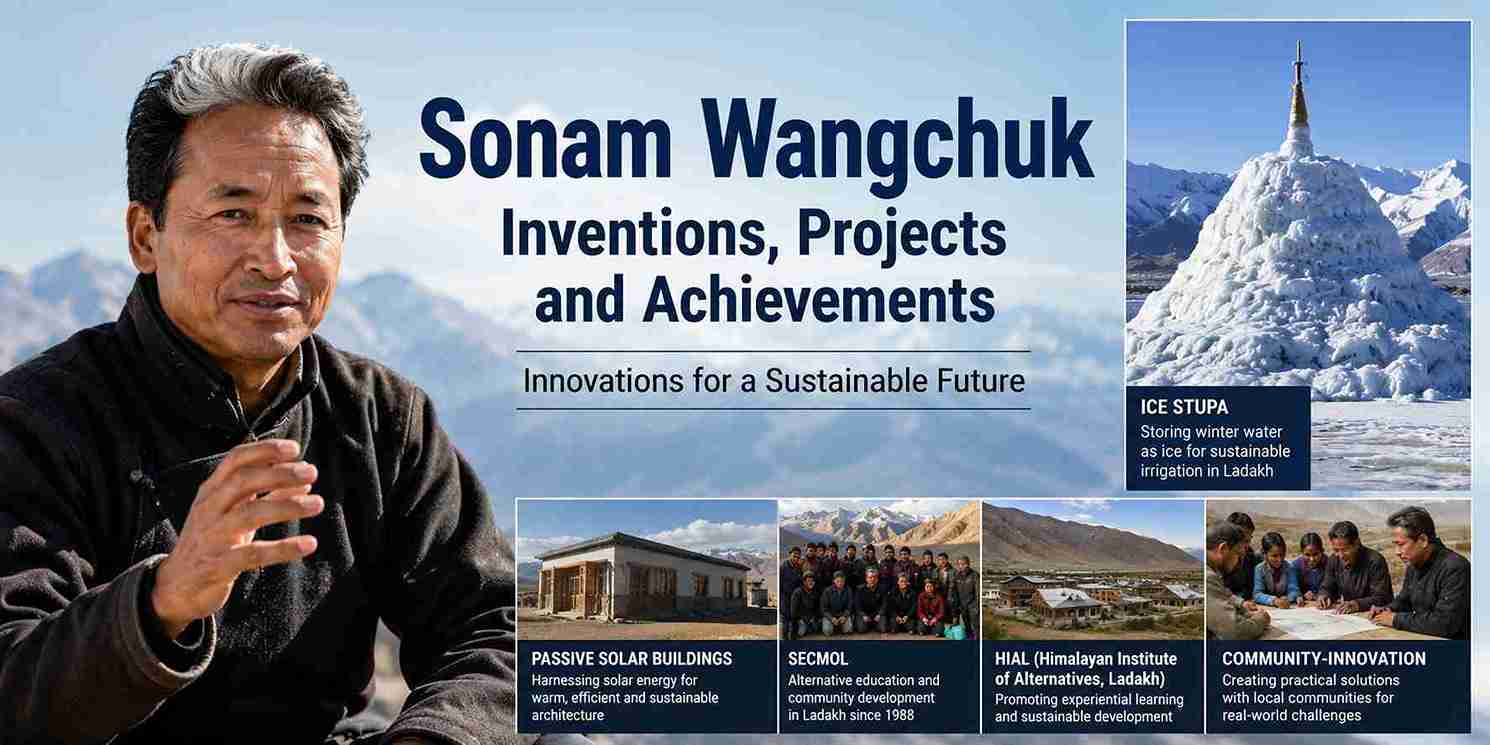
His work with passive-solar architecture addressed energy use in cold Himalayan environments.
The Ice Stupa project dealt with seasonal water scarcity.
His educational institutions emphasized sustainable development and locally appropriate solutions.
As political concerns grew in Ladakh following the region’s reorganization in 2019, Wangchuk increasingly connected environmental questions with issues involving governance, land and constitutional protection.
His argument was broadly that Ladakh’s fragile ecology could not be separated from decisions about how the region was governed and developed.
This brought him into a larger movement involving numerous organizations, community representatives, religious bodies and political leaders.
It is therefore inaccurate to describe the entire Ladakh movement as Sonam Wangchuk’s movement.
He became one of its most recognizable public faces, but the campaign was much broader than one individual.
What Happened to Ladakh in 2019?
To understand Wangchuk’s later hunger strikes, it is necessary to understand Ladakh’s political reorganization.
In 2019, the former state of Jammu and Kashmir was reorganized.
Ladakh became a separate Union Territory administered directly by the central government.
For some residents, becoming a separate Union Territory initially represented the fulfilment of a long-standing demand.
However, concerns subsequently grew about the absence of a legislative assembly and about protections for local land, employment, culture and tribal communities.
These concerns contributed to the emergence of a broader movement demanding stronger political and constitutional safeguards.
What Are the Main Demands of the Ladakh Movement?
The demands raised by organizations and representatives in Ladakh have evolved through negotiations and public campaigns.
Major issues have included:
- Statehood for Ladakh
- Constitutional safeguards under the Sixth Schedule
- Greater political representation
- Protection of land
- Protection of local employment
- Safeguards for tribal communities and culture
- Greater control over development decisions
- Protection of Ladakh’s fragile environment
These demands are connected, but they are not identical.
For example, statehood and Sixth Schedule protections are two separate constitutional questions.
Understanding that distinction is essential when explaining why Wangchuk and other Ladakhi representatives protested.
What Is the Sixth Schedule?
The Sixth Schedule is part of the Constitution of India and provides special administrative arrangements for certain tribal areas.
It allows for the creation of autonomous councils with powers in specified areas of local governance.
Supporters of similar protections for Ladakh have argued that constitutional safeguards could help protect:
- Land
- Culture
- Local communities
- Employment interests
- Natural resources
- The environment
The precise constitutional arrangement sought for Ladakh has been part of wider negotiations and political debate.
Therefore, the movement should not be reduced to the slogan “Give Ladakh the Sixth Schedule” without explaining the larger concerns behind the demand.

Why Is the Environment Central to Wangchuk’s Activism?
Ladakh is a high-altitude cold desert with limited water resources and a fragile ecosystem.
Climate change creates additional pressure through changing snowfall, glacier behaviour and water availability.
At the same time, rapid development can increase demand for:
- Water
- Energy
- Roads
- Construction
- Tourism infrastructure
- Waste management
- Land
Wangchuk has argued that development models designed for other parts of India may not always be suitable for Ladakh.
This reflects the same philosophy seen in his engineering work.
A building should fit its climate.
A water system should fit its geography.
And, in his political argument, a development policy should fit the ecological limits of the region where it is implemented.
Sonam Wangchuk’s 2024 Climate Fast
One of Wangchuk’s most prominent protest actions began on March 6, 2024, in Leh.
He announced a 21-day hunger strike, which he described as a Climate Fast.
The protest followed dissatisfaction over the progress of discussions between Ladakhi representatives and the central government.
The fast drew attention to demands concerning constitutional safeguards, statehood and environmental protection.
Wangchuk continued the protest through extremely cold conditions in Ladakh.
As images and videos of the fast circulated nationally, the campaign attracted growing attention from the media and supporters outside the region.
How Long Did the 2024 Hunger Strike Last?
The planned fast lasted 21 days.
Wangchuk began on March 6 and completed the fast on March 26, 2024.
The end of his personal hunger strike did not mean that the wider Ladakh movement had ended.
Other protest activities and phases of fasting continued as campaigners attempted to maintain pressure around their demands.
This distinction is important when interpreting headlines claiming that Wangchuk “ended the Ladakh protest.”
He ended that particular 21-day fast, not the broader movement.
What Did the 2024 Climate Fast Achieve?
The answer depends on how “achievement” is measured.
The hunger strike did not immediately result in Ladakh receiving statehood or the constitutional safeguards sought by protesters.
However, it significantly increased national attention around the region’s demands.
Many Indians who previously knew Wangchuk primarily through the Ice Stupa or his popular association with 3 Idiots encountered a very different side of his public life.
The protest helped bring questions about Ladakh’s political representation, land protection and environmental vulnerability into wider public discussion.
Public visibility, however, is different from policy success.
The core political demands remained unresolved.
The Proposed 2024 Border March
Following the 21-day fast, another proposed action attracted national attention: a march toward a border area.
The proposed march was presented as a way to highlight concerns about land, grazing areas and environmental pressures.
However, this episode must be described carefully.
A planned march is not automatically the same as a completed march.
Authorities imposed restrictions, and the circumstances surrounding what was proposed, permitted and ultimately carried out need to be distinguished.
When documenting protest movements, three questions should always be separated:
What did organizers announce?
What did authorities allow?
What actually happened?
Failing to make these distinctions can turn an announced protest plan into a false historical event.
The Ladakh Movement Continues Into 2025
The political issues underlying the 2024 protests did not disappear.
Talks and negotiations continued, but dissatisfaction remained among sections of Ladakhi civil society.
By September 2025, Wangchuk was again participating in a hunger strike linked to the region’s unresolved demands.
This protest would lead into the most serious and controversial episode of his activism.
Sonam Wangchuk’s 2025 Hunger Strike
Wangchuk’s September 2025 hunger strike focused on the continuing Ladakh movement.
By September 24, 2025, he had been fasting for approximately two weeks.
The protest environment became increasingly tense.
On September 24, demonstrations in Leh turned violent.
Buildings and police vehicles were set on fire as clashes erupted between protesters and security personnel.
Police opened fire during the unrest.
Four people were killed and dozens were injured.
Wangchuk ended his hunger strike following the violence.
What happened next became the subject of competing claims between government authorities and Wangchuk.
What Did the Government Say About Sonam Wangchuk?
Following the violence, the central government accused Wangchuk of contributing to the unrest through provocative statements.
Authorities linked their subsequent actions to concerns involving public order and security.
These were government allegations and should be presented as such.
They should not be rewritten as:
“Sonam Wangchuk caused the violence.”
That would convert a disputed allegation into an established fact.
What Was Sonam Wangchuk’s Response?
Wangchuk denied that he had incited the violence.
He argued that the unrest reflected accumulated frustration surrounding Ladakh’s unresolved political demands.
His side later also argued in legal proceedings that statements attributed to him had been misinterpreted and that his response to the violence was intended to calm the situation.
This creates two distinct positions:
Government position: Wangchuk’s statements contributed to an environment associated with the unrest.
Wangchuk’s position: He did not incite violence and sought to restore peace once the situation deteriorated.
A responsible account should present both positions without pretending that an allegation is the same thing as a judicial finding.
Why Was Sonam Wangchuk Arrested?
Sonam Wangchuk was arrested on September 26, 2025, two days after the deadly unrest in Leh.
His arrest came amid restrictions imposed following the violence, including a curfew in parts of the region and the suspension of mobile internet services.
The central government had accused him of making provocative statements, an allegation he denied.
He was subsequently placed under preventive detention under the National Security Act, or NSA.
This distinction is critical.
An arrest can be followed by different legal processes.
In Wangchuk’s case, the most significant development was his preventive detention under the NSA.
What Is the National Security Act?
The National Security Act is an Indian preventive-detention law.
Preventive detention differs from punishment following a criminal conviction.
In a conventional criminal case, a person is prosecuted for an alleged offence and may be sentenced if convicted by a court.
Preventive detention is designed to prevent authorities from what they assess as potential threats to specified public interests.
Therefore, saying that Wangchuk was “sentenced to jail under the NSA” would be inaccurate.
He was held under a preventive-detention order.
That legal distinction is essential to understanding the next phase of the story.
Why Was Sonam Wangchuk Detained Under the NSA?
After being taken into custody on September 26, 2025, Sonam Wangchuk was placed under preventive detention under the National Security Act.
The detention followed the violence that had taken place in Leh two days earlier.
Authorities argued that action against Wangchuk was necessary on public-order and security grounds. The government relied on speeches and other material that it said supported its assessment of the situation.
Wangchuk and his representatives disputed the allegations against him.
His side argued that he had not encouraged violence and that statements attributed to him had been interpreted incorrectly or taken out of context.
This distinction remained central to the subsequent legal dispute.
The government defended the preventive detention.
Wangchuk’s side challenged its legality and factual basis.
The detention itself should not be confused with a judicial finding that Wangchuk was guilty of causing the September 2025 violence.
Was Sonam Wangchuk Sent to Jail?
Sonam Wangchuk was held in Jodhpur Central Jail during his preventive detention.
Therefore, in ordinary language, it is understandable that people search for terms such as:
“Sonam Wangchuk jail”
“Why was Sonam Wangchuk sent to jail?”
“How long was Sonam Wangchuk in jail?”
However, the legal context must always accompany the answer.
Wangchuk was not serving a prison sentence imposed after a criminal conviction in connection with the NSA detention.
He was being held under a preventive-detention order.
The difference can be summarized simply:
Criminal imprisonment after conviction: A court finds a person guilty of an offence and imposes a sentence.
Preventive detention: Authorities detain a person under a law intended to prevent conduct they assess as threatening specified public interests, subject to the applicable legal safeguards and judicial review.
Therefore, describing Wangchuk as a “convicted prisoner” would be inaccurate in relation to this detention.
Where Was Sonam Wangchuk Detained?
Wangchuk was moved from Ladakh and held at Jodhpur Central Jail in Rajasthan.
The considerable distance between Ladakh and Jodhpur became one of the notable features of the case.
His wife, Gitanjali J. Angmo, publicly challenged the detention and pursued legal remedies.
The legal dispute eventually reached the Supreme Court of India.
Who Challenged Sonam Wangchuk’s Detention?
The detention was challenged by Wangchuk’s wife, Gitanjali J. Angmo.
The petition sought judicial intervention against his continued preventive detention.
The case attracted national attention because it involved a prominent environmental activist and raised legal questions about the use of preventive-detention powers.
However, it is important to understand what the court proceedings represented.
The Supreme Court proceedings were not simply a criminal trial asking whether Wangchuk was “guilty” or “innocent” of the September violence.
The central issue was the legality and validity of his preventive detention.
What Were the Main Arguments Against the Detention?
Wangchuk’s legal side challenged the detention on multiple grounds.
A major part of the dispute concerned the material and speeches relied upon by authorities.
His representatives argued that statements attributed to Wangchuk had been misinterpreted.
They also argued that his conduct after the September 24 violence demonstrated an effort to restore peace rather than encourage unrest.
One significant argument concerned the context of his speech ending the hunger strike.
His side maintained that the tenor of the statement was intended to stop violence and calm the situation.
The broader challenge questioned whether the material relied upon by authorities justified continued detention under the NSA.
What Was the Government’s Position?
The government defended the detention.
Authorities maintained that the action had been taken based on their assessment of public order and security following the serious unrest in Leh.
The government’s position relied on material that it argued demonstrated sufficient grounds for preventive action.
As with Wangchuk’s arguments, these claims should be attributed rather than converted into independent factual conclusions.
The legal positions can therefore be summarized as follows:
Government: The preventive detention was justified on security and public-order grounds.
Wangchuk’s side: The grounds were legally and factually insufficient, and his statements had been misinterpreted.
The Supreme Court was considering this dispute when the circumstances changed in March 2026.
When Was Sonam Wangchuk Released?
The central government revoked Sonam Wangchuk’s preventive detention on March 14, 2026.
The revocation brought his detention under the National Security Act to an end.
Wangchuk had been taken into custody on September 26, 2025.
This means that his period of detention lasted approximately five and a half months.
The detention ending through revocation is an important legal detail.
It should not automatically be described as:
“The Supreme Court acquitted Sonam Wangchuk.”
Nor should it be written as:
“The Supreme Court found the detention illegal.”
The detention order was revoked by the government before the legal challenge produced a final judgment determining the validity of the continuing detention.
What Happened to the Supreme Court Case?
After the detention order was revoked and Wangchuk was released, the legal challenge concerning his detention no longer had the same immediate purpose.
The Supreme Court subsequently disposed of the petition.
This outcome should be described accurately.
The court disposing of the petition after the detention ended is not the same as a full judgment declaring that every government allegation was correct.
It is also not the same as a final judgment holding that every action taken against Wangchuk was unlawful.
The detention had already been revoked.
That ended the immediate question of whether Wangchuk should continue to remain in custody under that order.
Was Sonam Wangchuk Acquitted?
The word “acquitted” is not the appropriate description of what happened to his NSA detention.
An acquittal generally follows a criminal prosecution in which a court finds that the accused should not be convicted of the charges being tried.
Wangchuk’s case involved a challenge to preventive detention.
The more accurate sequence is:
September 26, 2025: Wangchuk was taken into custody.
Late September 2025: He was held under the National Security Act.
2025–2026: His detention was challenged legally.
March 14, 2026: The government revoked the detention order.
After the revocation: The Supreme Court disposed of the challenge to the detention.
Using precise terminology is especially important because words such as “arrested,” “detained,” “charged,” “convicted,” “acquitted” and “released” describe different legal events.
How Long Was Sonam Wangchuk in Jail?
Counting from September 26, 2025, to March 14, 2026, Wangchuk spent approximately five and a half months in custody.
During this period, he was held under preventive detention rather than serving a sentence following a conviction related to the NSA order.
For SEO purposes, the question “How long was Sonam Wangchuk in jail?” can be used because it reflects common search language.
The answer, however, should always provide the legal clarification.
Sonam Wangchuk Arrest and Detention Timeline
| Date | Event |
|---|---|
| September 10, 2025 | Hunger strike associated with Ladakh demands begins |
| September 24, 2025 | Protests in Leh turn violent |
| September 24, 2025 | Wangchuk ends his hunger strike |
| September 26, 2025 | Wangchuk is taken into custody |
| Late September 2025 | Preventive detention under the NSA begins |
| 2025–2026 | Detention is challenged legally |
| March 14, 2026 | Central government revokes the detention |
| March 2026 | Wangchuk is released |
| After revocation | Supreme Court disposes of the detention challenge |
This chronology provides a more accurate answer than the simplified claim that Wangchuk was “arrested, convicted and later cleared.”
That is not what the documented legal sequence shows.
What Happened After Sonam Wangchuk’s Release?
Wangchuk’s release did not end his involvement in public causes.
Within a few months, he was again participating in a major hunger strike.
However, the new protest had a very different context.
His earlier major fasts had focused primarily on Ladakh’s political future, constitutional safeguards and environmental concerns.
The hunger strike he joined in New Delhi in June 2026 centered on alleged irregularities in India’s examination system and demands raised by a youth-led protest movement.
This distinction is important because online searches for “Sonam Wangchuk hunger strike” can now refer to several different events.
A reader encountering a headline about his 2026 protest should not automatically assume that it concerns the Sixth Schedule or Ladakh statehood.
Sonam Wangchuk’s 2026 Hunger Strike
On June 28, 2026, Sonam Wangchuk joined an indefinite hunger strike at Jantar Mantar in New Delhi.
The protest concerned alleged examination paper leaks and irregularities and was associated with demands for accountability and changes in the examination system.
Among the political demands reported in connection with the campaign was the resignation of Union Education Minister Dharmendra Pradhan.
This represented a notable expansion of Wangchuk’s public activism.
His earlier hunger strikes had been closely connected with Ladakh.
The 2026 protest placed him within a broader national campaign involving students and examination-related concerns.
How Is the 2026 Hunger Strike Different?
The difference can be summarized clearly.
| Protest | Main Issue |
|---|---|
| March 2024 Climate Fast | Ladakh safeguards, statehood and environmental concerns |
| September 2025 Fast | Unresolved Ladakh demands |
| June–July 2026 Fast | Examination irregularities and related national demands |
Combining these protests into a single narrative would create confusion.
Each fast had its own immediate cause and political context.
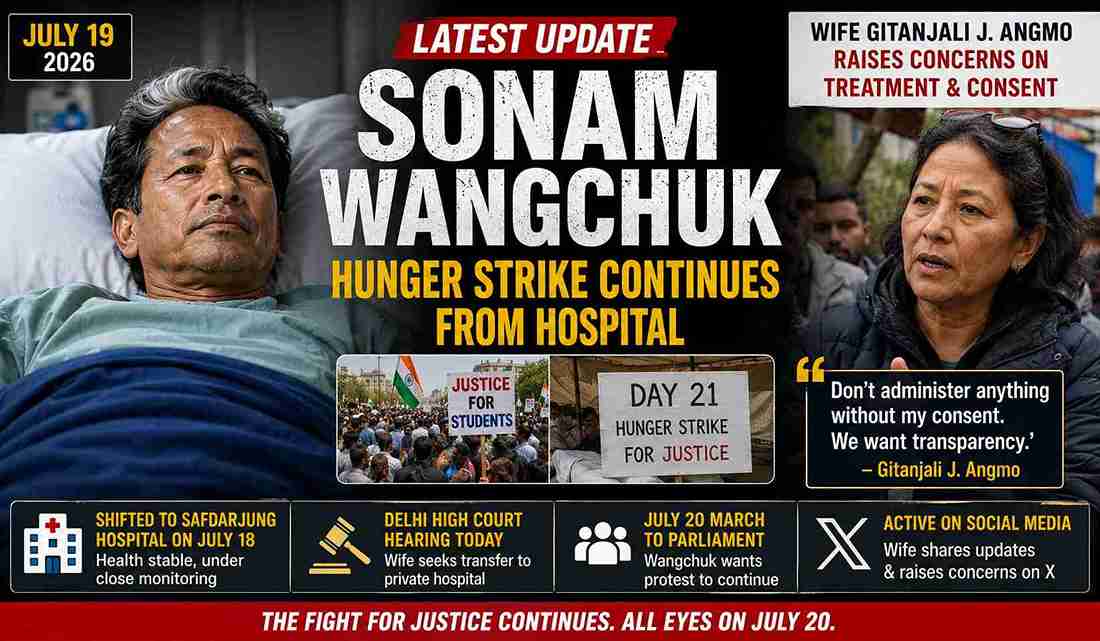
Sonam Wangchuk Hunger Strike 2026: Latest Update
Last updated: July 17, 2026
As of July 17, Wangchuk’s indefinite fast had reached Day 20.
His health had become a significant concern as the protest continued.
The Delhi High Court had directed authorities to monitor his medical condition and ensure intervention if necessary.
Wangchuk had reportedly lost more than nine kilograms during the hunger strike.
The protest movement was also looking toward a planned march to Parliament on July 20, 2026.
Because these events are developing, this section should always carry a visible update date.
Any change involving:
- The continuation or end of the fast
- Wangchuk’s health
- Government negotiations
- Court directions
- The July 20 march
- Changes to the protesters’ demands
should be added to the dedicated Sonam Wangchuk news article first and then reflected here when the information becomes historically settled.
How Many Hunger Strikes Has Sonam Wangchuk Done?
There is no simple authoritative lifetime count covering every fast, short protest and solidarity action Wangchuk may have undertaken.
However, three major recent hunger-strike episodes stand out:
March 2024
A 21-day Climate Fast focused on Ladakh’s constitutional and environmental concerns.
September 2025
A hunger strike linked to unresolved demands concerning Ladakh, which ended following deadly unrest in Leh.
June 2026
An indefinite hunger strike in New Delhi connected with alleged examination irregularities and related demands.
These should form the core of any modern Sonam Wangchuk hunger-strike timeline.
Complete Sonam Wangchuk Hunger Strike Timeline
| Date | Location | Main Cause | Outcome or Status |
|---|---|---|---|
| March 6–26, 2024 | Leh | Ladakh statehood, safeguards and environmental concerns | Completed 21-day fast |
| September 2025 | Leh | Ladakh’s unresolved political demands | Ended after September 24 violence |
| From June 28, 2026 | New Delhi | Examination irregularities and related demands | Ongoing as of July 17, 2026 |
The timeline illustrates how Wangchuk’s activism has evolved.
What began as environmental and political advocacy focused heavily on Ladakh has expanded into participation in a wider national protest campaign.
Whether that expansion becomes a permanent feature of his public role remains to be seen.
Where Does Sonam Wangchuk’s 2026 Hunger Strike Stand Now?
Last updated: July 17, 2026
As of July 17, 2026, Sonam Wangchuk’s indefinite hunger strike in New Delhi had entered its 20th day.
The protest remained connected with demands concerning alleged examination irregularities and accountability within India’s examination system.
Wangchuk’s health had become an increasingly important part of the developing story. Reports indicated that he had lost more than nine kilograms during the fast.
The Delhi High Court had also directed authorities to ensure medical monitoring and appropriate intervention if his condition deteriorated.
The next significant development was expected around the proposed July 20 Parliament march associated with the protest campaign.
Because this is an ongoing event, the outcome cannot yet be written as settled history.
The fast may continue.
It may end following negotiations.
Medical circumstances may force a change.
The planned march may lead to further political developments.
For this reason, readers should refer to the latest news section for developments after July 17, 2026.
Sonam Wangchuk’s Complete Activism Timeline
The following timeline brings together the major events covered in this article.
| Date | Event |
|---|---|
| 2019 | Ladakh becomes a separate Union Territory |
| 2023–24 | Campaign for statehood and constitutional safeguards intensifies |
| March 6, 2024 | Wangchuk begins his 21-day Climate Fast |
| March 26, 2024 | Completes the planned fast |
| April 2024 | Proposed border march becomes another focus of the campaign |
| 2024–25 | Negotiations and public campaigns continue |
| September 10, 2025 | Wangchuk begins another hunger strike |
| September 24, 2025 | Protests in Leh turn violent |
| September 24, 2025 | Wangchuk ends his hunger strike |
| September 26, 2025 | Wangchuk is taken into custody |
| Late September 2025 | Preventive detention under the NSA begins |
| 2025–26 | His wife challenges the detention |
| March 14, 2026 | Government revokes the detention order |
| March 2026 | Wangchuk is released |
| June 28, 2026 | Wangchuk joins an indefinite hunger strike in New Delhi |
| July 17, 2026 | The fast reaches Day 20 |
| July 20, 2026 | Proposed Parliament march scheduled |
Future events should be added only after they occur. A planned protest should never be written as a completed historical event in advance.
Major Controversies Surrounding Sonam Wangchuk
As Wangchuk’s public role expanded from education and environmental innovation into political activism, he became involved in several disputes.
The word “controversy,” however, can easily become a container for rumours.
A useful article should focus on identifiable events and explain the competing positions surrounding them.
Allegations Following the September 2025 Leh Violence
The most serious dispute arose after the violence in Leh on September 24, 2025.
Government authorities accused Wangchuk of contributing to the unrest through provocative statements.
This became part of the background to the action taken against him.
Wangchuk denied inciting violence.
His side argued that frustration had been building because Ladakh’s political demands remained unresolved and later maintained that his own response during the violence was intended to restore peace.
The disagreement can therefore be summarized as:
Authorities’ position: Wangchuk’s public statements contributed to circumstances affecting public order.
Wangchuk’s position: He did not incite violence and attempted to calm the situation once unrest began.
The dispute should not be resolved editorially by presenting either side’s allegation as a proven fact.
Controversy Over the Use of the NSA
Wangchuk’s preventive detention itself became a major controversy.
Supporters questioned why an internationally known education reformer and environmental activist was being held under a preventive-detention law.
The government defended its action on security and public-order grounds.
Wangchuk’s wife challenged the detention legally.
The government eventually revoked the order in March 2026 before the Supreme Court issued a final ruling determining the merits of the continuing detention challenge.
This means two extreme claims should both be avoided.
It would be inaccurate to say:
“The Supreme Court proved that Wangchuk was guilty.”
It would also be inaccurate to say:
“The Supreme Court ruled that the entire detention was illegal.”
Neither statement accurately describes the outcome documented in the detention proceedings.
Disputes Involving Organizations Associated With Wangchuk
Government scrutiny involving organizations associated with Wangchuk has also attracted public attention.
Questions involving funding, regulatory compliance and institutional activity have appeared in public reporting.
These matters require especially careful sourcing because organizational regulatory action is not automatically evidence of personal criminal wrongdoing.
Before publishing details about any specific licence cancellation, funding allegation or government investigation, the article should identify:
- The organization involved
- The exact government action
- The law or regulation cited
- The government’s stated reason
- The organization’s response
- Whether the matter reached a court
- The latest documented status
Without those details, broad phrases such as “foreign funding controversy” can mislead readers.
Is Sonam Wangchuk a Political Leader?
Wangchuk is primarily known as an engineer, education reformer, environmental advocate and activist rather than as a conventional elected politician.
His increasing involvement in political and constitutional issues has nevertheless made him an influential public figure.
There is an important distinction between:
Being politically active
and
Holding elected political office.
Wangchuk’s activism has involved public campaigns and policy demands, but that does not automatically make him a politician in the conventional electoral sense.
Has Sonam Wangchuk Been Convicted of a Crime?
His preventive detention under the NSA should not be presented as a criminal conviction.
The detention discussed in this article was preventive in nature.
A responsible article should also avoid making a sweeping lifetime statement about criminal convictions without conducting a comprehensive current legal-record check.
The precise answer regarding the 2025–26 episode is that Wangchuk was preventively detained under the NSA, the detention was challenged, and the government later revoked the detention order.
Why Does Sonam Wangchuk Use Hunger Strikes?
A hunger strike is a form of non-violent protest in which a person refuses food to draw attention to demands or pressure authorities to respond.
Wangchuk has used fasting to bring visibility to issues that he believes have not received sufficient political attention.
His 2024 fast brought national attention to Ladakh’s demands.
His 2025 fast formed part of the continuing Ladakh agitation.
His 2026 fast was connected with a separate national campaign concerning examination irregularities.
However, hunger strikes also carry serious health risks, particularly when prolonged.
The political effectiveness of a fast and its medical consequences are separate questions.
Frequently Asked Questions
Why did Sonam Wangchuk go on a hunger strike in 2024?
His 21-day Climate Fast focused on demands concerning Ladakh, including constitutional safeguards, statehood and environmental protection.
How many days did Sonam Wangchuk fast in 2024?
He completed a planned 21-day fast from March 6 to March 26, 2024.
Why did Sonam Wangchuk protest for the Sixth Schedule?
Supporters of constitutional safeguards argue that stronger protections could help safeguard Ladakh’s land, culture, tribal communities, employment interests and environment.
Why does Ladakh want statehood?
Supporters argue that statehood would provide greater democratic representation and local participation in governance after Ladakh became a Union Territory without a legislature in 2019.
Why was Sonam Wangchuk arrested in 2025?
He was taken into custody following the September 2025 violence in Leh. Authorities accused him of contributing to unrest through provocative statements, allegations he disputed. He was subsequently held under the National Security Act.
Was Sonam Wangchuk convicted?
His NSA detention was preventive detention and should not be described as a criminal conviction.
Why was Sonam Wangchuk in jail?
He was held in Jodhpur Central Jail under an NSA preventive-detention order following the September 2025 unrest.
How long was Sonam Wangchuk detained?
He was taken into custody on September 26, 2025, and his preventive detention was revoked on March 14, 2026, a period of approximately five and a half months.
Did the Supreme Court release Sonam Wangchuk?
The central government revoked his detention order. The Supreme Court subsequently disposed of the legal challenge after the detention had ended.
Was Sonam Wangchuk acquitted?
“Acquitted” is not the correct term for the end of his NSA detention. The preventive-detention order was revoked.
Why is Sonam Wangchuk protesting in 2026?
His June 2026 hunger strike is connected with a separate campaign concerning alleged examination irregularities and demands for accountability.
When did Sonam Wangchuk’s 2026 hunger strike begin?
He joined the indefinite fast in New Delhi on June 28, 2026.
How long has Sonam Wangchuk been fasting in 2026?
As of July 17, 2026, the fast had reached Day 20.
Is Sonam Wangchuk’s current protest about Ladakh?
The June–July 2026 hunger strike is separate from his earlier Ladakh-focused protests and concerns examination-related issues.
Where is Sonam Wangchuk now?
As of the last update on July 17, 2026, Wangchuk was participating in the hunger strike in New Delhi. Readers should check current reporting for developments after this date.
Conclusion
Sonam Wangchuk’s activism represents a major transformation in his public life.
For decades, he was known primarily for education reform, sustainable architecture and innovations such as the Ice Stupa.
During the 2020s, he increasingly became a public voice on Ladakh’s political and environmental concerns.
His 21-day Climate Fast in 2024 brought national attention to demands involving statehood and constitutional safeguards.
The following year marked a far more turbulent chapter. Protests in Leh turned violent in September 2025, leaving four people dead. Authorities accused Wangchuk of contributing to the unrest, allegations he denied.
He was subsequently held under the National Security Act and spent approximately five and a half months in preventive detention before the government revoked the order in March 2026.
His return to hunger-strike activism only months later demonstrated another evolution in his public role. The 2026 protest was no longer focused primarily on Ladakh but on alleged examination irregularities affecting young people nationally.
These events have made Wangchuk an increasingly debated figure.
Supporters view him as a prominent advocate using non-violent protest to draw attention to ignored issues.
Critics and government authorities have challenged aspects of his activism and statements, particularly in connection with the September 2025 unrest.
The most accurate way to understand this chapter of his life is neither through uncritical admiration nor through unproven accusations.
The documented facts, competing claims and legal distinctions should remain separate.
Sonam Wangchuk was arrested.
He was preventively detained under the NSA.
He was held in Jodhpur Central Jail.
His detention was legally challenged.
The government revoked the order on March 14, 2026.
And as of July 17, 2026, he was once again on hunger strike, this time for a different cause.
His activism, like the rest of his life story, remains unfinished.
