
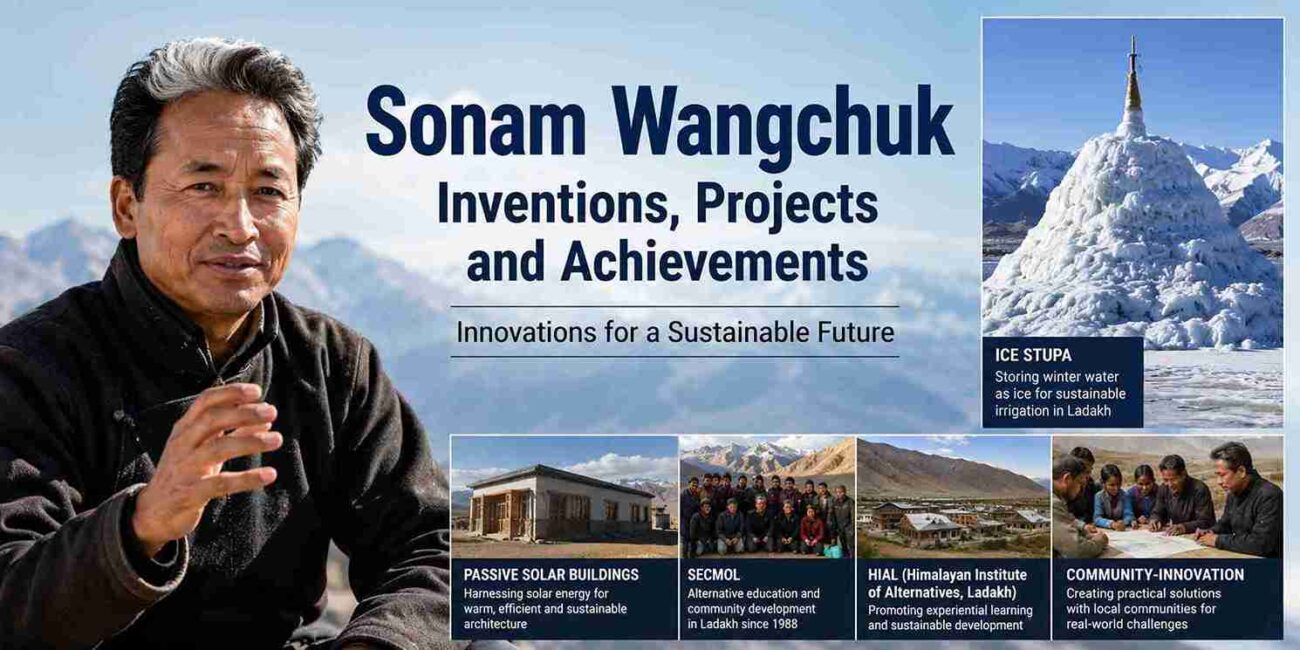
Sonam Wangchuk inventions– Sonam Wangchuk is widely known as the innovator behind the Ice Stupa, but describing his contribution through a single invention leaves most of the story untold. Over several decades, his work has crossed the boundaries of engineering, education, architecture, water conservation and sustainable development.
Some of Sonam Wangchuk’s most important contributions are not conventional inventions in the sense of a newly patented machine. His work also includes educational systems, institutions and locally adapted approaches designed to solve practical problems in Ladakh and other Himalayan regions.
His best-known initiatives include the Students’ Educational and Cultural Movement of Ladakh (SECMOL), Operation New Hope, sustainable and passive-solar buildings, the Ice Stupa artificial-glacier technique and the Himalayan Institute of Alternatives, Ladakh (HIAL).
This detailed guide explores the major Sonam Wangchuk inventions, innovations and projects, how they work, why they were developed and what impact they have had.

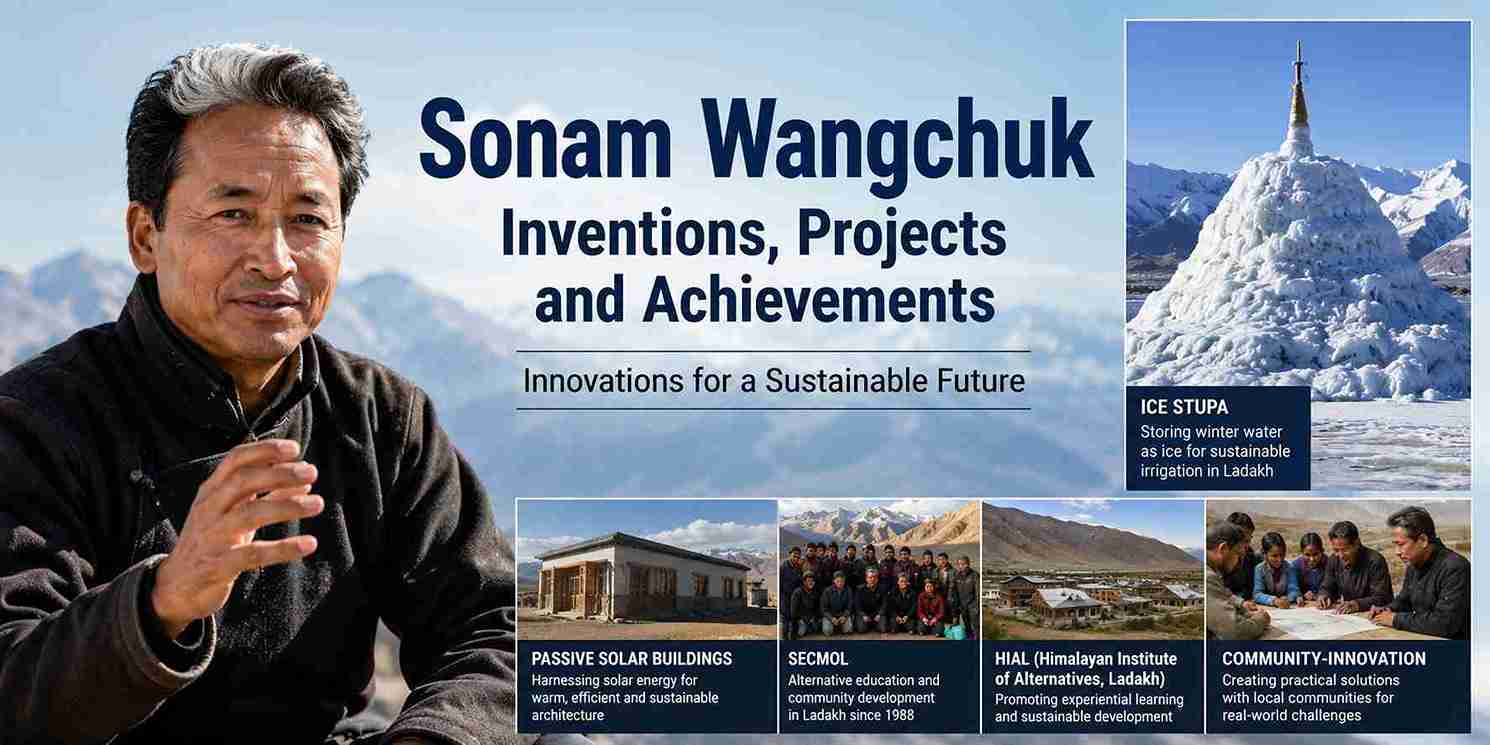

Sonam Wangchuk’s Major Inventions and Projects at a Glance
| Invention or Project | Field | Purpose |
|---|---|---|
| SECMOL | Education | Develop more relevant approaches to education in Ladakh |
| Operation New Hope | School reform | Improve government education through community participation and reform |
| SECMOL Alternative School | Experiential education | Support students who struggled in conventional schooling |
| SECMOL Sustainable Campus | Sustainable development | Demonstrate practical, environmentally appropriate living |
| Passive-Solar Buildings | Architecture | Reduce conventional heating requirements in cold climates |
| Ice Stupa | Water conservation | Store winter water as ice for use during warmer months |
| HIAL | Higher education | Promote experiential and locally relevant higher education |
| Ice Stupa Research | Climate adaptation | Improve and expand artificial ice-storage techniques |
| Solar and Cold-Climate Projects | Sustainable technology | Explore solutions suited to Himalayan environments |
Not every project associated with SECMOL or HIAL should automatically be described as a personal invention of Sonam Wangchuk. Many initiatives involve teams, students, communities, engineers and institutional collaborators.
Understanding this distinction gives a more accurate picture of his contribution.
Is Sonam Wangchuk Really an Inventor?
Yes, but the word “inventor” describes only one dimension of his work.
Wangchuk can more accurately be viewed as an engineer, innovator, education reformer and institution builder.
His contributions fall into three broad categories.
Technological Innovation
This category includes his work associated with the Ice Stupa, passive-solar buildings and other approaches to cold-climate sustainability.
Educational Innovation
This includes experiential learning, practical education and approaches designed around the needs of students and communities rather than examinations alone.
Institutional Innovation
Organizations such as SECMOL and HIAL attempt to create environments where alternative educational ideas can be tested in practice.
This three-part framework helps explain why a search for “Sonam Wangchuk inventions” leads to much more than a list of machines.
SECMOL: The Project That Started It All
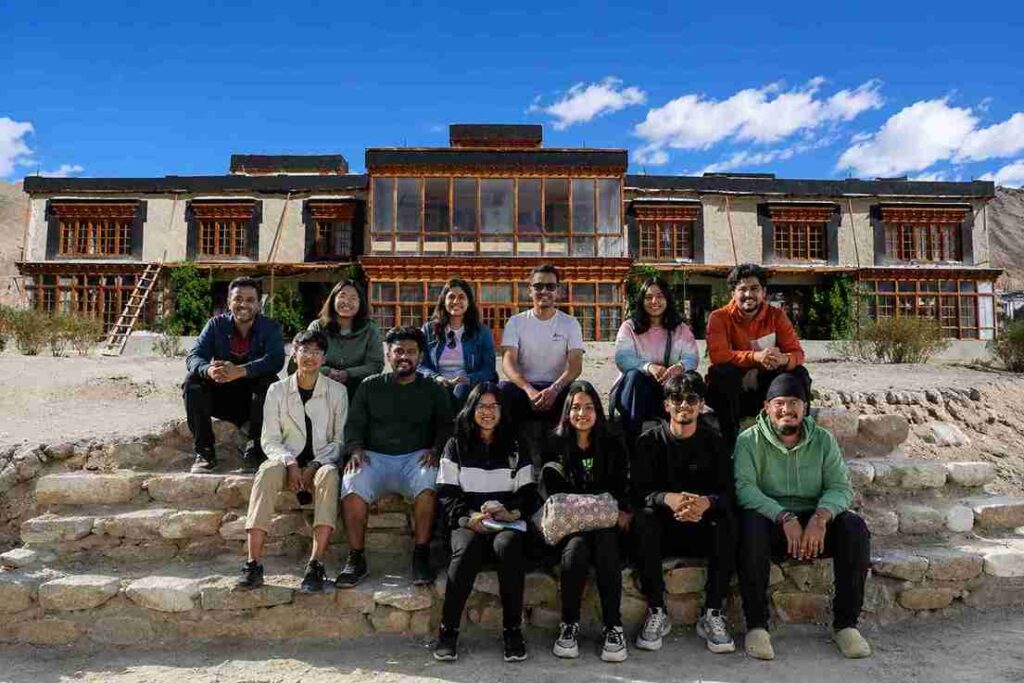
The Students’ Educational and Cultural Movement of Ladakh, better known as SECMOL, was established in 1988 by a group of young Ladakhis that included Sonam Wangchuk.
The organization emerged in response to serious educational challenges in the region.
Students in Ladakh often studied through systems that did not adequately reflect their language, culture, environment or everyday realities. Poor examination results were commonly treated as evidence that students lacked ability.
Wangchuk and his colleagues questioned that assumption.
Instead of asking why so many children were failing, they began examining whether the educational system itself was poorly suited to those children.
This shift in perspective became one of the most important innovations associated with Wangchuk’s career.
What Problem Did SECMOL Try to Solve?
SECMOL’s early work focused on helping students who struggled within conventional schooling.
However, tutoring students after failure addressed only the final symptom.
The deeper issues included:
- Language barriers
- Limited local relevance in education
- Dependence on rote learning
- Insufficient community participation
- Teaching practices that did not always suit local circumstances
- A tendency to define students through examination results
The organization therefore gradually moved toward broader educational reform.
Its work helped promote the idea that education should connect with the environment and society in which students actually live.
Operation New Hope
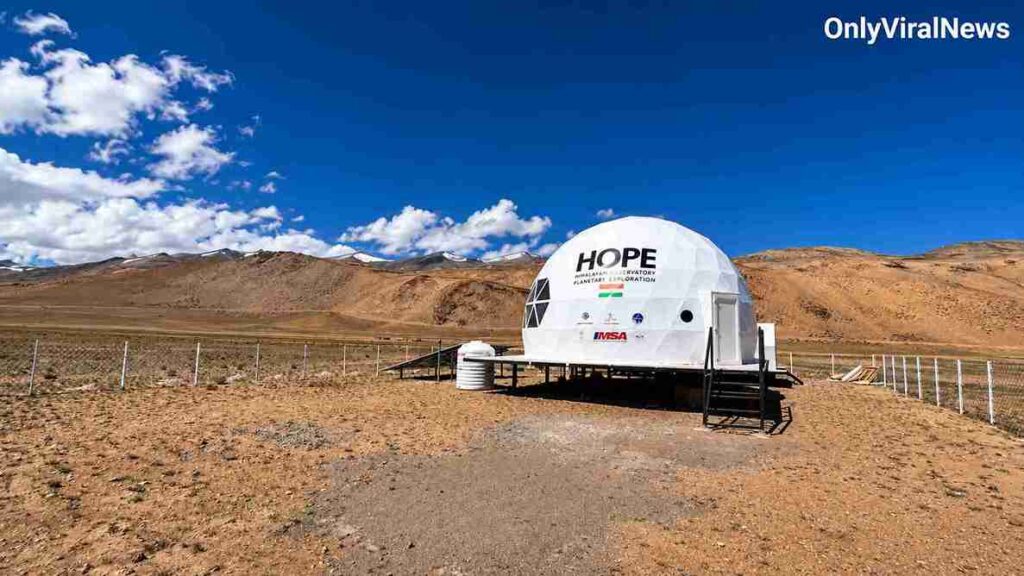
Operation New Hope became one of the major educational reform initiatives associated with SECMOL’s wider work in Ladakh.
The programme sought to improve mainstream schooling through collaboration among educational organizations, local communities and government institutions.
Rather than building an entirely separate educational universe, the initiative attempted to improve the existing system.
Important elements associated with the programme included:
- Community involvement
- Village Education Committees
- Teacher training
- More child-friendly teaching
- Locally relevant educational approaches
- Greater attention to language and cultural context
The initiative reflected a principle that would repeatedly appear in Wangchuk’s later projects: lasting solutions are more likely when local communities participate directly in creating and maintaining them.
Why Operation New Hope Matters
Operation New Hope is important because it challenges the simplified image of Wangchuk as someone who merely criticized conventional education.
The project attempted to engage directly with the existing school system.
That distinction matters.
Creating one successful alternative school can help a limited number of students. Reforming a larger network of schools has the potential to influence an entire generation.
The programme involved many people and institutions, so its outcomes should not be attributed to Wangchuk alone. Nevertheless, it remains an important part of the educational reform movement with which he became associated.
The SECMOL Alternative School
SECMOL’s alternative educational environment became one of the best-known demonstrations of experiential learning associated with Wangchuk.
The campus worked with young people who had often struggled in conventional schools.
Instead of assuming that examination failure represented a lack of intelligence, the approach attempted to give students opportunities to discover abilities through practical responsibility and real-world learning.
Students could become involved in activities connected with the functioning of campus life.
This created an educational environment where learning extended beyond textbooks.
The underlying principle was straightforward:
Responsibility can become a classroom.
Running systems, solving problems and working collaboratively can teach skills that conventional examinations do not always measure.
The SECMOL Campus as a Living Laboratory
One of the most distinctive features of the SECMOL campus is the way education and sustainability intersect.
The campus became associated with:
- Solar energy
- Passive heating
- Sustainable construction
- Water management
- Practical student participation
- Environmentally conscious living
Rather than teaching sustainability only as a subject, the campus attempted to make it part of everyday life.
A building could become a lesson in physics.
A solar-heating system could become an engineering experiment.
Managing resources could become an exercise in responsibility.
This approach transformed the physical campus into part of the curriculum.
Sonam Wangchuk and Passive-Solar Architecture
Ladakh presents an unusual architectural challenge.
The region receives abundant sunlight, yet winter temperatures can fall far below freezing. Conventional heating can require substantial quantities of fuel, creating both economic and environmental costs.
Passive-solar architecture attempts to use building design itself to capture and retain heat.
Instead of relying exclusively on heaters, a building can be designed around factors such as:
- Orientation toward sunlight
- Window placement
- Insulation
- Thermal mass
- Heat retention
- Locally appropriate construction materials
During daylight hours, sunlight enters and warms the interior and heat-storing materials. A well-designed building then reduces the rate at which that warmth escapes.
The result can be a more comfortable indoor environment with lower dependence on conventional heating.
Why Passive-Solar Buildings Matter in Ladakh
The technology is especially relevant in high-altitude cold regions because heating is not a minor convenience.
It can be essential for survival and daily life.
Reducing dependence on imported or limited fuels can offer several potential benefits:
Lower energy consumption
Reduced heating costs
Less environmental pressure
Greater use of locally available resources
Buildings better adapted to their climate
Wangchuk’s work helped bring attention to the principle that sustainable architecture should not be identical everywhere.
A solution designed for a tropical city may be unsuitable for a high-altitude desert.
Good design begins with geography.
From Sustainable Buildings to Frozen Water
The transition from passive-solar architecture to the Ice Stupa may appear dramatic, but both projects follow a similar philosophy.
In one case, the challenge is:
How can we use the winter sun instead of fighting the cold entirely with fuel?
In the other:
How can we use the winter cold instead of allowing seasonal water to flow away unused?
Both approaches treat the local environment not simply as an obstacle, but as part of the solution.
That philosophy led to Sonam Wangchuk’s most famous innovation.
What Is an Ice Stupa?
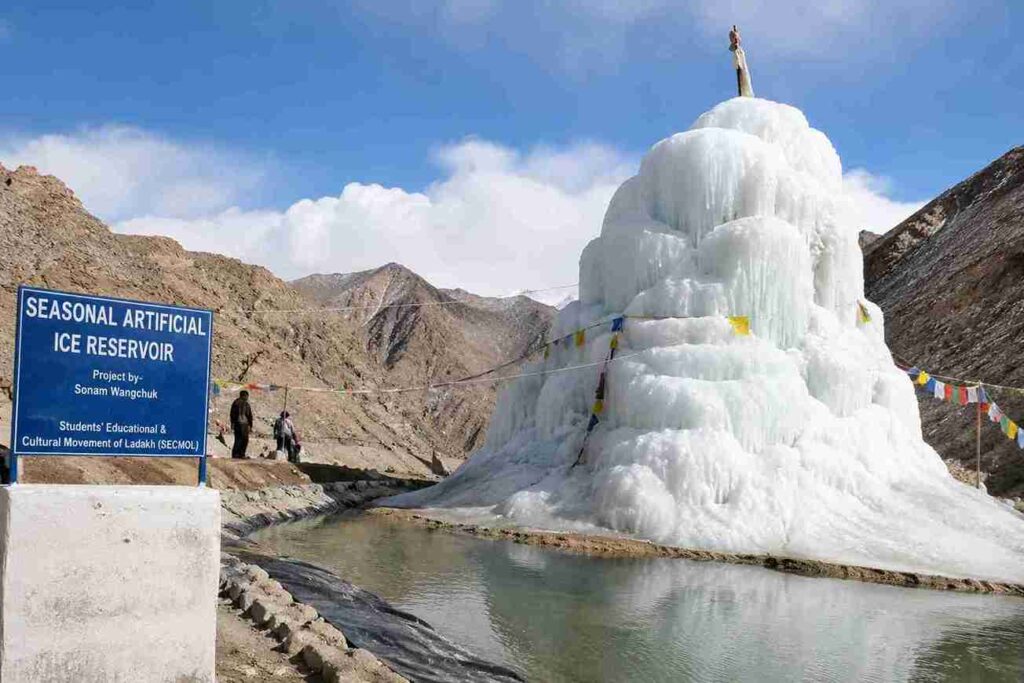
An Ice Stupa is a large, cone-shaped artificial ice reservoir created during winter to store water temporarily in frozen form.
The stored ice gradually melts as temperatures rise, potentially making water available during periods when agricultural communities need it.
The concept was developed for cold desert regions such as Ladakh, where the timing of water availability can be as important as the total quantity of water.
Winter streams may carry water when fields require little irrigation.
In early spring, however, farmers can face shortages because crops need water before higher natural glaciers begin melting strongly.
The Ice Stupa attempts to shift some winter water into the spring season by freezing it and allowing nature to release it gradually.
Why Did Sonam Wangchuk Develop the Ice Stupa?
The central challenge was a seasonal mismatch.
Imagine a community receiving a delivery in January for something it desperately needs in April.
The total resource may exist, but it arrives at the wrong time.
Water in Ladakh can present a similar problem.
During the coldest months, water may be available but agricultural demand is limited. When the planting season begins, sufficient meltwater may not yet be reaching fields.
A conventional reservoir can store water, but building large storage infrastructure in difficult mountain terrain can be expensive and complex.
The Ice Stupa offers a different approach:
Instead of building a container to hold the water, freeze the water itself into the container.
Winter becomes the refrigeration system.
Gravity can provide pressure.
Spring provides the release mechanism.
The landscape becomes part of the engineering.
How Does an Ice Stupa Work?
The basic Ice Stupa process can be understood in several stages.
Step 1: Water Is Collected at a Higher Elevation
A suitable winter water source is identified above the location where the Ice Stupa will be created.
Step 2: Water Travels Through a Pipe
The water is carried downhill through a pipeline.
Step 3: Gravity Creates Pressure
Because the source is located higher than the outlet, the difference in elevation creates hydrostatic pressure.
This can reduce or eliminate the need for electrically powered pumps in suitable locations.
Step 4: Water Is Sprayed Into Freezing Air
At the lower end of the system, water is directed upward through a pipe or sprinkler arrangement.
During sufficiently cold weather, droplets begin freezing as they fall.
Step 5: Ice Accumulates
Frozen water gradually builds around the structure.
As the process continues, a large vertical mass of ice develops.
Step 6: The Ice Survives Into Warmer Weather
The compact shape helps reduce the amount of ice surface exposed relative to the volume stored.
Step 7: Meltwater Is Released
As spring temperatures rise, the Ice Stupa gradually melts.
The resulting water can then support irrigation or other locally appropriate uses.
This process turns a seasonal surplus into a temporary frozen reservoir.
Why Is an Ice Stupa Cone-Shaped?
The distinctive shape is not purely decorative.
A tall, compact cone can hold a considerable volume of ice while exposing less surface area than a broad, shallow sheet containing a comparable volume.
Because melting occurs through exposed surfaces, reducing the surface-area-to-volume ratio can help the ice survive longer.
The form also resembles the traditional Buddhist monuments known as stupas, giving the project its memorable name.
The combination of engineering logic and cultural familiarity helped make the Ice Stupa visually distinctive.
It also turned a water-management project into an image that could travel around the world.
Yet the idea of storing winter water as artificial ice did not begin with Wangchuk. To understand the Ice Stupa accurately, we need to look at the earlier work of another Ladakhi engineer, Chewang Norphel.
Chewang Norphel and the History of Artificial Glaciers
The story of artificial glaciers in Ladakh did not begin with the Ice Stupa.
Before Sonam Wangchuk developed the vertical Ice Stupa approach, Ladakhi civil engineer Chewang Norphel had pioneered artificial-glacier techniques to address seasonal water shortages affecting mountain communities.
Norphel’s approach involved diverting winter water into suitable shaded areas at high elevations. The water was slowed and spread so that it could freeze in layers, creating artificial ice formations. When temperatures increased during spring, the stored ice melted and provided water that could support agriculture.
His work demonstrated an important principle: water that was relatively abundant during winter could be stored naturally as ice and released later when farmers needed it.
Sonam Wangchuk’s Ice Stupa developed this broader idea in a different geometric direction.
Instead of spreading water horizontally across a large area, the Ice Stupa stores it vertically in a compact cone-shaped structure.
This distinction is essential when discussing the question of who invented artificial glaciers.
A historically accurate explanation is:
Chewang Norphel pioneered earlier artificial-glacier techniques in Ladakh, while Sonam Wangchuk and his collaborators developed the distinctive vertical Ice Stupa method.
Recognizing Norphel’s contribution provides a more complete picture of how innovation develops. New ideas rarely appear in a vacuum. They often grow from earlier experiments, local knowledge and improvements made by different people over time.
How Did the Ice Stupa Idea Begin?
The Ice Stupa concept emerged from Wangchuk’s observations about how ice behaved under different conditions.
A key challenge with earlier artificial glaciers was that they generally needed suitable locations at relatively high elevations and could expose significant areas of ice to sunlight.
Wangchuk began exploring whether water could instead be stored vertically.
The underlying geometric principle was relatively simple.
For a given volume, a compact three-dimensional structure can expose less surface area than ice spread broadly across the ground.
Less exposed surface area can mean slower melting.
This led to experiments with freezing water into tall, cone-shaped formations closer to villages and agricultural areas.
The goal was not to create a permanent glacier.
An Ice Stupa is better understood as a seasonal artificial ice reservoir.
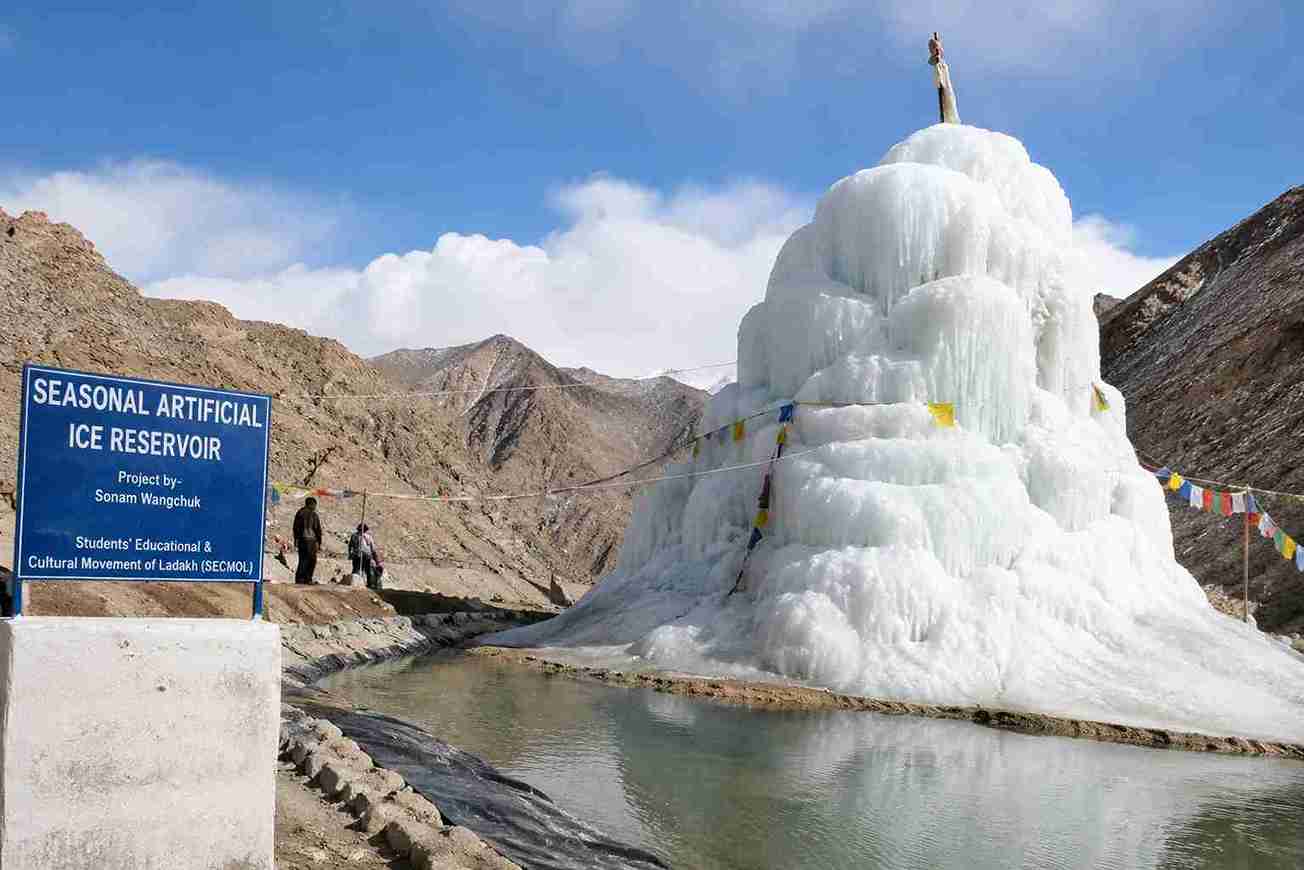
It is created during winter; stores water temporarily as ice and is expected to disappear through melting when temperatures rise.
Its disappearance is therefore not necessarily a failure.
Melting is the mechanism through which the stored water becomes useful.
Early Ice Stupa Experiments
Early experiments during the 2010s tested whether the concept could work under real Ladakhi winter conditions.
Water was carried through pipes from a higher source to a lower location. The natural pressure generated by the difference in elevation allowed water to spray upward.
When exposed to freezing temperatures, the droplets formed ice.
As more water froze, the structure grew vertically.
These experiments helped demonstrate that large volumes of water could potentially be stored in ice without constructing a conventional reservoir.
The project then moved toward larger demonstrations and community applications.
One of the best-known early Ice Stupa projects was associated with Phyang village near Leh, where the technology attracted substantial public and international attention.
The project was not simply about creating an impressive frozen monument.
The larger ambition was to investigate whether artificial ice reservoirs could support spring irrigation and potentially help establish vegetation in otherwise dry areas.
From Prototype to Community Project
Moving from a small prototype to a village-scale project created new engineering challenges.
A successful Ice Stupa requires more than freezing water.
The system must manage:
- A reliable winter water source
- Sufficient elevation difference
- Appropriate pipelines
- Extremely low temperatures
- Nozzle and sprinkler performance
- Pipe freezing and blockages
- Ice formation patterns
- Maintenance
- Safe operation
- Meltwater distribution
This is important because the Ice Stupa is sometimes described online as though anyone can simply point a hose into freezing air and create a useful artificial glacier.
The underlying principle may be simple, but reliable implementation can be technically demanding.
Ice Stupa Competitions and Community Participation
As interest in the technology grew, Ice Stupa projects also became opportunities for community and student participation.
Competitions and collaborative initiatives encouraged villages and young people to experiment with artificial ice reservoirs.
This approach matched a familiar pattern in Wangchuk’s work.
The technology itself was important, but so was the process of learning by building.
A community creating an Ice Stupa could gain practical experience involving:
- Water management
- Basic engineering
- Climate adaptation
- Teamwork
- Local problem-solving
The project therefore carried an educational dimension alongside its potential agricultural purpose.
Ice Stupas Beyond Ladakh
The Ice Stupa concept eventually attracted attention outside India.
One of the most notable international experiments took place in the Swiss Alps.
Mountain communities in Switzerland face environmental conditions very different from Ladakh, but the underlying physics of creating artificial ice in freezing temperatures can still be explored in other high-altitude environments.
European experiments helped demonstrate that the Ice Stupa concept was not geographically restricted to one valley.
However, international replication does not mean that the technology will work equally well everywhere.
Local temperature patterns, water availability, topography and the purpose of the project all influence whether an Ice Stupa is practical.
This leads to an important principle:
Ice Stupas are a context-dependent climate adaptation tool, not a universal solution to water scarcity.
Can Ice Stupas Save Natural Glaciers?
Some discussions surrounding artificial ice projects use dramatic language about “saving glaciers.”
This claim requires caution.
An Ice Stupa cannot replace a large natural glacier or solve global climate change.
Natural glaciers contain enormous volumes of ice accumulated over long periods. They influence river systems, ecosystems and regional water supplies on scales far beyond a village-level artificial ice reservoir.
Ice Stupas can potentially help communities manage seasonal water shortages under suitable conditions.
That is already a meaningful contribution.
Presenting them as a replacement for disappearing natural glaciers would exaggerate what the technology can realistically achieve.
Research projects in mountain regions may explore artificial snow and ice techniques for specific local applications, but these should be evaluated independently rather than grouped under sweeping claims.
Advantages of Ice Stupas
The Ice Stupa approach offers several potential advantages when local conditions are suitable.
1. Seasonal Water Storage
Winter water that might otherwise flow away can be stored temporarily as ice.
2. Limited Energy Requirements
Where sufficient elevation difference exists, gravity can generate the pressure needed to move and spray water.
3. No Large Conventional Reservoir
The frozen water itself becomes the temporary storage structure.
4. Potential Spring Irrigation Support
Gradual melting may provide water during the early agricultural season.
5. Adaptability
The basic principle can potentially be adjusted to different scales and locations with sufficiently cold winters.
6. Community Participation
Local communities and students can participate in construction and management.
7. Climate Awareness
The visually striking structures have helped draw public attention to water scarcity and climate challenges in mountain regions.
Limitations and Challenges of Ice Stupas
A balanced examination of Sonam Wangchuk’s inventions must discuss limitations as seriously as achievements.
Dependence on Cold Temperatures
Ice Stupas require sufficiently cold winter conditions.
Warmer winters could reduce the number of suitable freezing days, which is particularly significant in the context of climate change.
Dependence on Water Availability
The system cannot create water.
It can only change the timing of water availability by storing existing winter flows as ice.
Geographic Requirements
Gravity-fed systems generally benefit from an adequate difference in elevation between the water source and the Ice Stupa site.
Not every location has suitable terrain.
Pipe Freezing
Water pipes and nozzles can freeze or become blocked, creating operational challenges.
Maintenance
The system may require regular monitoring and adjustment during the freezing season.
Variable Agricultural Impact
The usefulness of an Ice Stupa depends on whether meltwater becomes available at the right time and in sufficient quantities for local needs.
Scaling Challenges
A technology useful at village scale should not automatically be assumed to solve water shortages across an entire region.
These limitations do not make the Ice Stupa ineffective. They define the circumstances in which the technology is most likely to be useful.
Good climate adaptation depends on matching the tool to the problem.
Is the Ice Stupa a Solution to Climate Change?
No single technology can solve climate change, and the Ice Stupa should not be presented as one.
Its more realistic role is as a local adaptation technique.
Climate mitigation and climate adaptation are different.
Climate mitigation attempts to reduce the causes of climate change, such as greenhouse-gas emissions.
Climate adaptation helps communities respond to impacts that are already occurring or becoming more likely.
Ice Stupas fall primarily into the second category.
They may help certain cold-region communities manage seasonal water availability, but they do not address the underlying global causes of glacier retreat or rising temperatures.
This distinction strengthens rather than weakens the case for the technology because it defines its actual purpose.
The Rolex Award for Enterprise
The Ice Stupa project brought Sonam Wangchuk one of the most important international recognitions of his career.
In 2016, he received a Rolex Award for Enterprise.
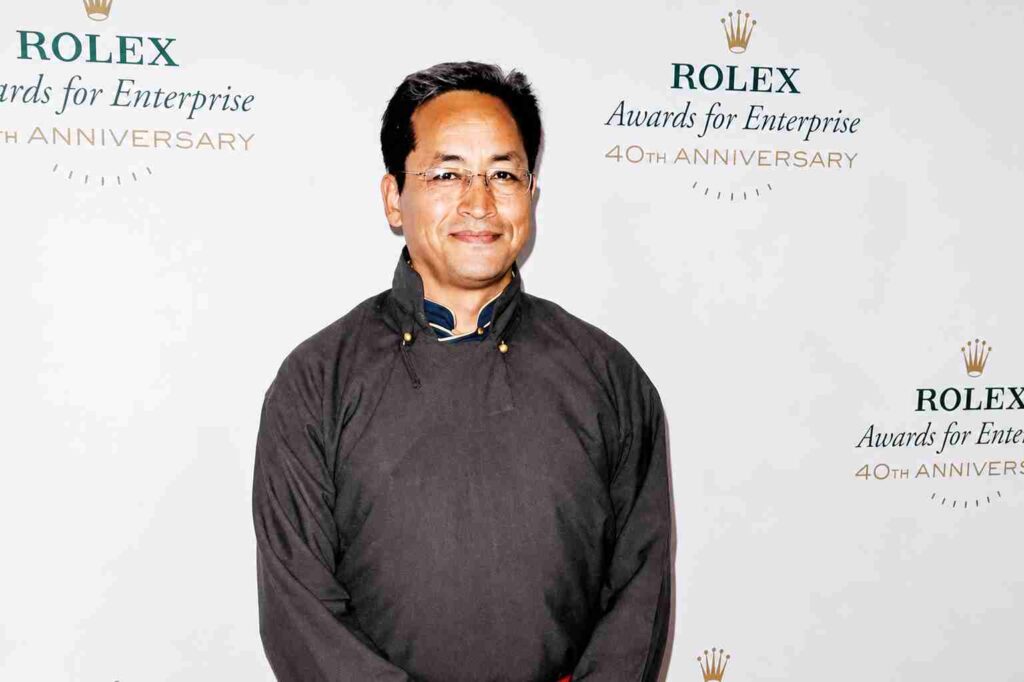
The award recognized his work on artificial ice reservoirs designed to help address water shortages affecting farmers in Ladakh.
The recognition provided both visibility and support for the wider ambitions surrounding the project.
Wangchuk’s plans included expanding Ice Stupa applications and exploring whether stored meltwater could contribute to the greening of dry land.
The award also introduced the project to a global audience.
Suddenly, a water-management experiment emerging from the high-altitude desert of Ladakh was being discussed internationally as an example of locally driven climate adaptation.
Why the Ice Stupa Became Globally Famous
The Ice Stupa attracted attention for several reasons.
First, the problem it addresses is easy to understand: water exists, but not always at the time it is needed.
Second, the engineering principle is visually understandable.
People can see water becoming ice and later melting.
Third, the structures themselves are dramatic.
A towering cone of ice rising from an otherwise dry mountain landscape creates an unforgettable image.
Finally, the project tells a larger story about appropriate technology.
It does not begin by asking:
What is the most advanced technology available?
It begins by asking:
What resources already exist here?
In Ladakh, those resources include freezing winter temperatures, mountain slopes, seasonal water flows and local communities capable of participating in the solution.
The resulting technology is therefore closely connected to its environment.
Ice Stupa Research and Automation
As the Ice Stupa concept developed, research began exploring ways to improve the reliability and efficiency of artificial ice formation.
Automation can potentially help manage variables such as:
- Water flow
- Temperature
- Freezing conditions
- Nozzle operation
- Pipe systems
- Timing
This could address one of the technology’s practical challenges.
A system that depends heavily on manual adjustment may become difficult to operate at larger scales or in remote conditions.
Automated controls could potentially release water only when environmental conditions are favourable for freezing, reducing waste and improving efficiency.
However, it is important to distinguish between the original Ice Stupa concept and later research projects conducted by teams, students and institutions.
Not every improvement connected with Ice Stupa technology should automatically be attributed to Wangchuk as a sole inventor.
Innovation is often a relay race rather than a solo sprint.
The Broader Significance of the Ice Stupa
The Ice Stupa’s greatest contribution may extend beyond the physical structures themselves.
It demonstrates a particular method of thinking:
Observe a local problem.
Understand the natural environment.
Use simple physical principles.
Experiment at small scale.
Learn from failure.
Adapt the design.
Involve communities.
That same pattern can be seen throughout Wangchuk’s work in education and architecture.
The Ice Stupa is therefore not an isolated curiosity in his career.
It is perhaps the clearest physical expression of the philosophy behind many of his projects.
The next major stage of that philosophy was an attempt to build an entire higher-education ecosystem around practical problem-solving: the Himalayan Institute of Alternatives, Ladakh.
Himalayan Institute of Alternatives, Ladakh: The HIAL Project
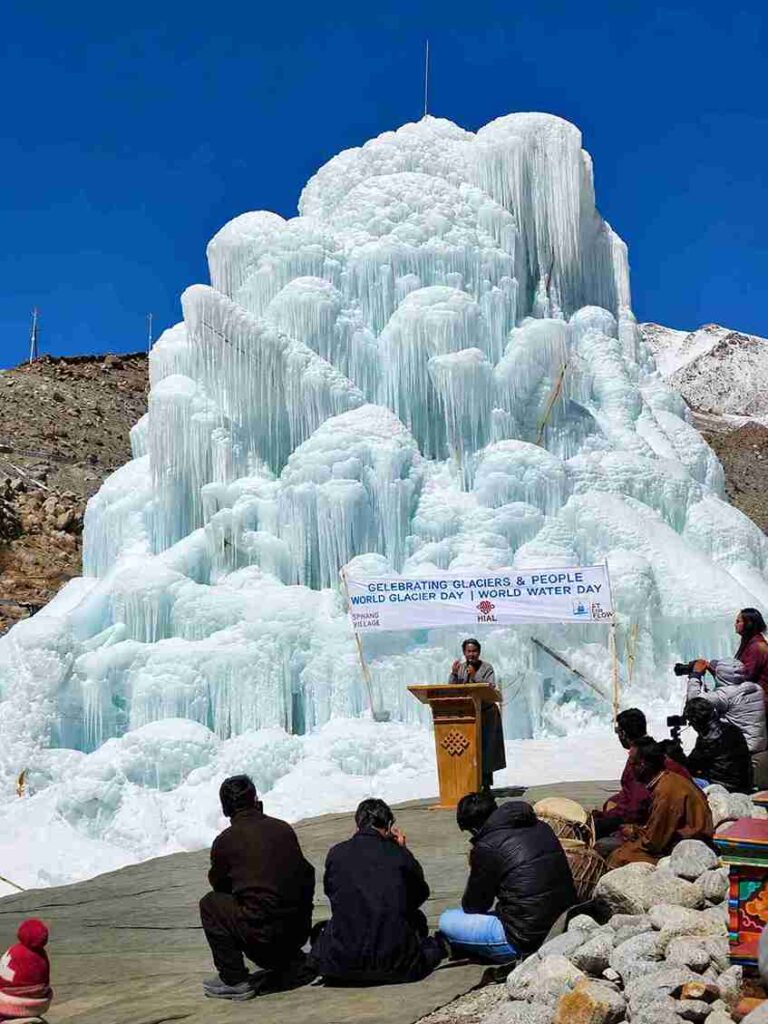
The Himalayan Institute of Alternatives, Ladakh, commonly known as HIAL, represents one of the most ambitious institutional projects associated with Sonam Wangchuk.
After decades of involvement in school-level education reform, Wangchuk increasingly turned his attention toward a larger question:
Can higher education itself be redesigned around the real problems of a region?
HIAL emerged from this broader vision.
The institution focuses on experiential education and challenges affecting Himalayan communities. Rather than treating the mountains merely as a backdrop for a conventional university, its educational philosophy attempts to make the Himalayan environment itself part of the learning process.
Wangchuk is identified as a founding figure of the institution and has played an important role in shaping its educational vision.
Why Was HIAL Created?
Conventional higher education often separates academic learning from practical experience.
A student may study environmental science without working directly on an environmental problem.
An architecture student may learn design principles without constructing a building.
An entrepreneurship student may study business plans without creating an enterprise.
HIAL’s broader philosophy attempts to narrow this gap.
The idea is that students should engage with genuine challenges affecting mountain communities and learn through the process of solving them.
Potential areas of engagement include:
- Sustainable architecture
- Water conservation
- Renewable energy
- Mountain agriculture
- Responsible tourism
- Entrepreneurship
- Environmental management
- Appropriate technology
- Climate adaptation
This does not mean that theoretical knowledge becomes unnecessary.
Instead, theory is expected to work alongside practice.
The Head, Heart and Hands Philosophy
One of the ideas associated with HIAL is education through Head, Heart and Hands.
Head
The Head represents knowledge, analysis and intellectual understanding.
Students need to understand the science, theory and broader context behind a problem.
Heart
The Heart represents values, empathy and responsibility.
A technically effective solution can still fail if it ignores the people who must live with its consequences.
Hands
The Hands represent practical skills.
Knowledge becomes more useful when students can turn ideas into working solutions.
Together, these three elements create an educational philosophy in which learning is not limited to collecting information.
A student should ideally be able to:
understand a problem, care about its consequences and do something useful about it.
This philosophy echoes many of the ideas that appeared earlier in Wangchuk’s work with SECMOL.
Learning Through Real-World Problems
The experiential model associated with HIAL treats practical projects as part of education rather than extracurricular activities.
For example, a student interested in water management might work on an actual water-conservation challenge.
A student studying architecture might participate in designing or constructing a building suited to Ladakh’s climate.
A student interested in entrepreneurship might develop a project intended to address a genuine economic need.
This approach transforms the relationship between the classroom and the outside world.
Instead of:
Study first → graduate → encounter real problems later
the model moves toward:
Encounter real problem → study it → experiment → build → evaluate → learn.
This is one of the strongest links between HIAL and Wangchuk’s earlier educational philosophy.
HIAL and Sustainable Architecture
Architecture is particularly important in a region such as Ladakh.
Buildings must respond to:
- Severe winter temperatures
- Strong solar radiation
- Water limitations
- Remote locations
- Transportation costs
- Local materials
- Environmental sensitivity
HIAL has consequently become associated with experimentation in sustainable and climate-responsive construction.
Passive-solar design is an important part of this broader approach.
A well-designed building can use sunlight, orientation, insulation and thermal mass to reduce dependence on conventional heating.
This matters environmentally, but it also has an educational function.
When students participate in designing, constructing or evaluating such buildings, architecture becomes a practical classroom.
HIAL as an Innovation Ecosystem
It would be inaccurate to describe every project emerging from HIAL as a personal invention of Sonam Wangchuk.
An institution contains many people.
Researchers, students, architects, engineers, local communities and external collaborators may all contribute to individual projects.
Wangchuk’s role is better understood partly through the creation and promotion of an ecosystem where practical experimentation can occur.
This distinction matters because innovation has two levels.
The first is:
Who created this specific technology?
The second is:
Who helped create an environment where people could develop new solutions?
Both can be significant, but they are not the same claim.
The Solar Tent Project
One project associated with the HIAL innovation ecosystem is the Solar Tent.
The broad idea addresses a familiar Himalayan challenge: how can people remain warm in extremely cold environments while reducing dependence on conventional fossil-fuel heating?
A solar-heated or solar-assisted shelter could potentially make use of abundant sunlight in cold high-altitude regions.
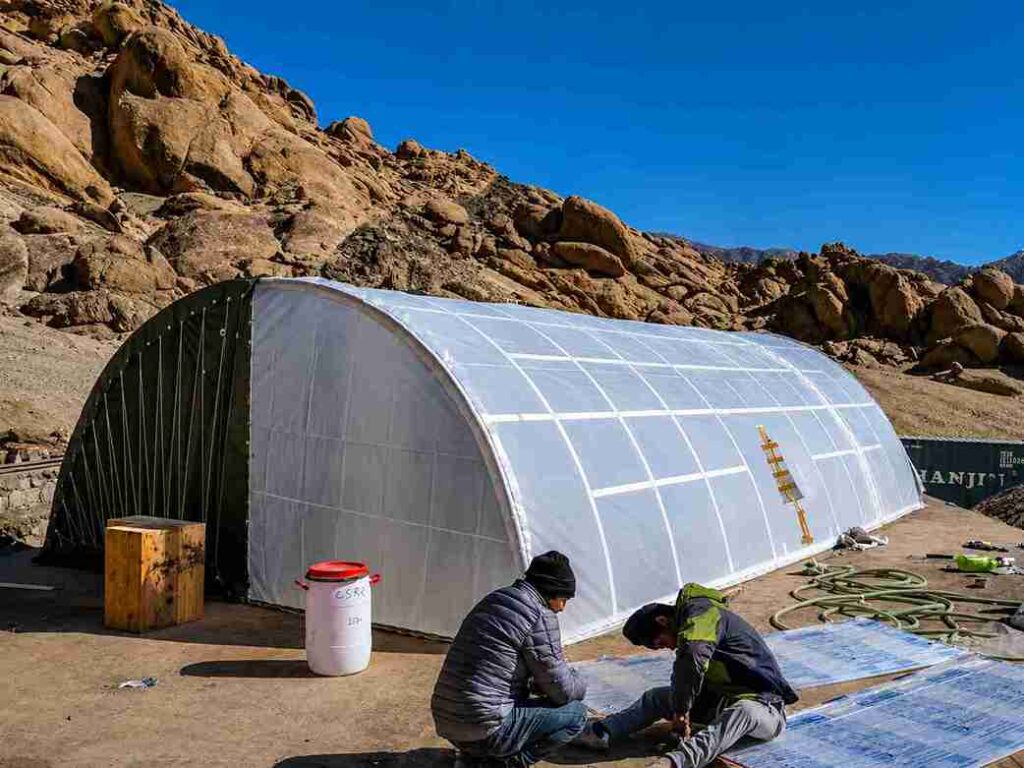
The concept fits naturally within the larger philosophy behind Wangchuk’s sustainable architecture work.
However, this project requires careful attribution.
Unless primary documentation establishes Wangchuk as the sole inventor, the Solar Tent should be described as a project associated with the HIAL research and innovation ecosystem rather than automatically labelled “an invention by Sonam Wangchuk.”
That same editorial rule should apply to all institutional research projects.
Ice Stupa Automation
Another research area associated with HIAL is Ice Stupa Automation.
Traditional Ice Stupa systems can require active monitoring.
Operators may need to respond to changing temperatures, water flow, pipe freezing and other environmental conditions.
Automation could potentially make the process more efficient.
For example, a system might use environmental measurements to determine when conditions are favourable for ice formation.
Water could then be released at appropriate times rather than flowing continuously.
Potential benefits could include:
- Reduced water waste
- Better freezing efficiency
- Less manual intervention
- Improved monitoring
- Greater operational reliability
However, the practical performance of any automated system depends on its design and field testing.
The concept illustrates how the original Ice Stupa idea can continue evolving through engineering research.
Educational Innovation as Sonam Wangchuk’s Largest Project
When people search for Sonam Wangchuk’s inventions, they usually expect physical technologies.
Yet his longest-running experiment may be education itself.
From SECMOL to HIAL, Wangchuk has repeatedly challenged several assumptions about conventional learning.
Assumption 1: Examination Failure Means Lack of Ability
His educational work argues that students may perform poorly because the system does not match their circumstances, language or way of learning.
Assumption 2: Learning Happens Mainly in Classrooms
Experiential education treats farms, buildings, workshops, communities and environmental projects as learning spaces.
Assumption 3: Theory Must Come Before Practice
Wangchuk’s approach frequently allows practical problems to create the need for theoretical knowledge.
Assumption 4: Students Are Only Recipients
Students can become active participants in operating institutions and solving problems.
Assumption 5: The Same Educational Model Works Everywhere
His work emphasizes adapting education to local culture, geography and economic realities.
These ideas connect nearly every major project associated with his career.
The “Do School” Approach
A phrase often associated with alternative educational models is the idea of a “Do School”, where learning is organized around doing rather than only listening.
The concept can be summarized through a simple contrast.
A conventional model may say:
Learn the theory now so you can use it someday.
An experiential model asks:
What are we trying to do, and what do we need to learn to do it well?
This reverses the order.
A real problem creates curiosity.
Curiosity creates questions.
Questions create the need for knowledge.
Knowledge is then applied and tested.
This cycle can make learning more tangible because students can see the consequences of what they understand and what they still need to improve.
Innovation Through Appropriate Technology
Another recurring feature of Wangchuk’s projects is the principle of appropriate technology.
Appropriate technology does not necessarily mean primitive technology.
Nor does it mean rejecting modern science.
It means choosing a solution suited to the conditions where it will actually be used.
For example:
A complex water pump may be technologically impressive.
But if a mountain village has gravity, freezing temperatures and limited electricity, a gravity-fed system might be more appropriate.
Similarly, an advanced heating system may work well in a wealthy city.
But a passive-solar building that captures free sunlight may make more sense in a remote cold desert.
The question is not:
Which solution is the most technologically sophisticated?
The better question is:
Which solution fits the problem, people, environment and available resources?
This philosophy runs through the Ice Stupa, passive-solar buildings and much of Wangchuk’s educational work.
Environmental Impact of Sonam Wangchuk’s Projects
The environmental significance of Wangchuk’s work appears in several areas.
Reduced Heating Demand
Passive-solar buildings can potentially reduce the amount of conventional fuel required for winter heating.
Seasonal Water Management
Ice Stupas attempt to make winter water available during later periods of greater agricultural demand.
Climate Adaptation
Artificial ice reservoirs offer one possible adaptation tool for communities facing changing seasonal water patterns.
Environmental Education
SECMOL and HIAL expose students to sustainability through practical participation rather than theory alone.
Local Resource Use
Climate-responsive architecture can encourage greater consideration of locally available materials and environmental conditions.
Public Awareness
The visual power of projects such as the Ice Stupa has helped draw wider attention to water scarcity, glacier retreat and the ecological vulnerability of mountain regions.
However, environmental benefits should be evaluated project by project.
No technology is automatically sustainable simply because it carries a green label.
Challenges and Criticism of Innovation Projects
A comprehensive assessment should also examine challenges.
Scalability
A solution that works for one village may not automatically work for an entire region.
Climate Dependence
Ice Stupas depend on sufficiently cold winters, which creates an uncomfortable paradox: the technology designed partly to help communities adapt to climate change may itself face challenges as winters become warmer.
Maintenance
Simple engineering does not mean maintenance-free engineering.
Pipes, valves and water systems still require management.
Institutional Sustainability
Alternative educational institutions need long-term financial, administrative and academic sustainability.
Measuring Impact
Projects should be evaluated through evidence rather than reputation alone.
How much water was stored?
How much energy was saved?
How many students benefited?
What happened several years later?
These questions are important because meaningful innovation should survive measurement.
Sonam Wangchuk’s Projects Timeline
| Period | Project or Development | Main Area |
|---|---|---|
| 1988 | SECMOL established | Education reform |
| 1990s | Broader school-reform efforts expand | Education |
| 1994 | Operation New Hope begins | Government-school reform |
| Late 1990s | Alternative educational campus develops | Experiential education |
| 1990s–2000s | Passive-solar and sustainable building work expands | Architecture |
| 2013–14 | Early Ice Stupa experiments | Water conservation |
| Mid-2010s | Larger Ice Stupa projects develop | Climate adaptation |
| 2016 | Rolex Award supports wider Ice Stupa ambitions | International recognition |
| 2010s | International Ice Stupa experiments and collaboration | Water innovation |
| Late 2010s onward | HIAL develops as a major educational initiative | Higher education |
| Later years | Ice Stupa automation and related institutional research | Engineering research |
The timeline should be understood as a summary. Some projects evolved gradually rather than beginning on one exact date.
What Is Sonam Wangchuk’s Greatest Invention?
If “invention” means a specific technological creation, the Ice Stupa is unquestionably the innovation most strongly associated with Sonam Wangchuk.
But if the question is expanded to ask about his greatest contribution, the answer becomes more complicated.
The Ice Stupa may be his most famous technology.
SECMOL may represent his deepest long-term educational influence.
HIAL may represent his most ambitious attempt to reshape higher education.
Passive-solar architecture may demonstrate his philosophy of designing around local environmental conditions.
Perhaps the common invention behind all of them is a method of thinking:
Do not begin with the solution. Begin with the place.
Understand the climate.
Understand the people.
Understand the resources.
Understand why the existing system is failing.
Then build accordingly.
That philosophy connects projects that otherwise appear completely unrelated, from a school campus to a mountain of artificial ice.
Major Achievements of Sonam Wangchuk
Sonam Wangchuk’s achievements extend across several fields, making it difficult to measure his career through a conventional list of inventions.
His work can instead be understood through five major areas of contribution.
1. Helping Transform the Conversation Around Education
SECMOL challenged the assumption that students who perform poorly in examinations necessarily lack intelligence or potential.
The movement encouraged a different question: could the educational system itself be contributing to student failure?
This perspective helped create space for alternative approaches involving practical learning, local relevance and community participation.
2. Developing the Ice Stupa Technique
The Ice Stupa became Wangchuk’s most internationally recognized technological innovation.
Building upon the broader history of artificial-glacier work in Ladakh, Wangchuk and his collaborators developed a vertical approach to freezing and storing winter water.
The technology demonstrated how simple physical principles could be used to address a specific seasonal problem.
3. Promoting Climate-Responsive Architecture
Wangchuk’s work with passive-solar buildings helped demonstrate the importance of designing architecture around local climate.
In Ladakh, abundant sunlight can become a heating resource when buildings are properly designed.
This reduces the need to treat extreme winter conditions exclusively through fuel-intensive heating.
4. Connecting Education With Real Problems
Through SECMOL and later HIAL, Wangchuk promoted educational models in which students learn by working on practical challenges.
This approach attempts to narrow the gap between knowing and doing.
5. Bringing Himalayan Sustainability Into Global Discussion
Projects such as the Ice Stupa attracted international attention to challenges faced by mountain communities.
The structures became symbols of climate adaptation and helped make complex issues involving seasonal water scarcity visually understandable to a global audience.
Comparing Sonam Wangchuk’s Major Projects
| Project | Main Problem | Core Approach | Primary Field |
|---|---|---|---|
| SECMOL | Students struggling in conventional education | Locally relevant and experiential learning | Education |
| Operation New Hope | Weaknesses in mainstream schooling | Community and institutional reform | Education policy |
| SECMOL Campus | Need for practical sustainable education | Learning through campus operations | Education and sustainability |
| Passive-Solar Buildings | High heating demand | Capture and retain solar heat | Architecture |
| Ice Stupa | Seasonal water shortages | Store winter water as artificial ice | Water management |
| HIAL | Gap between higher education and real-world problems | Experiential and project-based learning | Higher education |
| Ice Stupa Automation | Operational challenges in artificial ice systems | Monitoring and automated control | Engineering research |
The table reveals an important pattern.
Wangchuk’s projects differ in subject, but they often follow the same logic:
Identify a local failure → understand available resources → experiment with an alternative → involve people in implementation.
Sonam Wangchuk’s Global Influence
Wangchuk’s international visibility increased substantially after the Ice Stupa project gained attention.
The concept attracted interest from researchers, environmentalists, architects and mountain communities outside India.
Experiments involving artificial ice structures in European mountain environments demonstrated that the underlying principle could be explored beyond Ladakh.
His educational ideas have also reached global audiences through conferences, interviews and public talks.
However, global influence should not be confused with universal applicability.
A technology developed for Ladakh may need major modification elsewhere.
An educational model designed around Himalayan communities cannot simply be copied into every school.
The broader lesson is not necessarily to reproduce each project exactly.
It is to reproduce the process of asking:
What does this particular place actually need?
Sonam Wangchuk’s Approach to Problem-Solving
Several principles repeatedly appear across Wangchuk’s projects.
Start With the Problem
His projects generally begin with a clearly identifiable local challenge.
Work With Nature Where Possible
The Ice Stupa uses freezing temperatures. Passive-solar buildings use sunlight.
The environment becomes part of the engineering system.
Keep Solutions Contextual
A technology is useful only when it fits the place where it is deployed.
Learn Through Experimentation
Prototypes and practical projects allow ideas to be tested rather than remaining theoretical.
Involve Communities and Students
Participation can turn a project into both a solution and a learning process.
Question Conventional Assumptions
Students who fail may not lack intelligence.
A cold climate is not only an obstacle; it can also become a refrigeration system.
A school need not be confined to classrooms.
These reversals are a recurring feature of Wangchuk’s thinking.
Are All Projects Associated with Sonam Wangchuk Successful?
No serious account of innovation should assume that every experiment succeeds.
Projects can face technical, environmental, financial and institutional challenges.
Ice Stupas, for example, depend on suitable freezing temperatures, water supplies and geography.
Alternative educational institutions must address questions involving funding, recognition, administration and long-term sustainability.
New technologies also need independent evidence demonstrating their impact at scale.
A failed experiment does not necessarily make the underlying idea worthless.
Equally, an inspiring story does not remove the need for evidence.
The strongest way to evaluate Wangchuk’s projects is therefore to examine each one individually:
What problem was identified?
What solution was attempted?
What measurable results followed?
Can the solution be maintained?
Can it work elsewhere?
This approach produces a more useful assessment than either uncritical praise or blanket dismissal.
Frequently Asked Questions About Sonam Wangchuk’s Inventions
What is Sonam Wangchuk’s most famous invention?
Sonam Wangchuk is best known for developing the Ice Stupa technique, which stores winter water in large cone-shaped artificial ice reservoirs for gradual melting during warmer months.
Did Sonam Wangchuk invent artificial glaciers?
No. Ladakhi engineer Chewang Norphel pioneered earlier artificial-glacier techniques. Wangchuk developed the distinctive vertical Ice Stupa approach.
What is an Ice Stupa?
An Ice Stupa is a cone-shaped artificial ice reservoir created by freezing winter water. The stored ice gradually melts when temperatures rise and can provide water during periods of seasonal scarcity.
How does an Ice Stupa work?
Water from a higher elevation is carried downhill through a pipe. Gravity creates pressure that allows the water to spray into freezing air. The droplets freeze and gradually form a large cone of ice.
Does an Ice Stupa need electricity?
A gravity-fed Ice Stupa can operate without an electric pump when there is sufficient elevation difference between the water source and the freezing site. Other components or monitoring systems may still require energy depending on the design.
Why is an Ice Stupa cone-shaped?
A compact vertical shape can store a large volume of ice while limiting the exposed surface area relative to the amount of ice stored. This can help slow melting.
Are Ice Stupas real glaciers?
Not in the geological sense. They are temporary artificial ice reservoirs rather than naturally formed glaciers accumulated over long periods.
Can Ice Stupas stop glaciers from melting?
No. Ice Stupas cannot replace large natural glaciers or stop global glacier retreat. Their primary role is local seasonal water management under suitable climatic conditions.
Who is Chewang Norphel?
Chewang Norphel is a Ladakhi engineer known for pioneering artificial-glacier techniques before the development of Wangchuk’s Ice Stupa approach.
What is SECMOL?
SECMOL stands for the Students’ Educational and Cultural Movement of Ladakh. Established in 1988, it became associated with educational reform and experiential learning in Ladakh.
Did Sonam Wangchuk found SECMOL alone?
No. SECMOL was established by a group of young Ladakhis, with Wangchuk becoming one of its most prominent founding figures.
What was Operation New Hope?
Operation New Hope was an educational reform initiative aimed at improving schooling in Ladakh through approaches including community participation and changes in educational practices.
What is HIAL?
HIAL stands for the Himalayan Institute of Alternatives, Ladakh. It promotes experiential higher education and practical approaches to challenges affecting Himalayan regions.
What does Head, Heart and Hands mean?
The concept combines intellectual knowledge, social responsibility and practical ability. Students are encouraged not only to understand problems but also to care about their consequences and develop the skills needed to address them.
What is Sonam Wangchuk’s Solar Tent?
The Solar Tent is a project associated with the broader HIAL innovation ecosystem that explores solar-based approaches for cold environments. Exact inventorship should be attributed according to primary project documentation rather than assuming every HIAL project was personally invented by Wangchuk.
What is Ice Stupa Automation?
Ice Stupa Automation refers to research aimed at improving the operation of artificial ice systems through monitoring and automated control of factors such as water flow and freezing conditions.
Has the Ice Stupa been used outside India?
The concept has been demonstrated and explored in other mountain regions, including Switzerland. Local conditions determine whether the technology is practical in any particular location.
What are the limitations of Ice Stupas?
Major limitations include dependence on sufficiently cold temperatures, winter water availability, suitable terrain, maintenance requirements and challenges associated with scaling the technology.
Is Sonam Wangchuk a scientist?
Wangchuk is formally trained as a mechanical engineer and is widely described as an engineer, innovator and education reformer. The term “scientist” may appear informally in some coverage, but engineer is a more precise description of his formal technical background.
How many inventions has Sonam Wangchuk made?
There is no authoritative fixed number of inventions attributable solely to Wangchuk. His work includes technologies, educational initiatives and institutions, many of which were developed collaboratively.
Sonam Wangchuk’s Inventions: The Bigger Picture
The search for a list of Sonam Wangchuk’s inventions can create the impression that his career is a collection of separate products.
It is more coherent than that.
SECMOL began with a problem in education.
Passive-solar architecture addressed a problem created by extreme winter conditions.
The Ice Stupa responded to a mismatch between seasonal water availability and agricultural demand.
HIAL attempts to address the gap between formal higher education and the practical needs of Himalayan communities.
Each project asks a version of the same question:
Can the resources already available around us be rearranged to solve the problem differently?
Sometimes the resource is sunlight.
Sometimes it is gravity.
Sometimes it is winter cold.
Sometimes it is the experience and intelligence of students whom the conventional system has underestimated.
That common thread may be more important than any single invention.
Conclusion
Sonam Wangchuk’s inventions and projects demonstrate an approach to innovation rooted in local conditions.
His most famous technological contribution, the Ice Stupa, uses freezing winter temperatures and gravity to store seasonal water as artificial ice. His work with passive-solar architecture explores how buildings can use Ladakh’s abundant sunlight to reduce heating requirements.
Yet his contribution extends beyond technology.
Through SECMOL, Operation New Hope and HIAL, Wangchuk has also participated in experiments aimed at changing how education works.
These projects vary enormously in scale and purpose, and they should be evaluated individually rather than grouped under a heroic narrative in which every experiment automatically succeeds.
The most useful lesson from his work is therefore not that every community should build an Ice Stupa or copy one educational model.
It is the principle behind the projects:
Understand the place. Identify the real problem. Use available resources intelligently. Experiment. Measure the results. Improve the solution.
That philosophy has connected more than three decades of Sonam Wangchuk’s work across education, engineering and environmental innovation.
