Quick Facts – Snapdragon Display Technology
| Feature | Details |
|---|---|
| Technology | Qualcomm Snapdragon Display Technology |
| Developed By | Qualcomm Technologies Inc. |
| Purpose | Improve display quality, efficiency, and graphics performance |
| Main Components | Display Engine, Adreno GPU, AI Engine, ISP, CPU |
| Supports | LCD, OLED, AMOLED, LTPO AMOLED |
| Maximum Refresh Rate | Up to 165Hz (device dependent) |
| HDR Support | HDR10, HDR10+, Dolby Vision, HLG (chipset/device dependent) |
| Color Depth | Up to 10-bit and 12-bit |
| Gaming Features | Snapdragon Elite Gaming, Variable Refresh Rate, Adaptive Sync |
| AI Features | AI brightness, AI color tuning, AI video enhancement |
| Battery Optimization | Adaptive refresh rate, intelligent display power management |
| Common Devices | Samsung Galaxy, OnePlus, Xiaomi, Motorola, ASUS ROG Phone, HONOR and more |
A smartphone’s display is the feature you interact with more than anything else. Whether you’re watching movies, scrolling through social media, editing photos, reading documents, or playing graphics-intensive games, almost every interaction depends on how well the display performs. While most people focus on terms like AMOLED, OLED, LTPO, or 120Hz refresh rate, there’s another equally important technology working quietly behind the scenes: Snapdragon Display Technology.
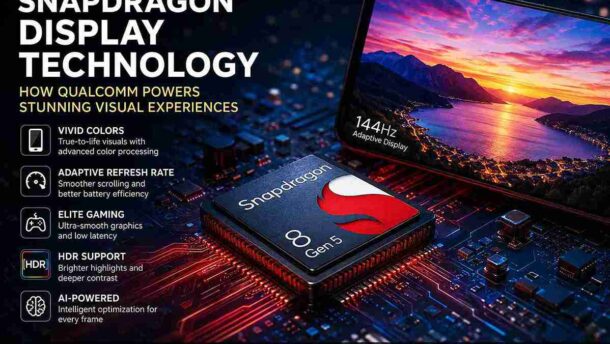
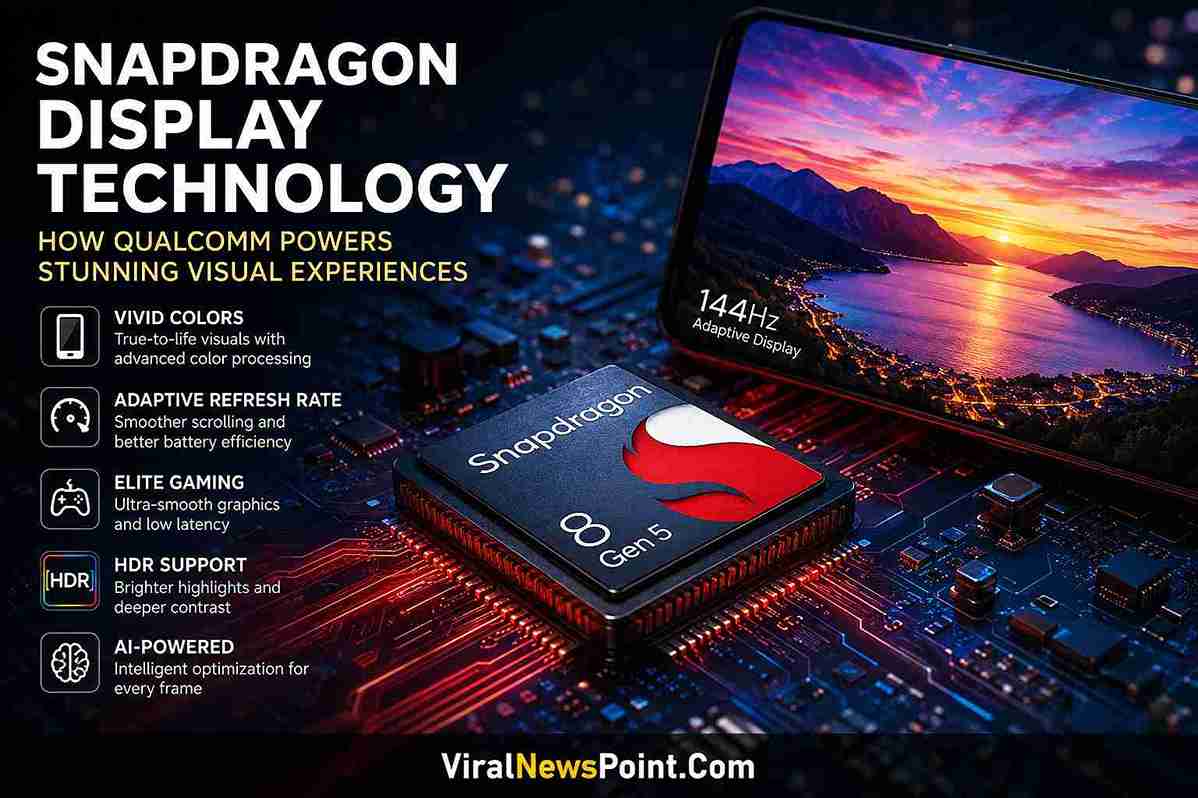
Developed by Qualcomm, Snapdragon Display Technology is not the physical screen itself. Instead, it is the intelligent display processing system built into Snapdragon mobile platforms. It works alongside the Adreno GPU, AI Engine, Image Signal Processor (ISP), and display controller to ensure that every frame displayed on your smartphone is smooth, vibrant, power-efficient, and optimized for the content you’re viewing.
Think of the display panel as a high-quality canvas. Snapdragon Display Technology is the artist that decides how every color is painted, how quickly images appear, how efficiently power is used, and how intelligently the screen adapts to changing conditions. From automatically adjusting refresh rates to enhancing HDR videos and improving gaming performance, it plays a crucial role in the overall smartphone experience.
Over the years, Qualcomm has continuously refined its display architecture to support higher resolutions, faster refresh rates, wider color gamuts, and more advanced AI-driven enhancements. Modern Snapdragon platforms can handle Quad HD+ and even 4K displays, refresh rates up to 165Hz on supported devices, HDR formats like HDR10+ and Dolby Vision, and adaptive technologies that improve both visual quality and battery life.
As smartphones become more powerful, displays are also becoming smarter. Features such as dynamic refresh rates, AI-powered brightness adjustment, motion smoothing, intelligent color calibration, and gaming-specific optimizations are no longer limited to premium flagship devices. Snapdragon’s display innovations have helped make these capabilities more accessible across a wide range of smartphones.
In this comprehensive guide, we’ll explore everything you need to know about Snapdragon Display Technology. We’ll explain how it works, break down the role of the Snapdragon Display Engine and Adreno GPU, compare different display technologies, examine gaming and HDR performance, and see how Snapdragon stacks up against competitors like Apple, MediaTek, Samsung Exynos, and Google Tensor. Whether you’re buying a new smartphone or simply curious about the technology powering modern mobile displays, this guide will help you understand why Snapdragon Display Technology has become a key part of today’s smartphone experience.
What Is Snapdragon Display Technology?
When people compare smartphones, they often focus on specifications such as AMOLED displays, 120Hz refresh rates, Quad HD+ resolution, or HDR support. While these features describe the display panel itself, they don’t tell the whole story. Behind every smooth animation, vibrant photo, and fluid gaming experience is a sophisticated display processing system that determines how content is rendered before it reaches your screen. This is where Snapdragon Display Technology comes into play.
Simply put, Snapdragon Display Technology is Qualcomm’s collection of hardware and software technologies built into Snapdragon mobile platforms to process, optimize, and deliver high-quality visuals to a smartphone’s display. It is not the screen itself but the intelligence that manages how images, videos, graphics, and user interface elements appear on the display.
Instead of thinking of it as a single component, imagine it as a team working together. The CPU handles instructions, the Adreno GPU renders graphics, the Image Signal Processor processes camera data, the AI Engine analyzes content, and the Display Engine coordinates everything before the final image is shown on the screen.
Understanding the Display Pipeline
Every image displayed on your smartphone follows a series of processing steps. This journey is often referred to as the display pipeline.
A simplified version looks like this:
Application
      ↓
Android Operating System
      ↓
Snapdragon CPU
      ↓
Adreno GPU
      ↓
AI Engine
      ↓
Display Engine
      ↓
Display Controller
      ↓
AMOLED / OLED / LCD Panel
Although the process happens in just a few milliseconds, each stage plays a critical role in producing the final image.
For example:
- A game sends 3D graphics to the GPU.
- The GPU renders every frame.
- The AI Engine may optimize brightness or enhance visual quality.
- The Display Engine synchronizes refresh rates and applies HDR processing.
- The display controller sends the completed image to the smartphone’s screen.
All of this happens continuously while you interact with your device.
Display Panel vs Snapdragon Display Technology
One of the biggest misconceptions is that Snapdragon creates smartphone displays.
It doesn’t.
Companies such as Samsung Display, BOE, LG Display, TCL CSOT, and Visionox manufacture the physical display panels used in smartphones. Snapdragon Display Technology works with these panels to maximize their performance.
Here’s a simple comparison:
| Display Panel | Snapdragon Display Technology |
|---|---|
| Physical screen | Display processing system |
| Manufactured by display companies | Developed by Qualcomm |
| Produces pixels | Processes visual data |
| Determines hardware quality | Optimizes how content appears |
| Controls brightness capability | Manages brightness intelligently |
| Supports refresh rates | Controls adaptive refresh behavior |
| Displays colors | Enhances color accuracy and rendering |
Think of it this way:
- The display panel is like a high-end television.
- Snapdragon Display Technology is the advanced video processor inside that television.
A premium panel without efficient processing cannot deliver its full potential, while excellent processing can significantly improve the experience even on less expensive hardware.
The Role of the Snapdragon Chipset
Modern Snapdragon processors integrate multiple specialized components that contribute to display quality.
CPU
The CPU manages application logic and coordinates communication between Android and the graphics subsystem.
For example:
- Opening apps
- Loading webpages
- Switching between applications
- Managing system resources
While the CPU doesn’t draw graphics directly, it ensures everything runs smoothly before visual data reaches the GPU.
Adreno GPU
The Adreno GPU is arguably the most important component for graphics rendering.
Its responsibilities include:
- Rendering user interface animations
- Drawing 2D and 3D graphics
- Running mobile games
- Processing visual effects
- Supporting high refresh rate displays
- Delivering smooth frame rates
A powerful GPU enables richer visuals, faster animations, and better gaming performance without overwhelming the processor.
Display Engine
The Display Engine acts as the final quality-control stage before an image appears on the screen.
Its responsibilities include:
- Color processing
- HDR rendering
- Motion handling
- Resolution scaling
- Adaptive refresh rate control
- Brightness optimization
- Display synchronization
This is one of the key reasons two smartphones with similar AMOLED panels can still deliver noticeably different visual experiences.
AI Engine
Artificial intelligence has become increasingly important in modern smartphone displays.
Snapdragon’s AI Engine can help with:
- Automatic brightness adjustment
- Scene recognition
- Video enhancement
- Intelligent color tuning
- Eye comfort optimization
- Battery-efficient display management
Instead of relying solely on fixed settings, AI allows the display to adapt to changing environments and user habits.
Image Signal Processor (ISP)
Although primarily associated with cameras, the ISP also influences the display experience.
After capturing a photo or recording a video, the ISP processes:
- Exposure
- White balance
- Dynamic range
- Noise reduction
- Color reproduction
The processed image is then displayed using the Snapdragon Display Engine, ensuring that what you see on the screen closely matches the captured content.
Why Snapdragon Display Technology Matters
Many smartphone buyers compare display specifications without realizing how much processing happens behind the scenes.
For example, two phones may both advertise:
- AMOLED display
- 120Hz refresh rate
- HDR10+
- Full HD+ resolution
Yet one device may appear noticeably smoother, more color accurate, and more responsive.
This difference often comes down to display optimization.
Snapdragon Display Technology contributes by improving:
- Motion smoothness
- Color accuracy
- HDR playback
- Gaming responsiveness
- Battery efficiency
- Brightness management
- Animation fluidity
- Display latency
These enhancements create a more polished experience that users notice every day, even if they never see the technology working in the background.
Real-World Benefits
Rather than simply increasing specifications, Snapdragon Display Technology improves how those specifications perform in daily use.
Some practical examples include:
- Videos appear more vibrant with better HDR tone mapping.
- Games feel smoother due to adaptive refresh rates and GPU optimizations.
- Scrolling through apps feels more fluid with intelligent frame synchronization.
- Outdoor readability improves through dynamic brightness adjustments.
- Battery life benefits from adaptive refresh rates that reduce power consumption when high frame rates aren’t needed.
- Photos display with more accurate colors after being processed by the ISP and Display Engine.
These improvements may seem subtle individually, but together they contribute to a noticeably better overall smartphone experience.
Why It Has Become More Important
As smartphone displays continue to evolve with higher resolutions, faster refresh rates, and richer color reproduction, the workload required to drive them efficiently also increases.
A 165Hz Quad HD+ AMOLED display demands significantly more processing power than a traditional 60Hz Full HD LCD. Without an advanced display engine, users could experience stuttering, higher battery drain, inconsistent colors, or excessive heat.
Qualcomm’s continued investment in Snapdragon Display Technology helps manufacturers unlock the full potential of modern display hardware while balancing performance and efficiency.
In the next section, we’ll dive deeper into the Snapdragon Display Engine, exploring how it manages image rendering, HDR processing, variable refresh rates, AI-assisted enhancements, and the technologies that power today’s flagship smartphone displays.
Snapdragon Display Engine Explained
When people hear the term Snapdragon Display Technology, they often think of it as a single feature. In reality, it’s an advanced collection of hardware blocks and software algorithms that work together to deliver the visuals you see on your smartphone.
At the center of this ecosystem is the Snapdragon Display Engine.
The Display Engine acts as the bridge between the graphics processor and the physical display. Every image rendered by the Adreno GPU passes through the Display Engine before reaching the AMOLED, OLED, or LCD panel. During this process, the engine optimizes colors, synchronizes refresh rates, applies HDR enhancements, manages power consumption, and ensures every frame is displayed accurately.
Simply put, it is the final quality control stage before anything appears on your screen.
How the Snapdragon Display Engine Works
The display engine doesn’t work alone. It collaborates with several components inside the Snapdragon chipset.
The complete workflow looks like this:
Application
      ↓
Android Framework
      ↓
Snapdragon CPU
      ↓
Adreno GPU
      ↓
AI Engine
      ↓
Snapdragon Display Engine
      ↓
Display Controller
      ↓
AMOLED / OLED / LTPO Display
Every stage contributes to delivering smooth animations, accurate colors, and efficient power usage.
Major Components of the Snapdragon Display Engine
1. Display Controller
The Display Controller manages communication between the processor and the physical display panel.
Its responsibilities include:
- Sending image data to the display
- Managing display timing
- Synchronizing frames
- Controlling screen resolution
- Supporting multiple display outputs
- Preventing screen tearing
Think of it as the traffic controller for everything appearing on the screen.
Without proper synchronization, animations would stutter, videos could skip frames, and games might suffer from visual artifacts.
2. Adreno GPU
The Adreno GPU is responsible for generating every graphical element displayed on your smartphone.
This includes:
- Android interface animations
- Games
- Video rendering
- 3D graphics
- User interface transitions
- Visual effects
Modern Adreno GPUs also support advanced technologies such as:
- Vulkan API
- OpenGL ES
- OpenCL
- Variable Rate Shading
- Hardware ray tracing (on supported Snapdragon platforms)
Compared to older mobile GPUs, the latest Adreno architecture delivers higher frame rates while consuming less power, making it ideal for both gaming and everyday use.
3. Image Rendering
Before an image reaches the display, it must be rendered.
Rendering involves converting digital information into visible graphics.
For example, when you open a game:
- Characters are rendered.
- Shadows are calculated.
- Reflections are generated.
- Lighting effects are applied.
- Textures are processed.
- Anti-aliasing smooths jagged edges.
The Adreno GPU performs these calculations, while the Display Engine ensures the final rendered frame appears correctly on the screen.
This process repeats dozens or even hundreds of times every second.
4. Motion Processing
Smooth motion is essential for modern smartphones.
Whether you’re:
- scrolling Instagram,
- watching YouTube,
- editing videos,
- playing BGMI,
- or switching between apps,
motion processing ensures animations remain fluid.
The Display Engine optimizes:
- Frame pacing
- Motion interpolation
- Animation timing
- Display synchronization
Instead of simply increasing the refresh rate, Qualcomm focuses on maintaining consistent frame delivery.
This helps eliminate:
- stuttering,
- frame drops,
- judder,
- uneven animations.
5. Display Stream Compression (DSC)
Modern flagship smartphones often use:
- Quad HD+ displays
- 4K external displays
- 144Hz refresh rates
- HDR content
These features require enormous amounts of bandwidth.
To solve this challenge, Snapdragon supports Display Stream Compression (DSC).
DSC is a visually lossless compression technology standardized by the Video Electronics Standards Association (VESA).
Its benefits include:
- Lower bandwidth usage
- Higher resolutions
- Faster refresh rates
- Reduced power consumption
- Support for premium display panels
Users won’t notice any visible loss in image quality, but the hardware benefits significantly from reduced data transmission requirements.
6. Variable Refresh Rate (VRR)
One of the most important innovations in modern smartphone displays is Variable Refresh Rate.
Instead of refreshing at a fixed frequency, the display adjusts itself according to what’s happening on screen.
Examples include:
| Activity | Refresh Rate |
|---|---|
| Always-On Display | 1Hz |
| Reading Articles | 10Hz |
| Watching Movies | 24Hz or 60Hz |
| Social Media Scrolling | 90Hz |
| Gaming | 120Hz or 144Hz |
This intelligent adjustment offers two major advantages:
Better Battery Life
Lower refresh rates consume less power.
When you’re reading an ebook, refreshing the display 144 times per second is unnecessary.
Dropping to 1Hz or 10Hz can noticeably reduce battery consumption.
Smoother Experience
During gaming or fast scrolling, the display automatically switches to higher refresh rates.
The result is:
- smoother animations,
- lower input latency,
- improved responsiveness.
Users don’t need to manually change settings because the system adapts automatically.
7. AI-Assisted Rendering
Artificial Intelligence is becoming increasingly important in smartphone displays.
Modern Snapdragon platforms use AI to improve several aspects of visual quality.
Examples include:
Intelligent Brightness
Instead of relying solely on the ambient light sensor, AI learns user preferences.
For example:
- Two users may use their phones under identical lighting conditions.
- One prefers a brighter display.
- The other prefers a dimmer screen.
The AI Engine gradually learns these habits and adjusts brightness accordingly.
Color Optimization
Different content benefits from different color profiles.
AI can recognize whether you’re:
- watching a movie,
- reading text,
- gaming,
- browsing photos,
- or editing images.
It can then optimize:
- saturation,
- contrast,
- sharpness,
- brightness,
- white balance.
Gaming Optimization
During gameplay, AI helps maintain stable performance by balancing:
- GPU workload
- Display refresh rate
- Thermal limits
- Battery efficiency
Instead of maximizing performance at all times, the system intelligently adjusts resources based on the game’s demands.
Video Enhancement
AI can also improve video playback by:
- reducing visual noise,
- sharpening details,
- enhancing colors,
- improving HDR rendering,
- optimizing contrast.
These enhancements are applied in real time without requiring users to edit the video manually.
How the Components Work Together
The Snapdragon Display Engine is not a standalone processor.
Instead, it coordinates multiple specialized hardware blocks.
| Component | Primary Role |
|---|---|
| CPU | Manages application instructions |
| Adreno GPU | Renders graphics and games |
| AI Engine | Optimizes brightness, colors, and efficiency |
| ISP | Processes captured images and videos |
| Display Engine | Final image optimization |
| Display Controller | Sends processed frames to the display panel |
This collaborative architecture allows Snapdragon-powered smartphones to deliver smooth, vibrant, and efficient visual experiences across gaming, video playback, photography, and everyday use.
Why the Display Engine Matters
It’s easy to focus on display specifications like resolution or refresh rate, but these numbers alone don’t guarantee a great viewing experience.
A high-quality display panel still relies on intelligent processing to:
- Render graphics accurately
- Deliver consistent frame timing
- Enhance HDR content
- Reduce power consumption
- Maintain color fidelity
- Prevent screen tearing
- Optimize gaming responsiveness
This is why two smartphones with similar AMOLED panels can feel noticeably different in everyday use. The quality of the underlying display engine plays a significant role in how smooth, responsive, and visually refined the final experience becomes.
In the next section, we’ll explore how Snapdragon complements modern display technologies such as OLED, AMOLED, and LTPO AMOLED, and why these combinations have become the standard for today’s flagship smartphones.
AMOLED, OLED, LTPO & Snapdragon: Understanding Modern Smartphone Display Technologies
When shopping for a new smartphone, you’ll often come across terms like OLED, AMOLED, LTPO AMOLED, Super AMOLED, or POLED. These names are usually associated with the display panel, while Snapdragon is associated with the processor. Because they are frequently mentioned together in smartphone specifications, many people assume they are the same technology.
They are not.
The display panel determines how images are physically shown on the screen, while Snapdragon Display Technology determines how those images are processed, optimized, and delivered. A premium display panel combined with an advanced Snapdragon chipset creates the smooth, colorful, and responsive experience found on many flagship smartphones.
In this section, we’ll break down the differences between the major display technologies and explain how Snapdragon helps each one perform at its best.
What Is an LCD Display?
Before OLED became popular, LCD (Liquid Crystal Display) was the standard technology used in smartphones.
Unlike OLED-based displays, LCD screens require a separate backlight that remains active whenever the display is turned on.
Advantages of LCD
- Lower manufacturing cost
- Good brightness levels
- Long lifespan
- Less risk of image retention
Disadvantages
- Lower contrast ratio
- Blacks appear gray rather than true black
- Higher power consumption
- Thicker display assembly
- Less vibrant colors
Although LCD technology has improved significantly over the years, it cannot individually control each pixel’s illumination.
What Is OLED?
OLED (Organic Light-Emitting Diode) represents one of the biggest advances in display technology.
Instead of using a backlight, every pixel generates its own light.
When a pixel needs to display black, it simply turns itself off.
This results in:
- True black levels
- Extremely high contrast
- Better energy efficiency for dark content
- Thinner displays
- Faster response times
OLED Benefits
✔ True blacks
✔ Excellent contrast
✔ Better HDR performance
✔ Wide viewing angles
✔ Faster pixel response
What Is AMOLED?
AMOLED stands for Active Matrix Organic Light-Emitting Diode.
It builds upon OLED technology by adding an active matrix that individually controls every pixel more efficiently.
Compared to standard OLED displays, AMOLED panels offer:
- Faster refresh rates
- Improved touch responsiveness
- Better power efficiency
- Higher brightness
- Superior color accuracy
- Enhanced gaming performance
This is why AMOLED has become the preferred display technology for flagship Android smartphones.
OLED vs AMOLED
| Feature | OLED | AMOLED |
|---|---|---|
| Pixel Control | Passive | Active Matrix |
| Response Time | Fast | Faster |
| Gaming Performance | Good | Excellent |
| Refresh Rate Support | Moderate | Very High |
| Power Efficiency | Good | Better |
| Smartphone Usage | Limited | Widely Used |
| HDR Performance | Good | Excellent |
While the differences may not always be obvious during casual use, AMOLED provides greater flexibility for modern smartphones that require high refresh rates and advanced power management.
What Is LTPO AMOLED?
LTPO stands for Low-Temperature Polycrystalline Oxide.
Rather than being a completely different display technology, LTPO is an improved transistor backplane used with OLED and AMOLED panels.
Its primary advantage is the ability to change the refresh rate dynamically without consuming excessive power.
Instead of refreshing at a fixed frequency, an LTPO display can intelligently switch between multiple refresh rates depending on the task being performed.
For example:
| Activity | Refresh Rate |
|---|---|
| Always-On Display | 1Hz |
| Reading an Ebook | 10Hz |
| Watching Movies | 24Hz or 60Hz |
| Browsing Social Media | 90Hz |
| Gaming | 120Hz or 144Hz |
This flexibility allows smartphones to conserve battery when high refresh rates aren’t necessary while still delivering an exceptionally smooth experience during demanding tasks.
Why LTPO Is Important
Higher refresh rates make smartphones feel faster and more responsive, but they also consume more power.
Without LTPO technology:
- A display running constantly at 120Hz would drain the battery more quickly.
- Heat generation would increase.
- Overall efficiency would decline.
LTPO solves this problem by lowering the refresh rate whenever possible.
Combined with Snapdragon’s display controller and adaptive refresh algorithms, the system continuously adjusts the refresh rate in real time based on user activity.
This intelligent coordination helps improve battery life without sacrificing smoothness.
How Snapdragon Works with AMOLED Displays
Many people mistakenly believe Snapdragon manufactures AMOLED displays.
In reality:
- Samsung Display
- BOE
- LG Display
- TCL CSOT
- Visionox
manufacture the display panels.
Snapdragon provides the processing that allows these panels to perform at their full potential.
Some of the ways Snapdragon enhances AMOLED displays include:
Intelligent Refresh Rate Control
The Snapdragon Display Engine continuously communicates with the display controller to determine the most appropriate refresh rate.
For example:
- While reading an article, the display may operate at 10Hz.
- During gaming, it can instantly switch to 144Hz.
- Watching a 24fps movie? The refresh rate can adapt accordingly to reduce unnecessary processing.
This not only improves smoothness but also extends battery life.
HDR Processing
Modern AMOLED panels support rich colors and deep contrast, but they still rely on Snapdragon’s processing capabilities to render HDR content accurately.
The Display Engine helps with:
- Tone mapping
- Brightness optimization
- Dynamic contrast
- Color enhancement
- Shadow detail
The result is a more realistic viewing experience when watching compatible HDR videos.
Color Management
High-end AMOLED displays are capable of reproducing billions of colors, but accurate color reproduction depends on intelligent calibration.
Snapdragon Display Technology helps by:
- Managing color profiles
- Optimizing white balance
- Supporting wide color gamuts such as DCI-P3
- Reducing color banding
- Maintaining consistent color rendering across different applications
This ensures photos, videos, and games appear closer to their intended look.
Power Efficiency
AMOLED displays are already more energy-efficient than LCD panels when displaying dark content.
Snapdragon further improves efficiency through:
- Adaptive refresh rate management
- AI-based brightness adjustment
- Intelligent frame scheduling
- Display power optimization
- Efficient GPU rendering
These optimizations reduce unnecessary workload, helping users get more screen-on time from a single charge.
Why Flagship Smartphones Prefer Snapdragon + LTPO AMOLED
Most premium Android smartphones combine Snapdragon processors with LTPO AMOLED displays because the technologies complement each other exceptionally well.
This combination offers:
- Ultra-smooth scrolling
- High refresh rate gaming
- Excellent battery life
- Superior HDR playback
- Better color accuracy
- Lower display latency
- Improved outdoor visibility
- Efficient thermal management
While the exact experience also depends on the manufacturer’s software tuning, Snapdragon’s display architecture provides a strong foundation for flagship-level performance.
Comparison of Display Technologies
| Feature | LCD | OLED | AMOLED | LTPO AMOLED |
|---|---|---|---|---|
| Individual Pixel Lighting | ✖ | ✔ | ✔ | ✔ |
| True Blacks | ✖ | ✔ | ✔ | ✔ |
| Contrast Ratio | Good | Excellent | Excellent | Excellent |
| Refresh Rate Support | Up to 120Hz | Up to 120Hz | Up to 165Hz | Dynamic 1Hz to 165Hz* |
| HDR Performance | Moderate | Very Good | Excellent | Excellent |
| Battery Efficiency | Average | Good | Better | Best |
| Always-On Display | Limited | ✔ | ✔ | ✔ |
| Adaptive Refresh Rate | ✖ | Limited | Limited | ✔ |
| Premium Smartphone Usage | Rare | Moderate | Very Common | Flagship Standard |
*Actual supported refresh rates depend on the specific smartphone, display panel, and chipset.
Real-World Benefits for Users
The combination of Snapdragon Display Technology and modern AMOLED or LTPO panels translates into practical everyday advantages:
- Scrolling through social media feels smoother.
- Games respond more quickly with reduced input latency.
- HDR movies display richer colors and deeper contrast.
- Outdoor readability improves through intelligent brightness control.
- Battery life benefits from adaptive refresh rates and efficient display management.
- Dark mode becomes even more power-efficient on OLED-based panels.
These improvements may seem subtle individually, but together they create the polished experience users expect from premium smartphones.
In the next section, we’ll explore how refresh rates, touch sampling rates, Snapdragon Elite Gaming, and adaptive display technologies work together to deliver faster, smoother, and more responsive gaming and everyday performance.
Refresh Rate & Gaming Experience: How Snapdragon Delivers Smoother Performance
One of the biggest selling points of modern smartphones is a high refresh rate display. A few years ago, most phones used a standard 60Hz screen. Today, even many mid-range devices offer 90Hz or 120Hz panels, while premium gaming smartphones can reach 144Hz or even 165Hz.
However, a high refresh rate alone doesn’t guarantee a smooth experience. The processor, GPU, display controller, touch controller, and software must all work together seamlessly. This is where Snapdragon Display Technology and Snapdragon Elite Gaming make a significant difference.
Qualcomm has designed its Snapdragon platforms to support high refresh rates while maintaining stable frame delivery, responsive touch input, and efficient power consumption.
What Is Refresh Rate?
The refresh rate refers to how many times a display updates the image every second.
It is measured in Hertz (Hz).
For example:
- 60Hz = Screen refreshes 60 times every second.
- 90Hz = Screen refreshes 90 times every second.
- 120Hz = Screen refreshes 120 times every second.
- 144Hz = Screen refreshes 144 times every second.
- 165Hz = Screen refreshes 165 times every second.
A higher refresh rate creates smoother motion, especially when scrolling, gaming, or navigating the user interface.
Understanding Different Refresh Rates
60Hz
For many years, 60Hz was the industry standard.
It is still perfectly adequate for:
- Reading articles
- Messaging
- Video streaming
- Web browsing
However, animations and scrolling may feel less fluid compared to higher refresh rate displays.
90Hz
A 90Hz display provides a noticeable improvement in smoothness over 60Hz.
Users will particularly notice:
- Faster scrolling
- Smoother app transitions
- Improved UI animations
- Better browsing experience
Many upper mid-range smartphones now use 90Hz displays.
120Hz
Today, 120Hz has become the flagship standard.
Benefits include:
- Exceptionally smooth scrolling
- More responsive gaming
- Better stylus performance
- Reduced motion blur
- Improved animation quality
For most users, 120Hz offers an excellent balance between smoothness and battery efficiency.
144Hz
Originally popular in gaming monitors, 144Hz has made its way into premium smartphones.
Advantages include:
- Ultra-smooth gameplay
- Lower perceived latency
- Better motion clarity
- Faster visual updates
Although not every mobile game supports 144fps, compatible titles can benefit from the higher refresh rate.
165Hz
Some dedicated gaming phones now feature 165Hz displays.
These panels target:
- Competitive gamers
- Esports enthusiasts
- Professional mobile gaming
While the visual difference between 144Hz and 165Hz is relatively small for casual users, competitive players may appreciate the slight improvement in responsiveness.
Refresh Rate vs Frame Rate
Refresh rate and frame rate are often confused, but they are different concepts.
| Refresh Rate | Frame Rate |
|---|---|
| Controlled by the display | Generated by the GPU |
| Measured in Hz | Measured in FPS |
| Determines how often the screen updates | Determines how many images the GPU renders per second |
For example:
- A phone with a 144Hz display can refresh up to 144 times per second.
- If a game only renders 60 FPS, the display can only show those 60 frames, even though it is capable of refreshing faster.
This is why a powerful GPU, such as Qualcomm’s Adreno GPU, is just as important as a high-refresh-rate panel.
What Is Touch Sampling Rate?
While refresh rate controls how often the screen updates, touch sampling rate determines how frequently the display checks for touch input.
For example:
| Touch Sampling Rate | Touch Detection |
|---|---|
| 120Hz | 120 touch checks per second |
| 240Hz | 240 touch checks per second |
| 480Hz | 480 touch checks per second |
| 720Hz | 720 touch checks per second |
A higher touch sampling rate reduces the delay between:
- touching the screen,
- processing the input,
- displaying the action.
This is especially beneficial for fast-paced games where quick reactions matter.
Adaptive Refresh Rate
Modern Snapdragon-powered smartphones don’t operate at a fixed refresh rate.
Instead, they use adaptive refresh rate technology.
Examples include:
| Activity | Refresh Rate |
|---|---|
| Always-On Display | 1Hz |
| Reading | 10Hz |
| Watching Movies | 24Hz or 60Hz |
| Social Media | 90Hz |
| Gaming | 120Hz to 144Hz |
The Snapdragon Display Engine dynamically adjusts the refresh rate to match the content on screen.
This approach offers two major benefits:
Better Battery Life
A display running continuously at 144Hz consumes significantly more power than one operating at 10Hz.
By lowering the refresh rate whenever possible, Snapdragon helps conserve battery without compromising the user experience.
Smoother Performance
When high refresh rates are needed, such as during gaming or rapid scrolling, the display automatically switches to a faster mode, ensuring fluid visuals and responsive interactions.
Snapdragon Elite Gaming
Qualcomm introduced Snapdragon Elite Gaming to bring desktop-inspired gaming technologies to smartphones.
Rather than being a single feature, Elite Gaming is a collection of hardware and software optimizations designed to improve mobile gaming performance.
Key technologies include:
- Optimized GPU drivers
- Reduced input latency
- High refresh rate support
- HDR gaming
- Variable Rate Shading (on supported platforms)
- Vulkan API enhancements
- Better thermal management
- Stable frame pacing
Together, these technologies help games run more smoothly while improving responsiveness and visual quality.
Frame Pacing
A high average frame rate doesn’t always guarantee a smooth experience.
If frame delivery is inconsistent, gameplay can feel jerky even when the FPS counter looks impressive.
This is where frame pacing becomes important.
Good frame pacing ensures that frames are delivered at consistent intervals.
Benefits include:
- Smoother animations
- Reduced stuttering
- Better camera movement
- More predictable gameplay
- Improved visual comfort
Qualcomm’s graphics pipeline is designed to maintain stable frame timing alongside high frame rates.
Motion Smoothness
Smooth motion depends on several factors working together:
- Refresh rate
- GPU performance
- Display controller
- Touch sampling
- Frame pacing
- Software optimization
A smartphone with a powerful Snapdragon chipset can better coordinate these components, resulting in fluid scrolling, responsive gaming, and polished system animations.
Real-World Gaming Benefits
In everyday use, Snapdragon Display Technology contributes to a more enjoyable gaming experience.
For example:
BGMI
- Faster touch response
- Stable frame rates (device and game dependent)
- Reduced input lag
- Smooth camera movement
Call of Duty: Mobile
- Better visual clarity
- Responsive controls
- Consistent gameplay during extended sessions
Genshin Impact
- Improved GPU efficiency
- Better thermal management
- Reduced frame drops in demanding scenes
Asphalt Legends
- Smooth high-speed animations
- Rich HDR visuals on supported displays
- Responsive steering controls
Actual performance will vary depending on the Snapdragon chipset, game optimization, graphics settings, and device cooling system.
Why Refresh Rate Alone Isn’t Enough
Many smartphone advertisements emphasize high refresh rates, but the display panel is only one part of the equation.
To fully benefit from a 120Hz or 144Hz screen, a smartphone also needs:
- A powerful GPU to render enough frames.
- An efficient display controller to synchronize output.
- Intelligent adaptive refresh rate management.
- Effective thermal control to sustain performance.
- Software optimization that minimizes frame drops and input latency.
This is why two smartphones with the same display specification can still feel very different in everyday use.
Key Takeaways
- Higher refresh rates create smoother scrolling and gaming experiences.
- The Adreno GPU is responsible for rendering the frames that high-refresh-rate displays can show.
- Touch sampling rate affects how quickly the phone responds to user input.
- Adaptive refresh rate technology balances smoothness with battery efficiency.
- Snapdragon Elite Gaming combines multiple technologies to improve responsiveness, graphics, and overall gaming performance.
- A great gaming experience depends on the entire hardware and software ecosystem, not just the refresh rate.
In the next section, we’ll explore how HDR technologies, peak brightness, and advanced color science work together to produce vibrant visuals and lifelike images on Snapdragon-powered smartphones.
HDR, Brightness & Color Science: How Snapdragon Creates Richer, More Realistic Visuals
A high-resolution display and a fast refresh rate are only part of what makes a smartphone screen look impressive. If colors appear washed out, bright areas lose detail, or shadows become overly dark, the viewing experience suffers regardless of how many pixels the display has.
This is where High Dynamic Range (HDR), advanced color science, and Snapdragon’s display processing play an essential role.
Modern Snapdragon mobile platforms are designed to support multiple HDR standards, wide color gamuts, high bit-depth displays, and intelligent image processing. Together, these technologies help create brighter highlights, deeper blacks, smoother color gradients, and a more lifelike viewing experience.
Whether you’re streaming a movie, editing photos, browsing social media, or playing HDR-enabled games, Snapdragon works behind the scenes to ensure the display presents content as accurately and efficiently as possible.
What Is HDR?
HDR (High Dynamic Range) is a display technology that increases the difference between the brightest and darkest parts of an image.
Instead of simply making everything brighter, HDR improves the range of visible detail.
For example:
Without HDR:
- Bright skies may appear completely white.
- Dark shadows may lose important details.
- Colors can look flat.
With HDR:
- Clouds retain texture.
- Shadows reveal more information.
- Colors appear richer.
- Highlights become more realistic.
- Overall contrast improves significantly.
This creates images that look closer to what the human eye naturally perceives.
Why HDR Matters
Imagine watching a sunset.
A standard display might show:
- Bright orange sky
- Dark foreground
- Limited detail
An HDR-capable display can reveal:
- Individual cloud textures
- Gradual color transitions
- Better lighting effects
- Improved shadow detail
- More realistic highlights
The difference is especially noticeable in:
- Movies
- Nature documentaries
- HDR gaming
- Professional photography
- High-quality streaming content
HDR Formats Supported by Snapdragon
Different streaming platforms and devices use different HDR standards.
Snapdragon platforms support multiple formats depending on the specific chipset and smartphone implementation.
HDR10
HDR10 is the most widely used HDR standard.
Features include:
- 10-bit color
- Static metadata
- Broad industry support
- Excellent compatibility
You’ll commonly find HDR10 content on:
- YouTube
- Amazon Prime Video
- UHD Blu-ray
- Many Android smartphones
HDR10+
HDR10+ builds upon HDR10 by introducing dynamic metadata.
Instead of applying the same brightness settings to an entire movie, HDR10+ adjusts image parameters scene by scene.
Benefits include:
- Better highlight preservation
- Improved shadow detail
- More accurate contrast
- Enhanced color reproduction
This results in a more consistent viewing experience, particularly for movies with dramatic lighting changes.
Dolby Vision
Dolby Vision is one of the most advanced HDR formats available today.
It offers:
- Dynamic metadata
- Higher brightness support
- Superior color precision
- Better tone mapping
- Professional mastering workflow
When supported by both the smartphone and the streaming service, Dolby Vision can deliver exceptional image quality.
Hybrid Log-Gamma (HLG)
HLG was developed primarily for live television broadcasts.
Unlike HDR10 or Dolby Vision, it doesn’t require metadata.
It is commonly used for:
- Live sports
- Television broadcasts
- Live HDR events
Although less common on smartphones, Snapdragon platforms are capable of supporting HLG where manufacturers enable it.
Comparing HDR Standards
| HDR Format | Metadata | Bit Depth | Common Usage |
|---|---|---|---|
| HDR10 | Static | 10-bit | Most common HDR format |
| HDR10+ | Dynamic | 10-bit | Premium streaming |
| Dolby Vision | Dynamic | Up to 12-bit | High-end movies and TV |
| HLG | None | 10-bit | Live broadcasting |
Support depends on both the Snapdragon platform and the device manufacturer’s implementation.
Peak Brightness Explained
One of the most advertised display specifications today is peak brightness.
Manufacturers often promote figures such as:
- 1,500 nits
- 2,500 nits
- 4,000 nits
- 6,000 nits
- 7,000 nits
But what do these numbers actually mean?
Nits measure the brightness of a display.
Higher brightness improves:
- Outdoor readability
- HDR performance
- Highlight visibility
- Overall viewing comfort
However, it’s important to distinguish between:
Peak Brightness
The maximum brightness a display can achieve under specific conditions, usually for a small portion of the screen while displaying HDR content.
Sustained Brightness
The brightness the display can maintain across the entire screen for an extended period.
For everyday use, sustained brightness often has a greater impact than peak brightness.
Snapdragon’s Display Engine helps manage brightness intelligently, balancing visibility with power efficiency and thermal limits.
Wide Color Gamut
Not all displays can reproduce the same range of colors.
A color gamut defines the range of colors a display is capable of showing.
Modern Snapdragon-powered smartphones commonly support wide color gamuts such as:
- sRGB
- DCI-P3
- Adobe RGB (less common on smartphones)
sRGB
sRGB is the standard color space used by most websites and everyday digital content.
Advantages:
- Consistent colors
- Excellent compatibility
- Ideal for web browsing
DCI-P3
DCI-P3 offers a significantly wider color range than sRGB.
Benefits include:
- Richer reds
- Deeper greens
- More vibrant images
- Better HDR performance
Most premium smartphones now target near-complete DCI-P3 coverage.
Adobe RGB
Adobe RGB is primarily used by professional photographers and graphic designers.
Although smartphones rarely display the full Adobe RGB gamut, Snapdragon processors can accurately process high-quality images captured in wider color spaces when supported by the device.
10-Bit vs 12-Bit Color
Another specification often mentioned alongside HDR is color depth.
Color depth determines how many color variations a display can reproduce.
8-Bit
Approximately 16.7 million colors.
Still common on budget smartphones.
10-Bit
Over 1 billion colors.
Benefits include:
- Smoother gradients
- Reduced color banding
- Better HDR rendering
- More realistic skies and sunsets
Most premium Snapdragon smartphones support 10-bit displays.
12-Bit
Around 68 billion theoretical color variations.
Although true 12-bit smartphone displays remain uncommon, some Snapdragon platforms support 12-bit image processing for compatible workflows.
Color Accuracy
Brightness alone doesn’t determine display quality.
Accurate color reproduction is equally important.
Snapdragon Display Technology helps improve:
- White balance
- Color consistency
- Tone mapping
- Saturation control
- Contrast optimization
This is particularly valuable for:
- Photographers
- Video editors
- Graphic designers
- Content creators
Accurate colors ensure that what appears on the smartphone closely matches the original content.
Outdoor Visibility
Using a smartphone in direct sunlight can be challenging.
Bright ambient light reduces contrast and makes darker content difficult to see.
Snapdragon helps improve outdoor visibility through:
- Intelligent brightness adjustment
- HDR optimization
- Local tone mapping
- Contrast enhancement
- Efficient display power management
Combined with high-brightness AMOLED panels, these technologies improve readability in challenging lighting conditions.
HDR Gaming
HDR isn’t limited to movies.
Many modern mobile games now support HDR graphics.
Benefits include:
- Better lighting effects
- More realistic environments
- Richer colors
- Improved contrast
- Enhanced visual immersion
When paired with Snapdragon Elite Gaming and an HDR-capable display, compatible games can deliver a noticeably richer visual experience.
Comparison of Display Color Technologies
| Feature | Standard SDR | HDR10 | HDR10+ | Dolby Vision |
|---|---|---|---|---|
| Dynamic Range | Standard | High | Higher | Excellent |
| Metadata | None | Static | Dynamic | Dynamic |
| Color Depth | 8-bit | 10-bit | 10-bit | Up to 12-bit |
| Contrast | Moderate | High | Higher | Excellent |
| Streaming Support | Universal | Very Common | Growing | Premium Services |
| Visual Quality | Good | Excellent | Better | Best |
AI Display Features: How Artificial Intelligence Makes Snapdragon Displays Smarter
Artificial Intelligence (AI) has become one of the biggest innovations in modern smartphones. While many people associate AI with chatbots, voice assistants, or photo editing, it also plays a major role in improving the display experience.
In Snapdragon-powered smartphones, AI isn’t just a software feature. It is deeply integrated into the chipset through the Qualcomm AI Engine, working alongside the CPU, Adreno GPU, Image Signal Processor (ISP), and Display Engine. Together, these components continuously analyze how you use your phone and optimize the display in real time.
Instead of relying on fixed settings, Snapdragon’s AI capabilities can intelligently adjust brightness, colors, refresh rates, power consumption, and even gaming performance based on your environment and usage patterns.
What Is the Qualcomm AI Engine?
The Qualcomm AI Engine is a dedicated set of hardware and software technologies built into Snapdragon chipsets to accelerate machine learning tasks directly on the device.
Unlike cloud-based AI, on-device AI processes data locally, which offers several advantages:
- Faster response times
- Improved privacy
- Reduced internet dependency
- Lower latency
- Better battery efficiency
For display-related tasks, the AI Engine constantly analyzes visual content and user behavior to deliver a more personalized viewing experience.
AI Adaptive Brightness
One of the most widely used AI-powered display features is Adaptive Brightness.
Traditional automatic brightness relies solely on the ambient light sensor. It adjusts the screen brightness based on surrounding light levels, but it doesn’t consider personal preferences.
AI takes this a step further.
How It Works
The AI system learns from your manual adjustments over time.
For example:
- If you consistently reduce brightness indoors, the system remembers your preference.
- If you increase brightness outdoors, it adapts accordingly.
- If you prefer a dimmer screen at night, future adjustments become more accurate.
Over time, the display begins to match your habits instead of relying on generic settings.
Benefits
- More comfortable viewing
- Reduced manual adjustments
- Better battery efficiency
- Improved readability in different environments
AI Color Enhancement
Different types of content benefit from different color profiles.
A movie, for example, requires different color tuning than a document or a mobile game.
The Snapdragon AI Engine can recognize the type of content being displayed and optimize visual settings accordingly.
Examples include:
- Increasing contrast during movie playback
- Enhancing text clarity while reading
- Adjusting saturation for photo viewing
- Optimizing colors for gaming
The goal is not to artificially oversaturate images but to improve clarity while maintaining a natural appearance.
AI Video Enhancement
Streaming services now deliver millions of hours of video every day, but not all content is recorded in high quality.
Some videos suffer from:
- Low resolution
- Compression artifacts
- Poor lighting
- Digital noise
- Inconsistent colors
AI-powered video enhancement can improve playback by applying intelligent processing in real time.
Typical improvements include:
- Sharper details
- Better contrast
- Enhanced color balance
- Reduced visual noise
- Improved edge definition
These enhancements are especially noticeable when watching older videos or lower-resolution content on high-resolution displays.
AI HDR Optimization
HDR content already offers improved brightness and contrast, but AI can refine it further.
The Snapdragon AI Engine can help with:
- Dynamic tone mapping
- Highlight preservation
- Shadow enhancement
- Scene analysis
- Contrast optimization
For example, in a movie with both bright sunlight and dark interiors, AI can adjust processing dynamically to retain detail in both areas, creating a more balanced and realistic image.
AI Gaming Optimization
Gaming places heavy demands on both the GPU and the display.
Snapdragon uses AI to balance performance, responsiveness, and battery life during gameplay.
Instead of always running at maximum performance, the system intelligently allocates resources based on the game’s requirements.
AI can optimize:
- GPU workload
- Refresh rate
- Frame stability
- Touch responsiveness
- Thermal management
- Power consumption
This helps maintain smooth gameplay while reducing unnecessary battery drain and heat buildup.
AI Frame Prediction
Frame drops can make games feel sluggish, especially during fast-paced action.
Modern Snapdragon platforms use AI-assisted techniques to improve frame consistency by predicting rendering workloads and optimizing resource allocation.
While AI does not “create” missing frames in the way some desktop technologies do, it helps reduce latency and maintain smoother performance during demanding scenes.
Benefits include:
- More consistent gameplay
- Fewer noticeable frame drops
- Reduced input latency
- Improved overall responsiveness
AI Battery Optimization
The display is one of the largest consumers of battery power in any smartphone.
Snapdragon’s AI Engine helps extend battery life by intelligently managing display-related tasks.
Examples include:
- Lowering the refresh rate when viewing static content
- Reducing brightness when appropriate
- Optimizing GPU usage
- Adjusting display processing based on workload
- Coordinating with Android’s power management features
These small optimizations add up over time, contributing to longer screen-on time without significantly affecting the user experience.
AI Eye Comfort Features
Extended screen time can cause eye strain, particularly in low-light environments.
Many Snapdragon-powered smartphones incorporate AI-assisted eye comfort features such as:
- Adaptive blue light reduction
- Automatic color temperature adjustment
- Reading modes
- Night mode optimization
- Intelligent brightness transitions
Rather than applying a fixed filter, AI can adjust these settings based on factors such as ambient lighting, time of day, and user preferences, helping create a more comfortable viewing experience.
Practical Examples of AI in Everyday Use
To understand the impact of AI display features, consider a typical day with a Snapdragon-powered smartphone:
Morning
You check emails in a brightly lit room. The display automatically increases brightness for better readability.
Afternoon
You watch an HDR movie during lunch. AI enhances contrast and color reproduction while optimizing battery usage.
Evening
You play a graphics-intensive game. The system maintains a high refresh rate, balances GPU performance, and manages heat to sustain smooth gameplay.
Night
Before bed, you read an eBook. The display lowers its refresh rate, reduces blue light, and adjusts brightness to create a more comfortable reading experience.
Throughout the day, these adjustments happen automatically without requiring manual intervention.
Benefits of AI Display Technology
| AI Feature | User Benefit |
|---|---|
| Adaptive Brightness | Learns your brightness preferences |
| Color Enhancement | More natural and vibrant visuals |
| Video Enhancement | Improved playback quality |
| HDR Optimization | Better contrast and dynamic range |
| Gaming Optimization | Stable performance and responsiveness |
| Battery Optimization | Longer battery life |
| Eye Comfort | Reduced eye strain during prolonged use |
The Future of AI Display Technology
Artificial intelligence is expected to play an even larger role in smartphone displays over the coming years.
Future Snapdragon platforms may introduce capabilities such as:
- Real-time AI image enhancement
- Personalized display profiles based on individual preferences
- Smarter power management using predictive algorithms
- Improved accessibility features
- Advanced AI-assisted gaming optimization
- Enhanced display calibration for professional content creation
As AI hardware continues to evolve, smartphone displays will become increasingly adaptive, efficient, and personalized.
Snapdragon Display vs Competitors: How Qualcomm Compares with MediaTek, Apple, Samsung Exynos, and Google Tensor
Choosing a smartphone today isn’t just about selecting the best display panel. The processor powering that display plays an equally important role in determining visual quality, gaming performance, battery efficiency, HDR capabilities, and overall responsiveness.
Qualcomm’s Snapdragon platform dominates the Android flagship market, but it isn’t the only player. MediaTek, Apple, Samsung, and Google have all developed advanced display processing technologies that compete directly with Snapdragon.
Each platform has its own strengths. Some prioritize gaming, others focus on photography, while some emphasize AI or software optimization.
In this section, we’ll compare Snapdragon Display Technology with its biggest competitors and explain where each platform excels.
Snapdragon vs MediaTek Dimensity
MediaTek has transformed from a budget chipset manufacturer into one of Qualcomm’s strongest competitors.
Its flagship Dimensity 9000, Dimensity 9300, and newer premium chipsets offer impressive graphics performance and modern display capabilities.
Display Support
Both Snapdragon and flagship Dimensity processors support:
- AMOLED displays
- LTPO AMOLED
- HDR10+
- High refresh rates
- Wide color gamut
- Adaptive refresh technology
However, Snapdragon generally offers more mature GPU optimization and broader developer support.
Gaming Performance
Qualcomm’s Adreno GPU has traditionally held an advantage in gaming.
Reasons include:
- Better GPU driver optimization
- Snapdragon Elite Gaming features
- Wider game compatibility
- Lower graphics latency
- Better Vulkan optimization
MediaTek’s Mali or Immortalis GPUs have improved significantly, particularly in ray tracing support, but many game developers still optimize first for Snapdragon-powered devices.
AI Display Processing
Both companies integrate dedicated AI hardware.
Snapdragon
Focuses on:
- AI brightness
- Gaming optimization
- HDR processing
- Color enhancement
- Power management
MediaTek
Focuses on:
- AI camera enhancements
- AI noise reduction
- AI video processing
- Display optimization
In everyday use, both platforms deliver excellent results, though Qualcomm’s ecosystem benefits from years of software refinement.
Snapdragon vs Apple A-Series
Apple takes a very different approach.
Instead of licensing its processors to multiple manufacturers, Apple designs both its silicon and its operating system.
This tight hardware-software integration allows for exceptional optimization.
Display Experience
Apple devices are known for:
- Excellent color calibration
- Smooth animations
- ProMotion adaptive refresh rate
- Consistent brightness
- Outstanding HDR playback
Qualcomm counters with:
- Wider device availability
- Support for multiple display technologies
- Excellent gaming optimization
- Greater flexibility for Android manufacturers
Apple’s advantage comes largely from software integration, while Snapdragon offers versatility across a broad range of smartphones.
Gaming
Both platforms perform exceptionally well.
Apple’s GPU benefits from:
- Metal graphics API
- Excellent optimization
- Strong developer support
Snapdragon benefits from:
- Adreno GPU
- Snapdragon Elite Gaming
- Vulkan optimization
- Wider Android game compatibility
For Android gaming, Snapdragon remains the preferred choice among many manufacturers.
Snapdragon vs Samsung Exynos
Samsung’s Exynos processors have evolved considerably over the years.
Recent flagship Exynos chips feature:
- AMD RDNA-based graphics
- Modern display controllers
- HDR support
- High refresh rate compatibility
Graphics
The AMD partnership has significantly improved Exynos graphics performance.
Advantages include:
- Better ray tracing support
- Advanced GPU architecture
- Strong multimedia capabilities
However, Snapdragon still enjoys broader game optimization and more consistent performance across Android titles.
Display Processing
Both platforms support:
- AMOLED displays
- HDR10+
- Adaptive refresh rates
- Wide color gamuts
The actual experience often depends more on Samsung’s display hardware than on the processor itself.
Snapdragon vs Google Tensor
Google Tensor focuses heavily on Artificial Intelligence.
Unlike Snapdragon, Tensor prioritizes:
- On-device machine learning
- AI photography
- Speech recognition
- Live translation
- Computational photography
Display Features
Tensor supports:
- OLED displays
- HDR
- Adaptive refresh rates
- High-resolution displays
However, Google’s biggest strengths lie in software rather than graphics performance.
Gaming
Compared to Snapdragon:
- GPU performance is generally lower.
- Sustained gaming performance is less competitive.
- Thermal management varies by device.
For users who primarily game, Snapdragon-powered phones typically provide a stronger experience.
Comparison Table
| Feature | Snapdragon | MediaTek Dimensity | Apple A-Series | Samsung Exynos | Google Tensor |
|---|---|---|---|---|---|
| GPU | Adreno | Mali / Immortalis | Apple GPU | AMD RDNA GPU | Mali GPU |
| Gaming | ⭐⭐⭐⭐⭐ | ⭐⭐⭐⭐☆ | ⭐⭐⭐⭐⭐ | ⭐⭐⭐⭐☆ | ⭐⭐⭐☆☆ |
| Adaptive Refresh | Excellent | Excellent | Excellent | Excellent | Very Good |
| HDR Support | HDR10, HDR10+, Dolby Vision* | HDR10+ | Dolby Vision | HDR10+ | HDR10 |
| AI Display Features | Excellent | Very Good | Excellent | Very Good | Excellent |
| Battery Efficiency | Excellent | Excellent | Excellent | Very Good | Good |
| Developer Support | Excellent | Very Good | Excellent | Good | Very Good |
| Android Optimization | Excellent | Excellent | N/A | Excellent | Excellent |
Which Platform Is Best for Different Users?
For Gamers
🥇 Winner: Snapdragon
Reasons:
- Snapdragon Elite Gaming
- Adreno GPU
- Better Vulkan support
- Stable frame rates
- Excellent thermal optimization
- Broad game compatibility
For Content Creators
🥇 Winner: Apple A-Series
Reasons:
- Outstanding color accuracy
- Excellent HDR implementation
- Strong video processing
- Professional creative ecosystem
Snapdragon-powered Android flagships are also excellent choices, especially for users who prefer Android.
For AI Features
🥇 Winner: Google Tensor
Tensor excels in:
- Live translation
- Voice recognition
- AI-powered photography
- On-device machine learning
Snapdragon, however, offers a more balanced combination of AI capabilities alongside stronger graphics performance.
For Battery Efficiency
🥇 Tie: Snapdragon and Apple
Both platforms combine powerful hardware with intelligent power management, though actual battery life also depends on factors such as display technology, software optimization, and battery capacity.
Is Snapdragon Still the Leader?
Qualcomm continues to hold a strong position in the Android ecosystem because of its balanced approach.
Rather than excelling in only one area, Snapdragon platforms typically deliver:
- Excellent graphics performance
- Reliable gaming
- Advanced HDR support
- Broad display compatibility
- Efficient power management
- Strong AI capabilities
Competition has become much stronger in recent years, particularly from MediaTek and Google, but Snapdragon remains one of the most complete mobile platforms for users seeking flagship-level display performance.
Best Snapdragon Smartphones with Excellent Displays (2026)
Choosing a smartphone with a Snapdragon processor doesn’t automatically guarantee an outstanding display. The final viewing experience depends on a combination of the display panel, Snapdragon chipset, software optimization, display calibration, and the manufacturer’s tuning.
Fortunately, several smartphone brands have successfully combined Qualcomm’s latest Snapdragon platforms with premium AMOLED and LTPO displays to deliver exceptional visual quality.
Below are some of the best Snapdragon-powered smartphones available in 2026 for users who value display performance, gaming, HDR content, and multimedia consumption.
1. Samsung Galaxy S26 Ultra
Best For: Professionals, photographers, and multimedia enthusiasts
Samsung continues to set the benchmark for flagship smartphone displays, and the Galaxy S26 Ultra is no exception.
Display Highlights
- 6.9-inch Dynamic LTPO AMOLED 2X
- Quad HD+ resolution
- Adaptive 1Hz–144Hz refresh rate
- HDR10+ support
- Extremely high peak brightness
- Gorilla Armor protection
Combined with Qualcomm’s latest Snapdragon flagship chipset in many markets, the S26 Ultra delivers one of the smoothest and most color-accurate display experiences currently available.
Ideal for:
- HDR streaming
- Mobile photography
- Video editing
- Productivity
2. OnePlus 15 Pro
Best For: Performance users and gamers
OnePlus has consistently delivered high-quality displays with excellent calibration and smooth animations.
Display Highlights
- LTPO AMOLED panel
- Quad HD+ resolution
- 120Hz adaptive refresh rate
- HDR10+
- Dolby Vision support
- Excellent color accuracy
The combination of Snapdragon processing and OxygenOS optimization results in a fast, fluid user experience.
Ideal for:
- Gaming
- Streaming
- Daily productivity
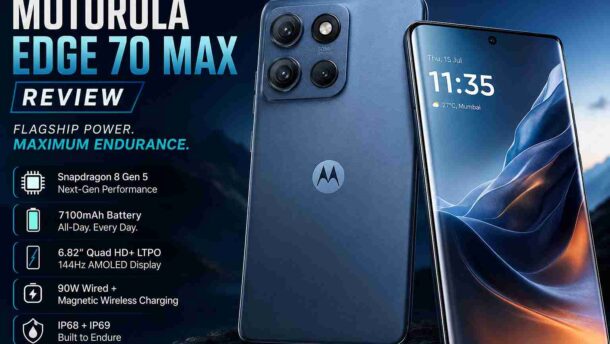
3. Motorola Edge 70 Max
Best For: Battery life and immersive entertainment
Motorola’s latest flagship focuses on endurance without sacrificing display quality.
Display Highlights
- 6.82-inch LTPO AMOLED
- Quad HD+ resolution
- 144Hz refresh rate
- HDR10+
- 10-bit color
- High peak brightness
Paired with the Snapdragon 8 Gen 5 processor, the Motorola Edge 70 Max is expected to offer smooth gaming, responsive touch controls, and excellent battery efficiency.
Ideal for:
- Long gaming sessions
- Movie watching
- Heavy multitasking
4. Xiaomi 16 Ultra
Best For: Photography and multimedia
Xiaomi continues to push smartphone display technology forward.
Key features include:
- Premium LTPO AMOLED display
- HDR10+
- Dolby Vision
- Adaptive refresh rate
- Professional color calibration
Combined with Snapdragon flagship hardware, the display delivers an excellent balance between vibrant colors and accurate reproduction.
5. ASUS ROG Phone 10
Best For: Competitive gamers
The ROG Phone series remains one of the strongest gaming smartphone lineups.
Display Features
- AMOLED display
- 165Hz refresh rate
- Ultra-high touch sampling rate
- HDR gaming support
- Gaming-focused calibration
Snapdragon Elite Gaming features complement the hardware exceptionally well.
6. HONOR Magic Series
Best For: Premium Android users
HONOR’s flagship smartphones combine:
- LTPO AMOLED
- High brightness
- Adaptive refresh rate
- AI eye comfort
- Excellent HDR support
The Snapdragon chipset ensures fluid animations and efficient power management.
7. Sony Xperia Flagship Series
Best For: Content creators
Sony focuses heavily on display accuracy rather than exaggerated colors.
Highlights include:
- OLED display
- Professional color calibration
- Creator Mode
- HDR support
- Excellent multimedia experience
These phones appeal particularly to photographers and videographers.
8. iQOO Flagship Series
Best For: Mobile gamers
iQOO smartphones are known for their aggressive performance tuning.
Display features often include:
- 144Hz AMOLED panels
- HDR support
- High touch sampling rates
- Gaming display enhancements
Combined with Snapdragon processors, these devices provide excellent gaming responsiveness.
Comparison Table
| Smartphone | Display | Refresh Rate | Processor | Best For |
|---|---|---|---|---|
| Samsung Galaxy S26 Ultra | Dynamic LTPO AMOLED | 1–144Hz | Snapdragon Flagship | Productivity & Photography |
| OnePlus 15 Pro | LTPO AMOLED | 120Hz | Snapdragon Flagship | Everyday Performance |
| Motorola Edge 70 Max | LTPO AMOLED | 144Hz | Snapdragon 8 Gen 5 | Battery & Gaming |
| Xiaomi 16 Ultra | LTPO AMOLED | 120Hz | Snapdragon Flagship | Multimedia |
| ASUS ROG Phone 10 | AMOLED | 165Hz | Snapdragon Flagship | Competitive Gaming |
| HONOR Magic Series | LTPO AMOLED | 120Hz | Snapdragon Flagship | Premium Experience |
| Sony Xperia Flagship | OLED | 120Hz | Snapdragon Flagship | Content Creation |
| iQOO Flagship | AMOLED | 144Hz | Snapdragon Flagship | Gaming |
What Makes These Displays Stand Out?
Despite coming from different manufacturers, these smartphones share several characteristics:
- High-quality AMOLED or LTPO panels
- Advanced Snapdragon chipsets
- Adaptive refresh rate technology
- HDR certification
- Wide color gamut support
- Intelligent display optimization
- Strong GPU performance
- Efficient battery management
The result is a consistently premium viewing experience across entertainment, gaming, and everyday use.
The Future of Snapdragon Display Technology
Smartphone displays have evolved dramatically over the past decade, and Qualcomm continues to invest heavily in next-generation display processing. While today’s Snapdragon platforms already support advanced technologies such as LTPO AMOLED, HDR10+, Dolby Vision, and adaptive refresh rates, future innovations are expected to make smartphone displays even smarter and more immersive.
Here are some of the developments likely to shape the next generation of Snapdragon Display Technology.
1. Smarter AI Display Processing
Artificial intelligence will continue to play a larger role in display optimization.
Future Snapdragon platforms may be able to:
- Learn individual viewing preferences more accurately.
- Automatically adjust color profiles based on content.
- Optimize brightness while reducing power consumption.
- Enhance lower-resolution videos using on-device AI.
- Improve accessibility through intelligent display customization.
2. MicroLED Displays
While OLED remains the dominant premium display technology today, MicroLED is widely viewed as a potential successor.
Compared to OLED, MicroLED promises:
- Higher brightness
- Longer lifespan
- Better energy efficiency
- Reduced risk of burn-in
- Improved outdoor visibility
As MicroLED panels become commercially viable, future Snapdragon platforms are expected to support them with advanced display processing.
3. Higher Refresh Rates
Although 120Hz and 144Hz are now common on flagship smartphones, future devices may support even higher adaptive refresh rates where practical.
Qualcomm’s focus is likely to remain on balancing smoothness with battery efficiency rather than simply increasing the refresh rate.
4. Enhanced XR and Spatial Computing
Extended Reality (XR), which includes augmented reality (AR), virtual reality (VR), and mixed reality (MR), demands displays with extremely low latency and high refresh rates.
Future Snapdragon platforms are expected to deliver:
- Lower motion-to-photon latency
- Improved stereoscopic rendering
- Better display synchronization
- Enhanced AI-assisted scene rendering
These improvements will benefit next-generation XR headsets and immersive mobile experiences.
5. More Efficient Display Pipelines
Future Snapdragon Display Engines are likely to focus on:
- Lower power consumption
- Improved thermal efficiency
- Faster graphics rendering
- Better HDR tone mapping
- Smarter adaptive refresh management
Rather than relying solely on more powerful hardware, Qualcomm is expected to continue optimizing the entire display pipeline for a smoother and more efficient user experience.
Frequently Asked Questions (FAQs)
| 1. What is Snapdragon Display Technology? |
|---|
| Snapdragon Display Technology is Qualcomm’s integrated display processing system built into Snapdragon mobile platforms. It works alongside the CPU, Adreno GPU, AI Engine, and Display Engine to improve image quality, HDR rendering, refresh rate management, gaming performance, and battery efficiency. It is not the physical display panel but the technology that processes visual content before it appears on the screen. |
| 2. Does Snapdragon manufacture smartphone displays? |
|
No. Qualcomm does not manufacture display panels.
The actual displays are produced by companies such as:
|
| 3. Is Snapdragon responsible for display quality? |
|
Partially.
Display quality depends on several factors working together, including:
|
| 4. Does Snapdragon support AMOLED displays? |
|
Yes.
Modern Snapdragon processors fully support:
|
| 5. Which Snapdragon processors support 120Hz and 144Hz displays? |
Many recent Snapdragon platforms support high-refresh-rate displays, including:
|
| 6. Does Snapdragon support HDR10 and Dolby Vision? |
|
Yes.
Many Snapdragon flagship platforms support:
|
| 7. What is the role of the Adreno GPU in display performance? |
|
The Adreno GPU is responsible for rendering graphics before they are sent to the display.
Its key functions include:
|
| 8. Is Snapdragon better than MediaTek for display performance? |
|
Both Qualcomm and MediaTek offer excellent display capabilities in their flagship chipsets.
Snapdragon generally has advantages in:
|
| 9. Does Snapdragon improve battery life? |
|
Yes.
Snapdragon processors include several display-related power-saving technologies, such as:
|
| 10. Is Snapdragon good for gaming? |
|
Absolutely.
Snapdragon processors are widely regarded as some of the best mobile gaming platforms because they combine:
|
Conclusion
Smartphone displays have evolved far beyond simply offering higher resolutions or brighter screens. Today, the quality of the visual experience depends just as much on intelligent processing as it does on the display hardware itself. Qualcomm’s Snapdragon Display Technology exemplifies this shift by combining advanced graphics processing, AI-driven optimization, adaptive refresh rate management, HDR support, and efficient power control into a unified ecosystem.
Throughout this guide, we’ve seen that Snapdragon doesn’t manufacture display panels. Instead, it enhances the capabilities of OLED, AMOLED, and LTPO AMOLED screens by ensuring images are rendered accurately, colors remain consistent, motion appears smooth, and battery consumption stays under control. Whether you’re streaming HDR movies, editing photos, playing demanding games, or simply scrolling through social media, Snapdragon works behind the scenes to make every interaction feel more fluid and visually engaging.
As smartphone technology continues to advance, future Snapdragon platforms are expected to push display innovation even further. Smarter AI algorithms, improved HDR processing, more efficient display pipelines, enhanced gaming technologies, and support for next-generation display technologies such as MicroLED will continue to redefine what users can expect from mobile devices.
For consumers, the takeaway is simple: when evaluating a smartphone, don’t look at the display panel alone. Consider the processor powering it as well. A high-quality AMOLED display paired with a modern Snapdragon chipset often delivers a more balanced, efficient, and enjoyable experience than specifications alone might suggest.
If display quality, gaming performance, multimedia consumption, and battery efficiency are high on your priority list, choosing a Snapdragon-powered smartphone remains one of the most reliable decisions you can make in 2026 and beyond.
Final Thoughts
Snapdragon Display Technology has become one of the cornerstones of the modern Android smartphone experience. By blending cutting-edge hardware with intelligent software optimization, Qualcomm continues to raise the standard for mobile displays. Whether you’re a casual user, a mobile gamer, a photographer, or a content creator, understanding how Snapdragon enhances your smartphone’s display will help you make a more informed buying decision and appreciate the technology working behind every tap, swipe, and frame.
Related Posts