
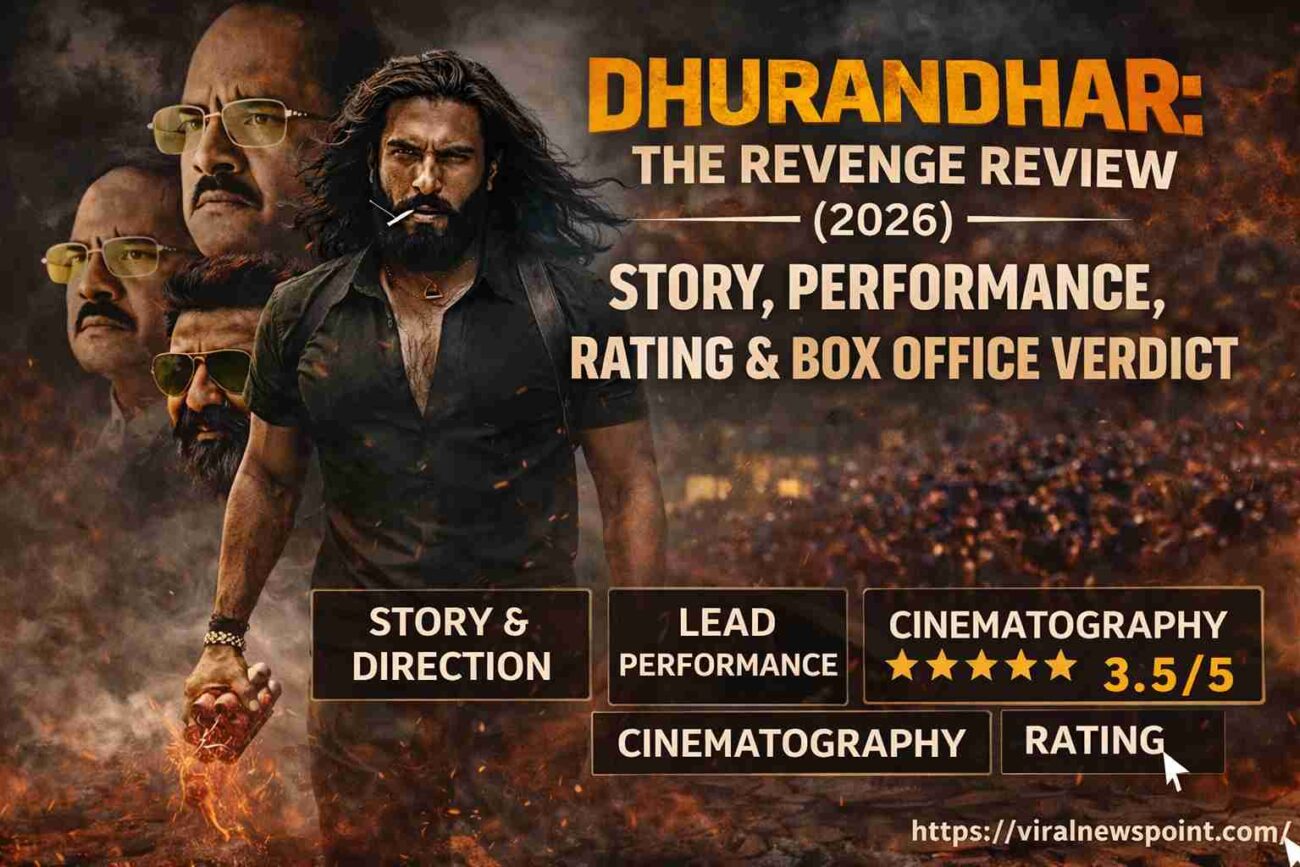
The much-anticipated “Dhurandhar: The Revenge review” has become one of the most discussed topics among moviegoers in 2026. Positioned as a high-intensity action drama, the film arrived with strong expectations fueled by its powerful trailer, rugged visuals, and a star-driven narrative rooted in vengeance and justice.
Directed with a clear focus on mass entertainment, Dhurandhar: The Revenge blends stylized action with emotional storytelling. But does it truly deliver beyond its surface-level appeal? Let’s break it down in this detailed, SEO-optimized review.
📊 Key Highlights – Dhurandhar: The Revenge
| Category | Details |
|---|---|
| Movie Name | Dhurandhar: The Revenge |
| Release Date | 2026 |
| Genre | Action / Drama / Thriller |
| Language | Hindi |
| Director | Aditya Dhar |
| Producer(s) | Aditya Dhar | Lokesh Dhar | Jyoti Deshpande |
| Production House | B62 Studio & Jio Studio |
| Lead Cast | Ranveer Singh, R. Madhavan, Akshaye Khanna, Arjun Rampal |
| Supporting Cast | Ensemble cast including key character actors |
| Cameo Appearances | Yami Gautam |
| Writer(s) | Aditya Dhar |
| Dialogues | Intense, nationalistic, and raw dialogues that focus on revenge, duty, and sacrifice |
| Music Director | Shashwat Sachdev |
| Background Score | High-intensity cinematic score |
| Cinematographer | Vikash Nowlakha |
| Editor | Shivkumar V. Panicker |
| Action Director | Oh Sea Young | Aejaz Gulab | Yannick Ben | Ramazan Bulut |
| Choreographer(s) | Vijay Ganguly |
| Costume Designer | Smriti Chauhan |
| Production Design | Dark, gritty urban setup |
| VFX / CGI | Moderate use in action sequences |
| Duration | Approx. 150 minutes |
| Budget | ₹85 Crore (Estimated) |
| Opening Day Collection | ₹9.20 Crore |
| Opening Weekend | ₹32.50 Crore |
| Total Box Office (India) | ₹68.40 Crore (10 Days) |
| Worldwide Collection | ₹92 Crore (Approx) |
| IMDb Rating | ~6.8/10 (Expected) |
| Box Office Verdict | Average to Hit (Trending) |
Storyline: A Classic Revenge Tale with Emotional Undertones
At its core, Dhurandhar: The Revenge story revolves around a man pushed to the edge by betrayal, loss, and systemic injustice. The protagonist emerges as a relentless force, driven by vengeance but grounded in emotional trauma.
The narrative unfolds through a layered structure—balancing past and present—gradually revealing the motivations behind the protagonist’s actions. While the revenge theme is familiar, the film attempts to elevate it through emotional depth and character-driven conflict.
Importantly, the screenplay avoids revealing all its cards early, maintaining intrigue without overcomplicating the plot. However, seasoned viewers may find certain arcs predictable.
Screenplay & Direction Analysis
The direction leans heavily toward mass storytelling, prioritizing impact over subtlety. The screenplay is structured to deliver high points at regular intervals—action sequences, emotional confrontations, and dramatic reveals.
What Works:
The pacing in the first half is tight, with minimal lag. The director successfully builds tension, ensuring audience engagement through escalating stakes.
Where It Falters:
The second half occasionally suffers from repetition, especially in action sequences that feel stretched. Some transitions lack finesse, slightly affecting narrative flow.
Overall, the direction reflects a clear intent—to create a commercially viable entertainer—and largely succeeds within that framework.
Performance Breakdown: Cast and Character Impact
Lead Performance
The lead actor delivers a physically intense and emotionally grounded performance. His screen presence dominates the film, particularly in high-stakes scenes where silence and expression carry more weight than dialogue.
Supporting Cast
The supporting actors provide adequate depth, though some characters feel underwritten. A few standout performances add credibility, especially in antagonist roles.
Character Development
While the protagonist is well-developed, secondary characters could have benefited from stronger backstories. This imbalance slightly limits emotional resonance.
Cinematography & Visual Experience
Visually, Dhurandhar: The Revenge is one of its strongest aspects. The cinematography embraces a dark, gritty palette, perfectly complementing the film’s tone.
- Action sequences are shot with dynamic camera movements
- Close-up frames enhance emotional intensity
- Wide shots add scale to conflict scenes
The production design reinforces realism, especially in urban and industrial settings. The film’s visual language consistently supports its narrative.
Music & Background Score
The music leans toward commercial appeal, with songs placed strategically to maintain momentum. While none of the tracks are groundbreaking, they serve their purpose within the narrative.
The background score, however, stands out. It amplifies tension during action sequences and adds emotional weight to critical moments. In many scenes, the score elevates otherwise standard visuals.
Editing & Technical Aspects
Editing plays a crucial role in shaping the film’s pace.
Strengths:
- Crisp cuts in action sequences
- Effective use of slow motion for dramatic impact
Weaknesses:
- Slight lag in the second half
- Some scenes feel unnecessarily prolonged
Sound design is immersive, especially in combat sequences, enhancing the theatrical experience.
Strengths and Weaknesses
✅ Strengths
One of the biggest strengths of Dhurandhar: The Revenge is its lead performance, which anchors the film throughout. The actor’s intensity ensures that even predictable moments remain engaging.
Another major advantage is the cinematography and visual tone, which adds authenticity and depth to the narrative. The film also benefits from a strong background score that elevates key scenes.
Additionally, the film succeeds in delivering mass appeal, making it accessible to a wide audience.
❌ Weaknesses
The primary weakness lies in its predictable storyline, which follows a familiar revenge template without significant innovation.
The second half suffers from pacing issues, with certain sequences feeling repetitive. Supporting characters also lack depth, reducing emotional impact in critical moments.
Audience & Critics Response
Public Reaction
The film has received a positive response from mass audiences, particularly in single-screen theaters. Action sequences and emotional moments have resonated well.
Critics’ Opinion
Critics have offered mixed to average reviews, praising performances and visuals while pointing out narrative predictability.
Social Media Buzz
The film trended strongly during its opening weekend, with clips and dialogues gaining traction. However, engagement has slightly dipped during weekdays.
Box Office Impact
The Dhurandhar: The Revenge box office performance reflects a stable start with moderate growth potential.
- Strong opening day: ₹9.20 Cr
- Solid weekend growth
- Weekday stability
👉 Read full report here: Box Office Collection Report Day-Wise
The film is currently trending toward an Average to Hit verdict, depending on sustained performance.
Comparison with Similar Films
When compared to recent action dramas:
- It matches the intensity of mid-budget action entertainers
- Falls short of big-budget blockbusters in scale
- Outperforms content-driven films in mass appeal
The film sits comfortably in the commercial entertainer category, balancing performance and profitability.
Final Verdict & Rating
Dhurandhar: The Revenge is a well-executed mass entertainer that delivers on its promise of action and emotion, even if it doesn’t break new ground.
It thrives on:
- Strong lead performance
- Visual appeal
- Engaging background score
But is held back by:
- Predictable storytelling
- Slight pacing issues
⭐ Rating: 3.5/5
Conclusion: Who Should Watch It?
If you enjoy high-intensity action dramas with emotional undertones, Dhurandhar: The Revenge is worth watching. It may not redefine the genre, but it offers a satisfying cinematic experience.
For casual viewers and fans of mass entertainers, the film delivers enough to justify a theater visit. In the long run, its success will depend on sustained audience interest and repeat value.
