
Educational and Cultural Movement of Ladakh (SECMOL)
Among Sonam Wangchuk’s most significant achievements, the Students’ Educational and Cultural Movement of Ladakh (SECMOL) stands at the foundation of his life’s work. Long before the Ice Stupa brought him international recognition, Wangchuk was working to address a problem that affected thousands of young people in Ladakh: an education system in which many students struggled to succeed.
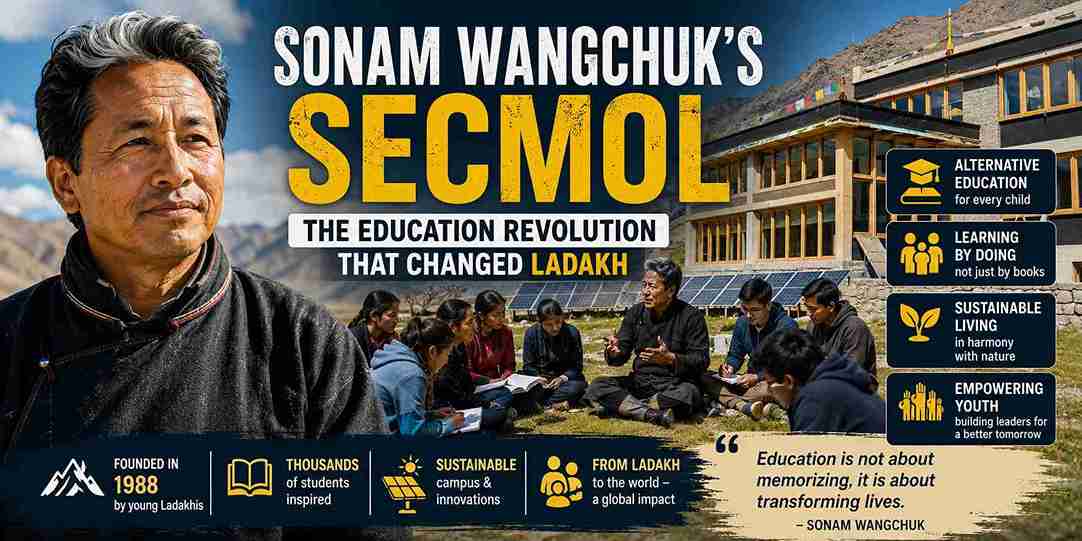
SECMOL was established in 1988 by a group of young Ladakhis, with Sonam Wangchuk becoming one of its most prominent founding figures. The movement was created to improve educational opportunities for Ladakhi students and explore alternatives to conventional methods of teaching and learning.
Its importance goes far beyond the establishment of a single school or campus. SECMOL became an experiment in rethinking what education could look like when students were given practical responsibility, local knowledge was valued, and learning extended beyond textbooks and examinations.
Why Was SECMOL Founded?
During the 1980s, Ladakh faced significant educational challenges. Many students struggled within the formal school system, and poor examination results became a serious concern.
The problem could easily have been interpreted as a failure of the students themselves.
Wangchuk and his colleagues approached the issue differently.
They questioned whether students were genuinely incapable of learning or whether the educational system was failing to provide an environment suited to their circumstances.
Several factors were important to this debate, including language barriers, teaching methods, limited local relevance and the gap between textbook knowledge and students’ everyday experiences.
SECMOL emerged from the belief that education should adapt more intelligently to the learners it serves.
The underlying question was simple but powerful:
What if students were not failing education, but the education system was failing some of its students?
That question would eventually influence much of Wangchuk’s later work.
What Does SECMOL Stand For?
SECMOL stands for the Students’ Educational and Cultural Movement of Ladakh.
The name itself reflects the organization’s broader purpose.
It was not conceived merely as an examination-coaching initiative. Its work developed around education, youth empowerment, cultural identity and practical learning.
Over time, SECMOL became particularly associated with students who had experienced difficulty within conventional schooling.
Instead of treating examination failure as the end of a student’s educational journey, the alternative model sought to create another opportunity to learn, develop confidence and acquire practical skills.
Sonam Wangchuk’s Role in SECMOL
Sonam Wangchuk was one of the young Ladakhis involved in establishing SECMOL in 1988.
His engineering background and interest in educational reform helped shape the organization’s practical approach to learning.
However, SECMOL should not be described as the achievement of one person alone.
Its development involved students, educators, community members, volunteers and other collaborators over many years.
Wangchuk nevertheless became one of the movement’s most recognizable figures and played a major role in developing and promoting its educational philosophy.
His work through SECMOL also established several ideas that would later appear repeatedly throughout his career:
- Learning by doing
- Solving real-world problems
- Adapting solutions to local conditions
- Giving young people meaningful responsibility
- Combining education with sustainability
- Questioning conventional systems when they produce poor outcomes
These principles later became visible in projects ranging from sustainable buildings to HIAL.
SECMOL’s Alternative Approach to Education
Traditional education often follows a relatively predictable structure.
Students attend classes, study textbooks, memorize information and take examinations.
SECMOL experimented with a different approach.
Students could participate directly in the functioning of their learning environment.
This meant that education was not limited to what happened during formal lessons.
Managing everyday activities could itself become part of the learning process.
Students could gain experience in areas such as organizational responsibility, communication, environmental management and practical problem-solving.
The broader philosophy was that young people learn not only by being told what to do but also by being trusted with genuine responsibilities.
A classroom can teach the theory of decision-making.
Running an actual activity teaches what happens when decisions have consequences.
This distinction became central to the experiential-learning model associated with SECMOL.
Learning by Doing
One of the defining characteristics of SECMOL is its emphasis on learning by doing.
Under this approach, practical activity is not treated as something separate from education.
It becomes part of education itself.
For example, a student involved in managing a campus system may encounter questions involving mathematics, science, communication or teamwork.
Instead of learning a concept only because it appears in a textbook, the student has an immediate reason to understand it.
The learning cycle becomes:
Problem → Question → Knowledge → Experiment → Result → Improvement
This approach can make abstract ideas more tangible.
A student does not simply learn that solar energy exists.
The student can observe how sunlight affects a building.
A student does not merely read about environmental responsibility.
The student can participate in managing resources.
A student does not only study teamwork.
The student experiences the consequences of working with other people.
This practical philosophy became one of the most recognizable features of Wangchuk’s educational work.
The SECMOL Campus
One of the strongest physical expressions of SECMOL’s philosophy is its campus near Leh.
The campus was designed not merely as a collection of classrooms but as a living educational environment.
Its operation incorporates ideas involving:
- Passive-solar architecture
- Renewable energy
- Environmental sustainability
- Local building techniques
- Resource management
- Student participation
The campus demonstrates how the physical environment of an educational institution can itself become a teaching tool.
Buildings can teach architecture.
Energy systems can teach sustainability.
Daily management can teach responsibility.
Community living can teach cooperation.
In this model, the campus is not simply where education happens.
The campus itself becomes part of the curriculum.
SECMOL and Sustainable Architecture
Ladakh presents an unusual architectural challenge.
Winters can be extremely cold, yet the region receives abundant sunlight.
Conventional buildings may require substantial heating during winter. Transporting fuel into a remote Himalayan region can also create economic and environmental costs.
SECMOL’s campus became associated with climate-responsive building practices, particularly passive-solar design.
The basic principle is to use the local environment intelligently.
Buildings can be designed to capture sunlight during the day and retain heat for longer periods through appropriate orientation, insulation, glazing and thermal mass.
The objective is not simply to install more heating equipment.
It is to design the building so that it requires less artificial heating in the first place.
This reflects a principle that later became central to Wangchuk’s broader work:
The environment does not always have to be treated as an obstacle. Sometimes it can become part of the solution.
Students as Participants, Not Just Recipients
Another important aspect of the SECMOL model is the idea of student participation.
In many conventional institutions, students primarily receive services.
Teachers teach them.
Administrators manage the institution.
Other employees maintain the facilities.
The student’s main responsibility is to attend classes and complete academic work.
SECMOL experimented with a more participatory model.
Students could take responsibility for aspects of campus life and contribute to the functioning of their community.
This approach attempts to develop skills that examinations may struggle to measure, including:
- Leadership
- Teamwork
- Communication
- Decision-making
- Accountability
- Problem-solving
- Self-confidence
The objective is not to eliminate academic learning.
It is to connect knowledge with responsibility.
SECMOL and Students Who Failed Conventional Exams
One of the most important parts of SECMOL’s story is its association with students who had struggled academically.
In a conventional system, repeated examination failure can create a powerful label.
A student may begin to believe that poor marks represent a permanent measure of intelligence.
SECMOL challenged this assumption.
Its educational philosophy suggested that performance can depend heavily on how, where and why a student is being taught.
A young person who struggles with textbook-based learning may demonstrate considerable ability when given practical responsibility.
Someone who performs poorly in a written examination may prove highly capable at solving real problems.
This does not mean examinations have no value.
It means examination results measure only certain forms of performance.
SECMOL’s work helped demonstrate that students can develop through educational environments that recognize a broader range of abilities.
The Cultural Dimension of SECMOL
The word “Cultural” in SECMOL’s name is significant.
Education does not happen in a vacuum.
Language, geography, traditions and local experience influence how students understand the world.
For Ladakhi students, an educational system disconnected from their immediate surroundings can create a gap between what they learn in school and the reality they experience outside it.
SECMOL’s broader philosophy sought to make education more connected with Ladakh’s social and environmental context.
This local relevance did not mean rejecting modern science or global knowledge.
Instead, it meant asking how education could connect universal knowledge with the realities of a specific place.
That principle would later become central to Wangchuk’s approach to innovation as well.
SECMOL and Operation New Hope
SECMOL’s educational work eventually contributed to a broader reform initiative known as Operation New Hope.
Launched in the 1990s, Operation New Hope sought to address problems affecting government schools in Ladakh through cooperation involving educational authorities, communities and civil society.
The initiative represented an important shift in scale.
SECMOL demonstrated alternative educational ideas within its own environment.
Operation New Hope attempted to influence the wider schooling system.
This progression illustrates an important difference between two kinds of change:
Alternative education creates a different model.
Systemic reform attempts to improve the larger system itself.
Wangchuk’s educational journey became associated with both.
How SECMOL Influenced Sonam Wangchuk’s Later Projects
SECMOL can be viewed as the seed from which many of Wangchuk’s later projects grew.
The subjects changed, but the underlying method remained remarkably consistent.
At SECMOL, the problem was education.
With passive-solar architecture, the problem was winter heating.
With the Ice Stupa, the problem was seasonal water scarcity.
With HIAL, the problem was the gap between higher education and real-world needs.
In each case, the approach followed a similar pattern:
Understand the local problem.
Question the conventional solution.
Identify resources already available.
Experiment with an alternative.
Learn from the results.
This makes SECMOL important not only as an educational organization but also as the intellectual foundation of Wangchuk’s wider career.
What Has SECMOL Achieved?
The significance of SECMOL can be understood across several areas.
Creating an Alternative Path for Students
SECMOL demonstrated that students who struggle in conventional education can benefit from a different learning environment.
Promoting Experiential Education
The movement helped popularize an approach in which practical responsibility becomes part of the educational process.
Connecting Education With Local Reality
Its philosophy emphasized the importance of making learning relevant to Ladakh’s geography, culture and environmental conditions.
Demonstrating Sustainable Campus Living
The SECMOL campus became an example of how educational institutions can incorporate climate-responsive architecture and sustainable practices.
Influencing Wider Educational Reform
The ideas associated with SECMOL contributed to broader conversations and initiatives concerning school reform in Ladakh.
Inspiring Later Educational Projects
The experiential-learning principles developed through Wangchuk’s earlier work later influenced the vision associated with the Himalayan Institute of Alternatives, Ladakh.
Why Is SECMOL One of Sonam Wangchuk’s Greatest Achievements?
The Ice Stupa may be Sonam Wangchuk’s most visually recognizable innovation, but SECMOL represents a much longer chapter of his life.
It was established decades before his international fame.
It addressed a problem that directly affected young people.
It provided a space for educational experimentation.
It connected learning with sustainability.
And it helped shape the philosophy that would influence many of his later projects.
Perhaps its most important contribution was changing the question asked about struggling students.
Instead of asking:
“Why is this student a failure?”
SECMOL’s philosophy encouraged another question:
“What kind of environment would allow this student to succeed?”
That shift may appear small on paper.
In practice, it changes where responsibility is placed and opens the door to entirely different ways of teaching.
Frequently Asked Questions (FAQs)
What is SECMOL?
SECMOL is the Students’ Educational and Cultural Movement of Ladakh, an organization established in 1988 to work on education and youth-related challenges in Ladakh.
What does SECMOL stand for?
SECMOL stands for Students’ Educational and Cultural Movement of Ladakh.
Who founded SECMOL?
SECMOL was established by a group of young Ladakhis in 1988. Sonam Wangchuk was among its prominent founding figures.
Did Sonam Wangchuk found SECMOL alone?
No. SECMOL was a collaborative initiative and should not be described as the work of Wangchuk alone.
Why was SECMOL started?
It was established in response to educational challenges facing students in Ladakh and sought to explore more locally relevant and practical approaches to learning.
Where is the SECMOL campus?
The SECMOL campus is located near Leh in Ladakh.
What is special about the SECMOL education model?
Its approach emphasizes experiential learning, student responsibility, practical problem-solving, sustainability and education connected with local conditions.
Is SECMOL only for failed students?
SECMOL became particularly known for working with students who had struggled within conventional education, but its broader significance lies in its alternative educational philosophy and youth-focused work.
Is SECMOL a school?
SECMOL is better understood as an educational movement and organization rather than simply a conventional school.
What is the connection between SECMOL and Operation New Hope?
SECMOL was involved in the broader educational reform environment from which Operation New Hope developed, with the initiative seeking improvements in government schooling through greater community participation and institutional cooperation.
What is Sonam Wangchuk’s role in SECMOL?
Wangchuk was among SECMOL’s founding figures and became closely associated with developing and promoting its experiential and locally relevant approach to education.
Conclusion
The Students’ Educational and Cultural Movement of Ladakh is one of the most important achievements in Sonam Wangchuk’s career.
Established in 1988, SECMOL challenged conventional assumptions about students who struggled academically and explored an educational model based on practical learning, responsibility and local relevance.
Its influence extended beyond classroom teaching.
The sustainable campus demonstrated how architecture and environmental responsibility could become part of education itself. Student participation turned everyday institutional life into a learning experience. The movement’s ideas also contributed to wider discussions about educational reform in Ladakh.
Most importantly, SECMOL established a pattern that can be seen throughout Wangchuk’s later work.
Find the real problem.
Question the existing system.
Design for local conditions.
Experiment in the real world.
And judge people by what they can become, not simply by the examination results they received in the past.
For understanding Sonam Wangchuk’s achievements, SECMOL is therefore not merely one project on a long list.
It is where much of the philosophy behind his life’s work began.
