
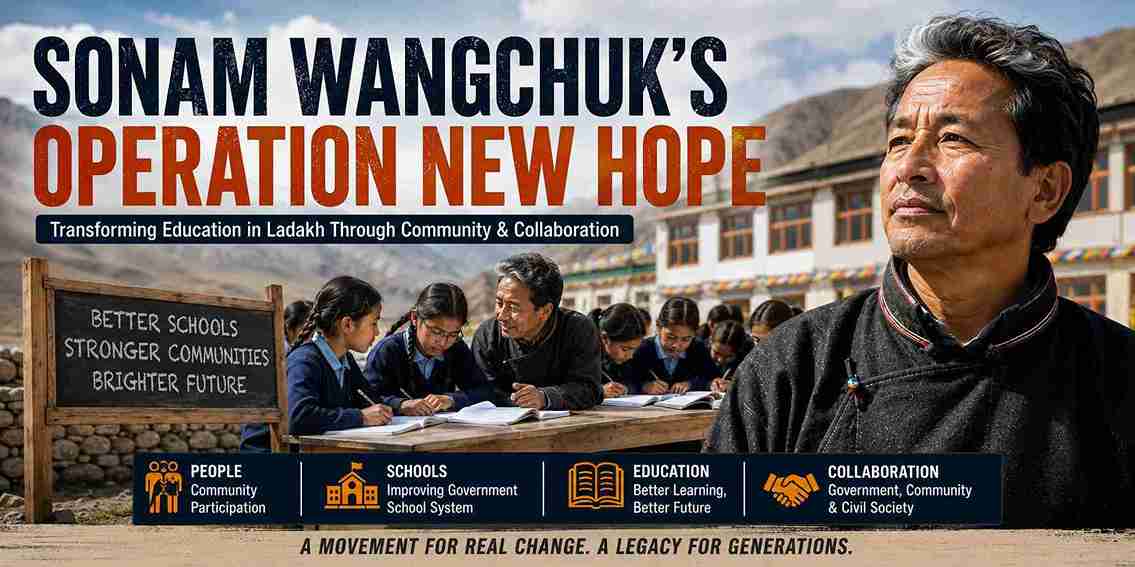
Sonam Wangchuk Operation New Hope: Long before Sonam Wangchuk became internationally known for the Ice Stupa, he was involved in a quieter but potentially more consequential experiment: changing how government schools worked in Ladakh.
That effort became known as Operation New Hope, commonly associated with a reform partnership launched in the mid-1990s involving the Students’ Educational and Cultural Movement of Ladakh (SECMOL), government education authorities and local communities. Wangchuk is widely described as instrumental in its launch, following earlier school-reform experiments associated with SECMOL.
Operation New Hope was significant because it attempted to move beyond helping individual students after they had struggled in school. Instead, it asked a more fundamental question:
Can the education system itself be changed so that fewer children fail in the first place?
That question turned an alternative-education movement into a wider attempt at systemic reform.
What Is Operation New Hope?
Operation New Hope, often shortened to ONH, was an educational reform initiative developed to improve government schooling in Ladakh.
Its basic model brought together three important groups:
Government + Local Communities + Civil Society
Rather than treating education as the responsibility of teachers and government departments alone, the initiative sought greater participation from parents, villages and organizations working in education.
Sonam Wangchuk and SECMOL played an important role in developing and promoting this approach.
According to widely documented accounts of Wangchuk’s career, Operation New Hope emerged after SECMOL experimented with school reforms, including work connected with a government high school at Saspol/Suspol. The larger initiative was then developed in collaboration with the education department and village communities.
Its ambition was larger than running one successful alternative school.
The goal was to improve the existing government education system.
Operation New Hope at a Glance
| Detail | Information |
|---|---|
| Initiative | Operation New Hope |
| Common abbreviation | ONH |
| Associated with | SECMOL and Sonam Wangchuk |
| Launch period | Commonly dated to 1994 |
| Location | Ladakh |
| Main field | School education reform |
| Core approach | Government-community-civil society collaboration |
| Major focus | Improving government schools and learning outcomes |
| Broader philosophy | Reform the system rather than only helping students after failure |
The exact implementation of Operation New Hope evolved over time, so it is better understood as a reform movement and collaborative programme rather than a single isolated project.
Why Was Operation New Hope Started?
To understand Operation New Hope, we first need to understand the educational problem that Sonam Wangchuk and his colleagues believed they were confronting.
During SECMOL’s early years, the organization worked closely with young people who had struggled in the conventional education system.
This created an uncomfortable realization.
Helping students after they had failed was valuable, but it did not address the source of the problem.
Imagine a factory producing defective products.
You could build an excellent repair centre at the end of the production line. The repair centre might save many products.
But if the production process itself remained unchanged, damaged products would continue arriving indefinitely.
The same logic could be applied to education.
SECMOL could help students rebuild confidence and continue learning after academic failure.
But what about the next generation?
And the generation after that?
The deeper challenge was to examine why so many children were struggling within the school system in the first place.
That realization helped shift attention from educational rehabilitation toward educational reform.
A 2026 retrospective on Wangchuk’s work describes this progression as a key reason SECMOL moved toward Operation New Hope, which sought broader reform of primary education in Ladakh.
The Problem With Ladakh’s Education System
Ladakh presents educational conditions that differ significantly from many other parts of India.
Its geography is remote.
Settlements can be widely dispersed.
Winters are severe.
Communities have their own languages and cultural traditions.
Yet educational systems are often built around standardized structures.
This can create a gap between:
The language children understand
and
The language used to teach them.
Between:
The world described in textbooks
and
The world children experience around them.
Between:
What examinations measure
and
What students are actually capable of doing.
Wangchuk’s own educational philosophy developed partly from his experiences with language and schooling.
The broader reform argument associated with SECMOL was that poor educational outcomes should not automatically be interpreted as proof that Ladakhi students lacked ability.
The system itself also needed examination.
From SECMOL to Operation New Hope
SECMOL was established in 1988 by a group of young Ladakhis, with Wangchuk becoming one of its best-known founding figures.
Its early work demonstrated an alternative approach to education.
Students who had struggled in conventional schooling could learn through a more practical and participatory environment.
But there was an obvious limitation.
An alternative campus could serve only a limited number of students.
Government schools, meanwhile, served children across the region.
If meaningful change was to reach a larger population, reform had to enter the mainstream education system.
This was the conceptual leap behind Operation New Hope.
SECMOL asked:
How can we help students who have struggled?
Operation New Hope asked:
How can we improve the system that is producing poor outcomes?
The two initiatives were therefore connected, but they were not identical.
SECMOL provided a space for alternative education and experimentation.
Operation New Hope attempted to take the reform conversation into government schooling.
The Three Pillars of Operation New Hope
One of the defining features of Operation New Hope was collaboration.
1. Government
Government participation was essential because public schools operate within an administrative system.
Long-term reform requires engagement with:
- Education departments
- Teachers
- School administrators
- Curriculum implementation
- Training systems
- Public resources
An NGO can experiment independently.
Changing a government school system requires institutional cooperation.
2. Local Communities
Parents and villages were another crucial part of the model.
A school may officially belong to the government, but it exists within a community.
If parents feel disconnected from the institution, accountability can weaken.
Greater community involvement can help local people understand what is happening inside schools and participate more actively in children’s education.
3. Civil Society
Organizations such as SECMOL could contribute ideas, experimentation, training and coordination.
This created a triangular model:
- Government provides institutional reach.
- Communities provide local participation.
- Civil society provides innovation and facilitation.
Operation New Hope attempted to make these three forces work together rather than operate in separate worlds.
What Were the Main Objectives of Operation New Hope?
The broader objectives associated with the initiative can be understood through several interconnected areas.
Improving the Quality of Government Schools
The central goal was not simply to increase school enrollment.
Children needed to actually learn.
That required attention to what happened inside classrooms and how schools functioned.
Making Education More Child-Friendly
Education becomes difficult when students cannot meaningfully connect with what they are being taught.
A more child-friendly system attempts to consider children’s language, background and learning needs.
Increasing Community Participation
Operation New Hope sought to reduce the distance between schools and the communities they served.
Parents were not supposed to remain silent spectators.
Improving Teacher Support
Teachers are the point where education policy becomes classroom reality.
Any serious school reform therefore needs to consider teacher preparation, resources and teaching methods.
Addressing Language Barriers
Language has historically been an important issue in Ladakh’s educational experience.
Children learn more effectively when early education connects with a language they understand.
Reducing School Failure
Ultimately, the initiative sought better educational outcomes.
The objective was not to become better at rescuing children after failure.
It was to prevent avoidable failure.
Community Participation: A Key Part of the Model
One of the most important ideas behind Operation New Hope was that education should not be outsourced entirely to the government.
Parents have a stake.
Villages have a stake.
Teachers have a stake.
Students have the largest stake of all.
When communities become more involved, several things can potentially change.
Parents can ask questions about school functioning.
Teachers may receive greater local support.
School problems can become visible sooner.
Communities can contribute to solutions.
Most importantly, education becomes something a village participates in rather than a distant government service delivered to it.
This philosophy fits naturally with Wangchuk’s broader approach to development.
Many of his projects attempt to turn people affected by a problem into participants in solving it.
The Role of Language in Educational Reform
Language is one of the most powerful but easily overlooked factors in education.
A child can understand a concept and still appear academically weak if the concept is presented in an unfamiliar language.
This creates a dangerous possibility.
A language problem can be mistaken for an intelligence problem.
Wangchuk’s own childhood experiences made this issue particularly relevant to his educational philosophy.
Operation New Hope’s broader reform environment placed importance on making education more accessible and locally meaningful.
The principle is not that children should avoid learning additional languages.
Multilingual ability can be enormously valuable.
The question is when and how languages are introduced.
A strong conceptual foundation in a familiar language can help children understand ideas before they are asked to navigate additional linguistic complexity.
Teacher Training and Educational Reform
Changing textbooks alone does not transform education.
Neither does changing government policy on paper.
The actual learning experience is created largely through interactions between students and teachers.
This makes teacher development central to educational reform.
The reform efforts associated with Operation New Hope included a broader emphasis on improving teaching practices and making classroom learning more effective.
Teachers themselves also need support.
A teacher working in a remote school may face challenges involving:
- Limited resources
- Difficult geography
- Multilingual classrooms
- Administrative responsibilities
- Inadequate training opportunities
Blaming teachers without addressing these structural conditions simply moves the problem from students to educators.
A sustainable reform model must support both.
Why Operation New Hope Was Different From a Charity Project
Operation New Hope is best understood as an attempt at systemic change.
Consider the difference.
Charity Model
A student lacks books.
You give the student books.
The immediate problem is addressed.
Institutional Improvement
A school lacks books.
You improve the school’s access to learning resources.
More students benefit.
Systemic Reform
You investigate why schools repeatedly lack resources, participation or effective teaching and attempt to change the mechanisms producing those outcomes.
Operation New Hope moved toward the third category.
This made the initiative much more complicated.
It is relatively easy to demonstrate a successful small project.
Changing a public system requires negotiation, cooperation, patience and the ability to survive institutional resistance.
Did Operation New Hope Succeed?
Operation New Hope is widely credited with contributing to substantial improvements in Ladakh’s education landscape, and later accounts describe its ideas as influencing regional education policy and priorities.
However, educational success should be evaluated carefully.
Statistics commonly repeated in profiles of Wangchuk often claim dramatic improvements in school examination pass rates over time.
Such figures can be useful, but they should be tied to a specific year, examination, geographic area and original government dataset before being presented as definitive.
Education outcomes can change for many reasons, including:
- Teaching reforms
- Curriculum changes
- Examination patterns
- Student demographics
- Government investment
- Community participation
Therefore, it would be too simplistic to attribute every improvement in Ladakh’s education outcomes exclusively to one person or one programme.
A stronger conclusion is that Operation New Hope helped create a collaborative reform movement that changed the conversation about public education in Ladakh.
Sonam Wangchuk’s Role in Operation New Hope
Sonam Wangchuk was instrumental in the development and launch of Operation New Hope through his work with SECMOL.
His role was particularly significant because he connected two worlds.
One was the experimental environment of alternative education.
The other was the institutional world of government schools.
His broader contribution was helping demonstrate that educational reform could involve more than changing a syllabus.
It could involve:
- Community participation
- Language
- Teacher support
- Local relevance
- Administrative cooperation
- Alternative teaching methods
At the same time, Operation New Hope should not be presented as Wangchuk’s achievement alone.
The initiative depended on collaboration among government officials, educators, village communities, parents, civil-society organizations and students.
That collaborative nature is precisely what made the model distinctive.
SECMOL vs Operation New Hope
The two are closely connected but should not be confused.
| SECMOL | Operation New Hope |
|---|---|
| Established in 1988 | Commonly dated to 1994 |
| Educational movement and organization | Broader school-reform initiative |
| Known for alternative education | Focused on improving mainstream government schooling |
| Direct work with young people | Multi-stakeholder reform approach |
| Demonstrated alternative learning models | Attempted wider systemic change |
| Associated strongly with experiential learning | Associated strongly with government-community collaboration |
A simple way to understand the relationship is:
SECMOL was the laboratory. Operation New Hope attempted to take lessons from reform experiments into the larger system.
How Operation New Hope Influenced Wangchuk’s Later Work
Operation New Hope reveals a pattern that appears repeatedly throughout Sonam Wangchuk’s career.
He often begins with a local problem.
Then he questions the assumptions surrounding it.
Finally, he attempts to redesign the system around local conditions.
With education, the question was:
Why are students failing?
With the Ice Stupa:
Why is water available when farmers do not need it and scarce when they do?
With passive-solar architecture:
Why burn enormous amounts of fuel when Ladakh receives abundant winter sunlight?
With alternative higher education:
Why should students spend years studying problems without participating in solving them?
Operation New Hope therefore represents more than one education programme.
It is an early example of Wangchuk’s broader problem-solving philosophy.
Why Operation New Hope Is One of Sonam Wangchuk’s Major Achievements
Operation New Hope deserves a prominent place in any detailed account of Sonam Wangchuk’s achievements because it represents his attempt to move from helping individuals to changing systems.
SECMOL demonstrated that alternative education could work differently.
Operation New Hope asked whether mainstream education could also change.
That distinction matters.
An exceptional alternative school can transform hundreds of lives.
A successful public-school reform can potentially affect generations.
Operation New Hope also challenged one of the easiest explanations for poor educational outcomes: blaming children.
Its underlying philosophy encouraged educators and policymakers to examine the entire ecosystem around a struggling student.
The child.
The teacher.
The language.
The textbook.
The school.
The parents.
The administration.
The community.
Education failure, in this view, is rarely a one-person story.
Frequently Asked Questions (FAQs)
What is Operation New Hope?
Operation New Hope is an educational reform initiative associated with SECMOL, Sonam Wangchuk, government education authorities and local communities in Ladakh.
When was Operation New Hope launched?
The initiative is commonly dated to 1994, following earlier school-reform experiments associated with SECMOL.
Who started Operation New Hope?
Sonam Wangchuk and SECMOL were instrumental in its development, but it was designed as a collaborative initiative involving government authorities and village communities rather than a one-person project.
Why was Operation New Hope started?
It was developed to address systemic problems affecting government schooling and improve educational outcomes rather than only helping students after they had already struggled or failed.
What was Sonam Wangchuk’s role in Operation New Hope?
Wangchuk was a major figure in the reform effort through SECMOL and is widely credited with being instrumental in its launch.
Is Operation New Hope the same as SECMOL?
No. SECMOL is an educational movement and organization established in 1988. Operation New Hope was a broader collaborative effort aimed at reforming government schooling.
What were the main features of Operation New Hope?
Its broader model emphasized cooperation among government, communities and civil society, alongside efforts to improve teaching, participation and the relevance of education.
Was Operation New Hope successful?
The initiative is widely credited with contributing to education reform in Ladakh and influencing the region’s educational priorities. Precise claims about improvements in pass percentages, however, should be supported by original year-specific education data.
Why is Operation New Hope important?
It represents an attempt to create systemic educational change rather than operating only as an alternative school or remedial programme.
Conclusion
Operation New Hope occupies an important place in Sonam Wangchuk’s journey as an education reformer.
The initiative grew from a simple but uncomfortable realization.
Helping students after they failed was not enough.
If large numbers of children repeatedly struggled, the education system itself needed to be examined.
Operation New Hope therefore sought to bring government, communities and civil society into a shared reform process.
Its importance lies not merely in one programme, one school or one statistic.
It introduced a different way of thinking about educational responsibility.
When a child fails, the easiest response is to ask what is wrong with the child.
Operation New Hope encouraged another question:
What can the school, community and education system do differently?
That shift from repairing individual outcomes to redesigning the system is what makes Operation New Hope one of the most important educational achievements associated with Sonam Wangchuk.
It also provides a bridge between two major chapters of his work.
SECMOL showed that education could be done differently.
Operation New Hope attempted to prove that the wider system could change too.
For readers following Sonam Wangchuk’s achievements chronologically, the next logical chapter is his work on Ladags Melong, the magazine he founded and edited, followed by his contributions to passive-solar architecture and sustainable school buildings.
