
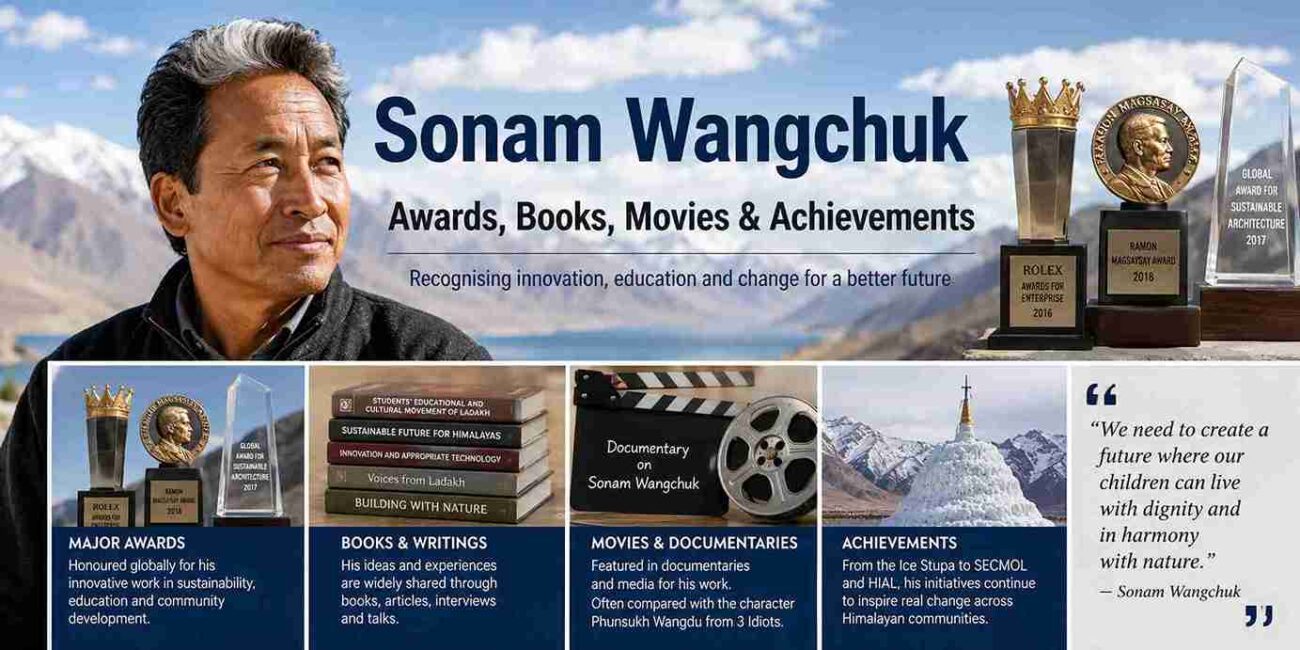
Sonam Wangchuk awards: Sonam Wangchuk has received national and international recognition for his work in education, sustainable development, architecture and water innovation. His best-known honours include the Rolex Award for Enterprise, the Global Award for Sustainable Architecture and the prestigious Ramon Magsaysay Award.
However, searches for Sonam Wangchuk’s awards often produce long lists copied across biography websites without explaining why he received them. Similar confusion surrounds searches for “Sonam Wangchuk books” and “Sonam Wangchuk movies,” where books written by people with similar names and films merely associated with him can be incorrectly presented as his own work.
This detailed guide brings these topics together while making an important distinction between verified major awards, older reported recognitions, books actually authored by Wangchuk, books about him, documentaries and his widely discussed connection with the Bollywood film 3 Idiots.

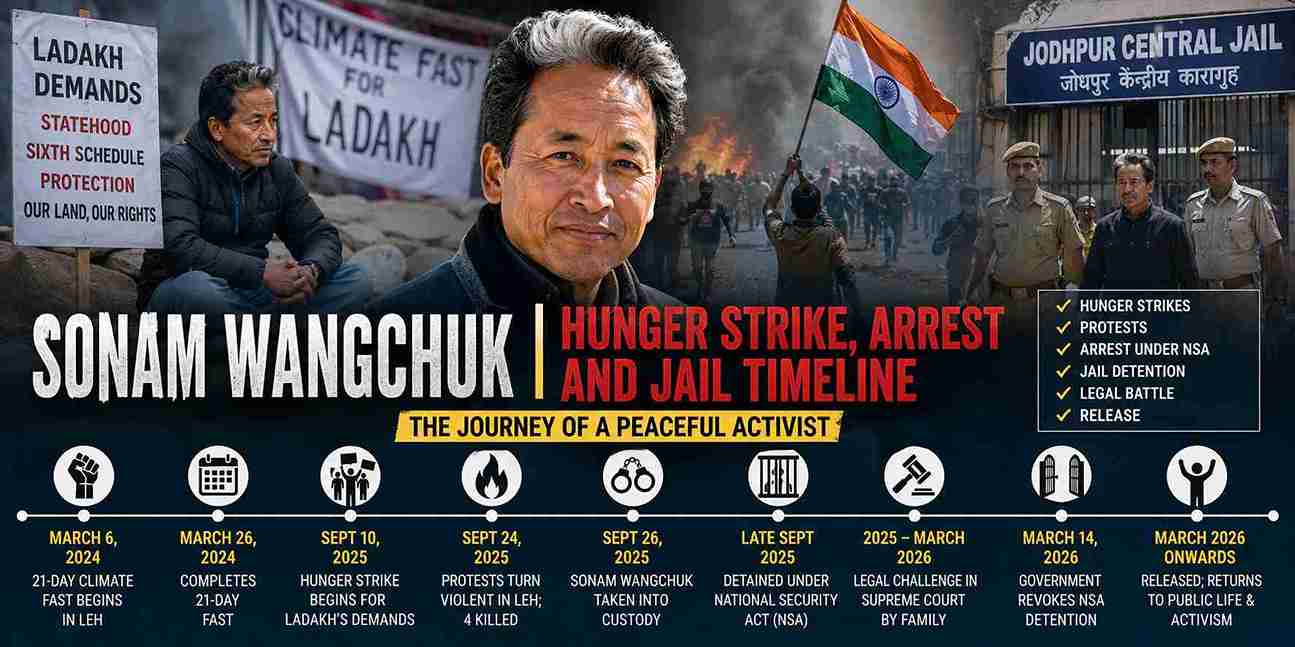
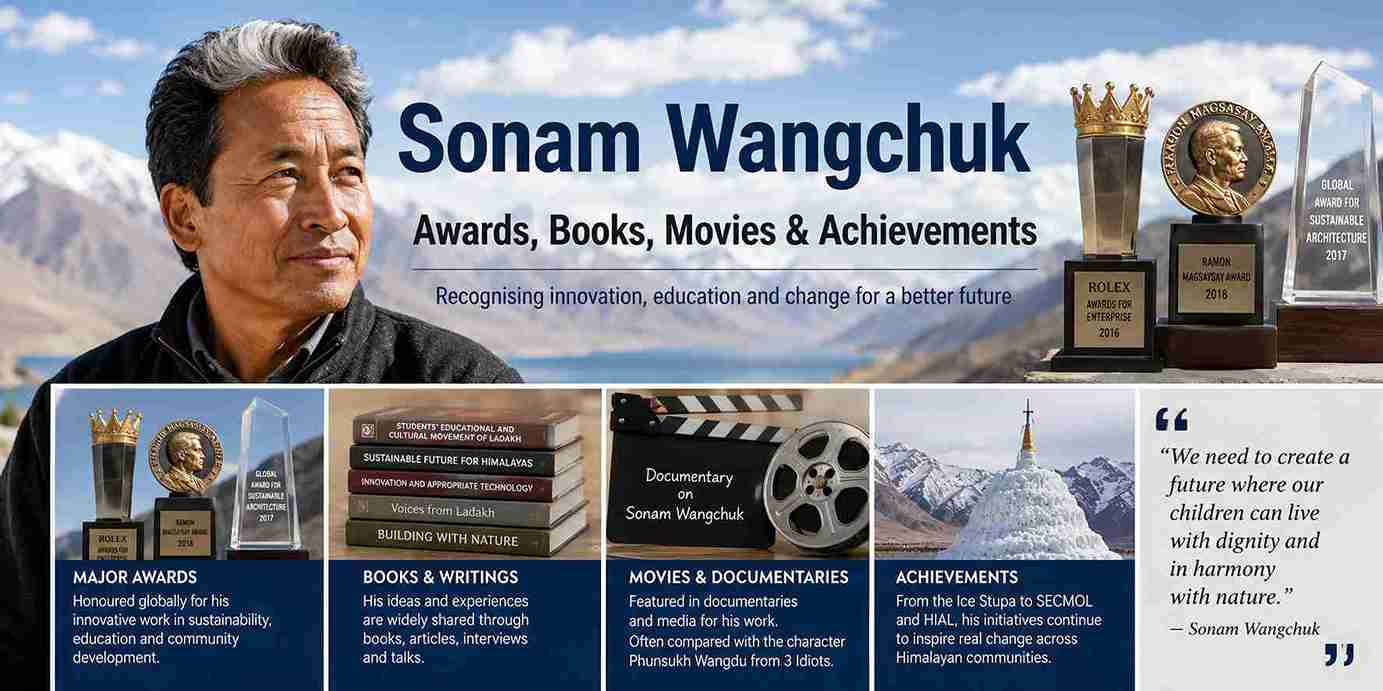
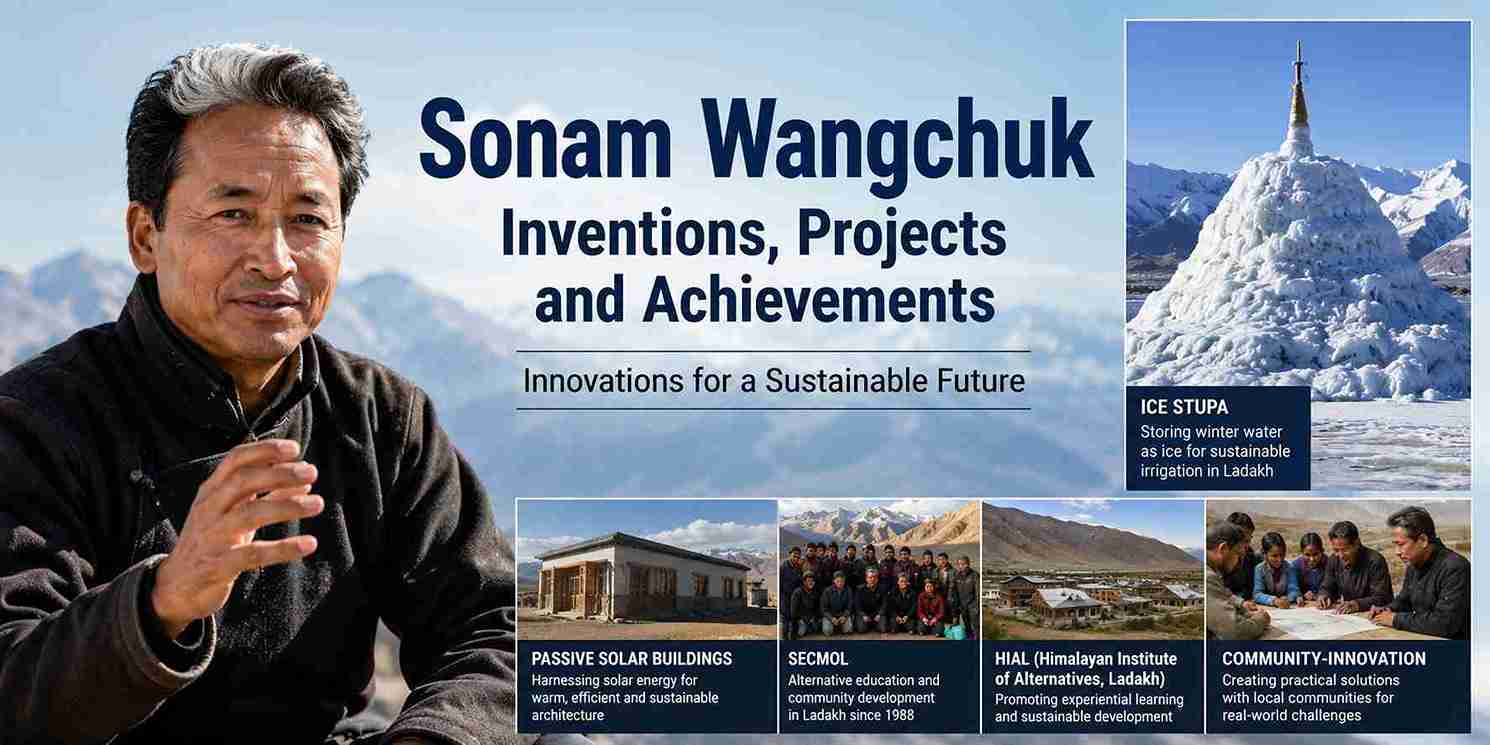
Sonam Wangchuk Awards List
The following table provides a working chronological overview of major awards and recognitions associated with Sonam Wangchuk.
| Year | Award or Recognition | Main Area |
|---|---|---|
| 1996 | Governor’s Medal, Jammu and Kashmir | Education and public contribution |
| 2001 | The Week Man of the Year | Social contribution |
| 2002 | Ashoka Fellowship | Social entrepreneurship |
| 2004 | Ashoka Fellowship for Innovation | Education |
| 2005 | Green Teacher Award | Environmental education |
| 2008 | CNN-IBN Real Heroes recognition | Education and social impact |
| 2016 | Rolex Award for Enterprise | Ice Stupa project |
| 2017 | Global Award for Sustainable Architecture | Sustainable architecture |
| 2017 | State-level environmental recognition in Jammu and Kashmir | Environmental contribution |
| 2018 | Ramon Magsaysay Award | Education and community innovation |
| 2018 onward | Various institutional and honorary recognitions | Education, innovation and sustainability |
Older award lists vary considerably between secondary sources. Some entries may refer to the same recognition under slightly different names, while others require confirmation from the original awarding institution.
For that reason, the most significant internationally documented awards deserve closer examination.
Rolex Award for Enterprise 2016
One of the defining international recognitions in Sonam Wangchuk’s career came in 2016, when he was selected as a Rolex Awards for Enterprise Laureate.
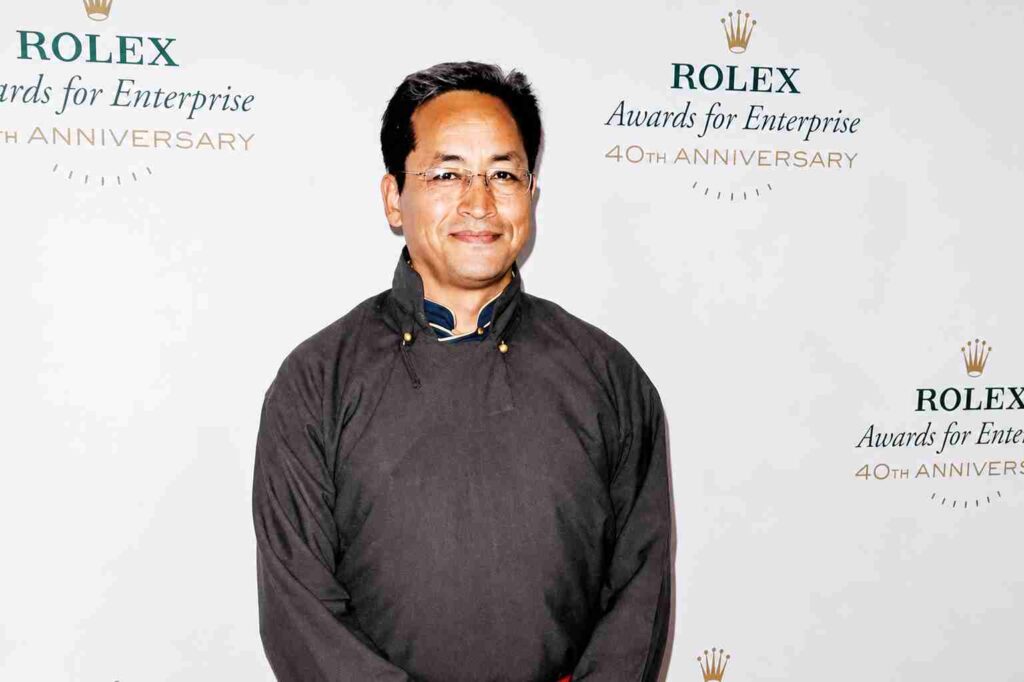
The recognition was connected with his work on the Ice Stupa project.
The Ice Stupa was developed to address a seasonal problem affecting agricultural communities in cold mountain regions such as Ladakh.
Water can be relatively available during winter, when agricultural demand is low, but scarce during early spring, when farmers need it.
Wangchuk’s approach involved storing some winter water in the form of large artificial ice structures.
Water is carried from a higher elevation through pipes. The difference in height creates pressure, allowing the water to spray into freezing air. As the droplets freeze, a large cone-shaped mass of ice develops.
When temperatures rise, the ice gradually melts.
The Rolex Award helped bring international attention to this approach and supported wider ambitions surrounding artificial ice reservoirs and water conservation.
The recognition was significant for another reason.
Before the Ice Stupa gained international attention, Wangchuk had already spent decades working in education reform in Ladakh.
The Rolex Award introduced his engineering and environmental work to a much larger global audience.
Why Did Sonam Wangchuk Receive the Rolex Award?
Wangchuk received the recognition for the Ice Stupa project and its potential application to seasonal water challenges in Ladakh.
The project stood out because it combined:
- A clearly defined local problem
- Simple physical principles
- The natural freezing conditions of winter
- Gravity-driven water pressure where terrain permits
- Potential agricultural applications
- Community participation
The project also represented the broader philosophy behind much of Wangchuk’s work: rather than importing a standard solution, design around the environment in which the problem actually exists.
Global Award for Sustainable Architecture 2017
In 2017, Sonam Wangchuk received recognition through the Global Award for Sustainable Architecture.
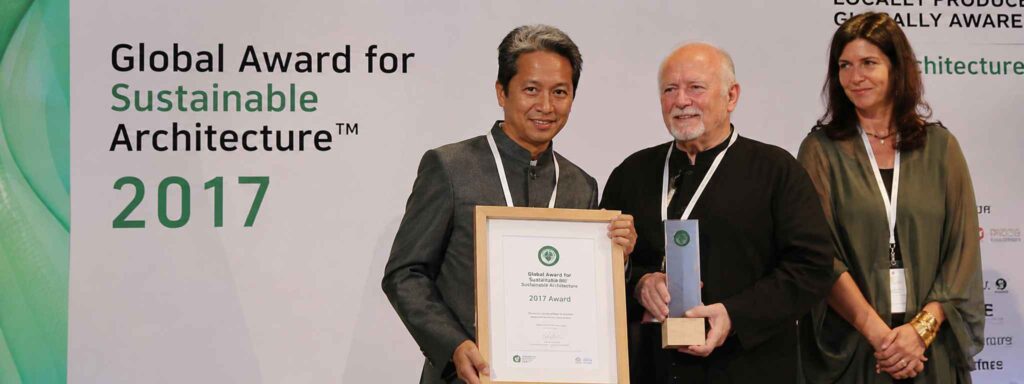
This honour reflected another major area of his work: climate-responsive building design.
Ladakh experiences extremely cold winters while also receiving strong sunlight.
This combination creates an opportunity for passive-solar architecture.
Buildings can be designed to capture solar heat during the day and retain that warmth through appropriate insulation, orientation, glazing and thermal mass.
Wangchuk’s educational work had already incorporated such ideas through sustainable campus environments.
The architectural recognition therefore acknowledged a body of work broader than the Ice Stupa alone.
It highlighted the idea that sustainable architecture should respond intelligently to local climate instead of forcing the same building model into every environment.
Ramon Magsaysay Award 2018
The Ramon Magsaysay Award, which Sonam Wangchuk received in 2018, is arguably the most prestigious recognition associated with his career.
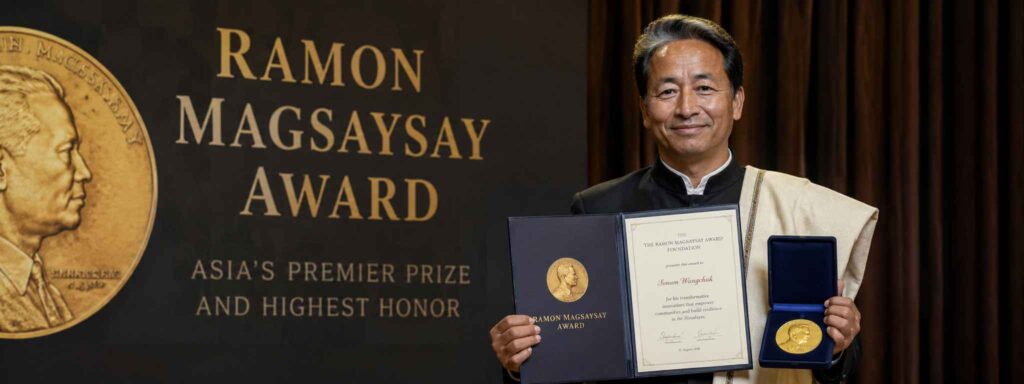
The award is one of Asia’s best-known honours for public service and leadership.
Wangchuk was recognized for his work in educational reform and his practical approach to improving opportunities for young people in Ladakh.
His journey in education had begun decades earlier.
As an engineering student, Wangchuk became aware of the difficulties faced by students from Ladakh within the conventional education system.
This eventually contributed to the creation of the Students’ Educational and Cultural Movement of Ladakh, or SECMOL, in 1988.
SECMOL and related reform efforts challenged the idea that poor examination results necessarily reflected a lack of intelligence among students.
Instead, Wangchuk and his colleagues questioned whether language barriers, teaching methods and a lack of local relevance were contributing to educational failure.
The Ramon Magsaysay Award recognized this larger journey.
It was therefore not simply an award for one invention.
It reflected decades of work connecting education, community participation and practical problem-solving.
Why Is the Ramon Magsaysay Award Important?
The award marked a significant moment in Wangchuk’s international recognition because it brought attention back to the foundation of his career: education.
By 2018, much of the global media attention surrounding Wangchuk focused on Ice Stupas.
The Magsaysay recognition helped highlight the fact that his work had begun much earlier and extended far beyond water technology.
It connected several chapters of his career:
Education reform
↓
SECMOL
↓
Community participation
↓
Experiential learning
↓
Sustainable innovation
↓
Alternative higher education
This broader context is essential for understanding why Wangchuk became internationally recognized.
Ashoka Fellowship
Sonam Wangchuk has also been associated with the Ashoka Fellowship, an international network that recognizes social entrepreneurs working on systemic problems.
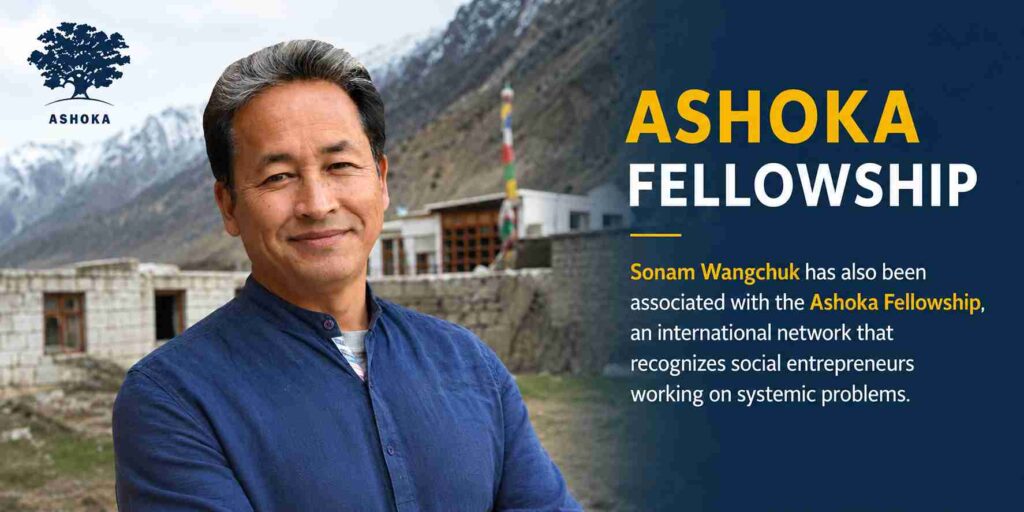
The fellowship fits naturally within the educational-reform phase of his career.
SECMOL was not designed merely to help individual students pass examinations.
Its broader work attempted to address structural problems in education.
This distinction between helping individuals and changing systems is central to the concept of social entrepreneurship.
However, online biographies provide inconsistent years and descriptions for Wangchuk’s Ashoka recognition.
Some sources list 2002, while others repeat differently worded entries in later years.
Therefore, the exact fellowship year should be confirmed through Ashoka’s own historical profile before publication rather than listing multiple versions as separate awards.
Governor’s Medal and Early Recognition
A Governor’s Medal from the Jammu and Kashmir government, commonly dated to 1996, appears frequently in published lists of Sonam Wangchuk’s awards.
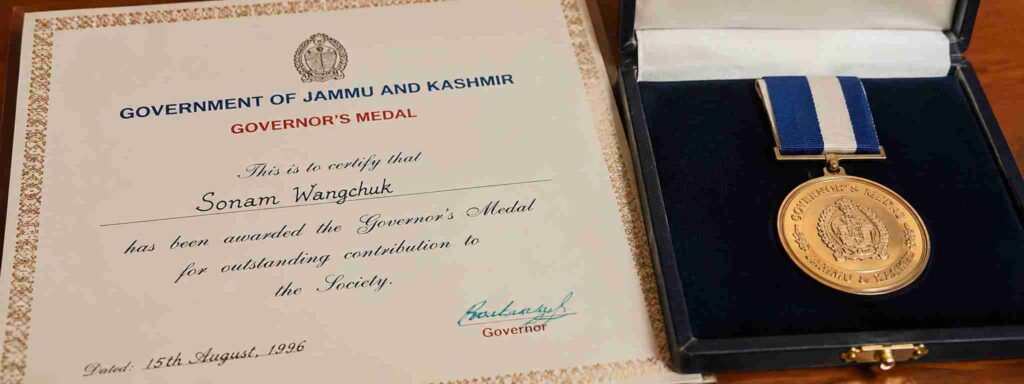
This would place the recognition relatively early in his career, during the period when his work was primarily associated with education reform.
However, older awards can be difficult to verify through surviving online primary records.
The recognition can be included when supported by credible biographical profiles, but it should not be given an invented citation or overly specific explanation without documentary evidence.
This is a useful editorial principle for the entire awards list:
A shorter verified list is more valuable than a longer copied list.
Green Teacher Award
A Green Teacher Award, commonly dated to 2005, is also frequently associated with Wangchuk.
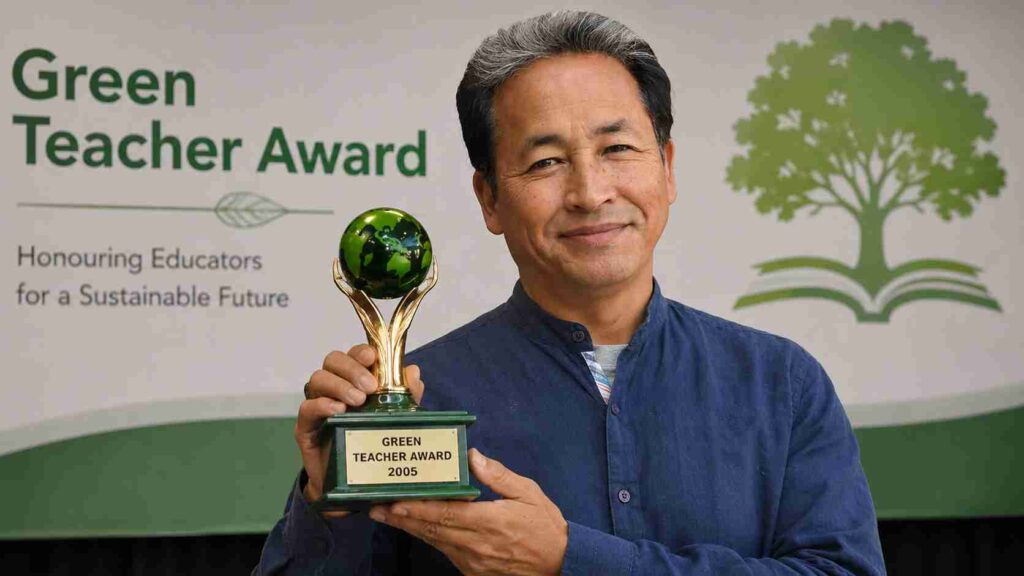
The recognition appears consistent with his work combining education and environmental sustainability.
By this period, sustainable living and climate-responsive design had become increasingly visible within the educational environments associated with his work.
Nevertheless, the precise awarding body and official title should be verified before presenting the entry as fully confirmed.
CNN-IBN Real Heroes Recognition
In 2008, Wangchuk was recognized through the CNN-IBN Real Heroes initiative, according to widely published biographical accounts.
Such recognition helped bring his educational work to a broader Indian audience before his international profile expanded dramatically through the Ice Stupa and later awards.
This timing is important.
Wangchuk was already receiving recognition for social and educational work before 3 Idiots was released in 2009.
His public career should therefore not be narrated as though it began with the film.
Has Sonam Wangchuk Won a UNESCO Award?
This is the kind of question that should be answered carefully.
Online biographies sometimes mix awards given to Wangchuk personally with awards or recognition connected to organizations, buildings, educational projects or institutions associated with his work.
Unless an official UNESCO source confirms that a specific award was personally given to Sonam Wangchuk, it should not automatically be added to his individual awards list.
The same rule applies to every institutional recognition.
If SECMOL receives an award, that does not automatically mean the award was personally awarded to Wangchuk.
If a building wins an architectural recognition, that does not necessarily make every person associated with the institution an individual recipient.
Clear attribution prevents award lists from becoming inflated over time.
How Many Awards Has Sonam Wangchuk Won?
There is no single authoritative number covering every award, fellowship, honorary degree, media recognition and institutional honour received throughout Wangchuk’s career.
The answer depends partly on what is counted.
For example:
- Is a fellowship an award?
- Is an honorary doctorate an award?
- Should media titles such as “Person of the Year” be counted?
- Should recognition given to an institution be included in the founder’s personal total?
Because these categories differ, claims such as “Sonam Wangchuk has won exactly X awards” should be avoided unless based on an official comprehensive record.
A more useful approach is to document his major verified honours individually.
Sonam Wangchuk’s Awards by Field
Wangchuk’s recognition can broadly be grouped into three areas.
Education and Social Innovation
This includes honours connected with SECMOL, educational reform and community-based development.
Sustainable Architecture and Environmental Innovation
This includes recognition for passive-solar architecture and environmentally responsive design.
Water Conservation and Climate Adaptation
The Rolex Award for Enterprise is the most prominent recognition connected directly with the Ice Stupa project.
Together, these categories show why Wangchuk is difficult to place inside a single professional box.
He is not recognized only as an engineer.
He is not recognized only as an educator.
His public career developed at the intersection of several fields.
That same complexity also explains why searches for his books and movies often produce confusing results. Unlike his awards, which can be tied to specific institutions, books and films associated with the name “Sonam Wangchuk” require much more careful identity verification.
Has Sonam Wangchuk Written Any Books?
The keyword “Sonam Wangchuk books” appears frequently in online searches, but answering the question accurately is more difficult than simply collecting titles from online bookstores.
Multiple authors share the name Sonam Wangchuk, and books written by those individuals can easily become incorrectly associated with the Ladakhi engineer, education reformer and innovator.
Based on the reliable biographical material available, Sonam Wangchuk is not primarily known as the author of a large catalogue of commercially published books.
His ideas are much more extensively documented through:
- Public lectures
- Interviews
- Educational initiatives
- Institutional writings
- Articles and commentary
- Recorded talks
- Project documentation
- Speeches on education and sustainability
Therefore, any article claiming to provide a “complete list of books written by Sonam Wangchuk” should first verify each title against the author’s identity.
Why Is There Confusion About Sonam Wangchuk’s Books?
The main problem is name duplication.
Search engines and online booksellers may return books written by different authors named Sonam Wangchuk or by writers whose longer names contain “Sonam Wangchuk.”
This does not mean those books were written by the founder associated with SECMOL and the Ice Stupa project.
The safest verification process is to check:
- The author’s full name
- The publisher
- The author’s biography
- ISBN records
- Library catalogues
- Official profiles or acknowledgements from Wangchuk himself
Without that verification, a book should not be added to his bibliography.
This is especially important for biography websites, where one incorrect book title can be copied hundreds of times across the internet.
Books About Sonam Wangchuk
Another category is books in which Sonam Wangchuk appears as a subject rather than an author.
His life and work may be discussed in publications covering:
- Indian innovators
- Education reformers
- Social entrepreneurs
- Climate innovators
- Sustainable architecture
- Ladakh
- Artificial glaciers
- Inspirational personalities
These should be clearly labelled as books about or featuring Sonam Wangchuk, not books written by him.
A dedicated bibliography could eventually be created, but every title should be independently verified before publication.
Sonam Wangchuk’s Articles and Publications
Although Wangchuk is not best known as a conventional book author, his ideas have appeared across numerous other formats.
His work has been documented through institutional publications, interviews, opinion pieces, project materials and academic discussions concerning education and sustainable development.
Topics commonly associated with his public writings and talks include:
Education Reform
Wangchuk has frequently discussed problems with rote learning and educational systems that fail to reflect local realities.
Experiential Learning
His work emphasizes learning through practical activity and solving genuine problems.
Sustainable Architecture
He has spoken about building design suited to cold Himalayan environments.
Water Conservation
The Ice Stupa project has generated extensive discussion about seasonal water storage and climate adaptation.
Himalayan Environment
Wangchuk has repeatedly raised concerns about ecological pressure on fragile mountain regions.
Ladakh
In later years, his public communication increasingly addressed environmental, constitutional and political issues affecting Ladakh.
For readers trying to understand Wangchuk’s thinking, these talks and interviews may provide a richer source than searching for a conventional bibliography that may not exist.
Sonam Wangchuk’s Famous Talks and Speeches
Wangchuk has become a frequent public speaker on education, innovation and sustainability.
His talks often use practical examples from Ladakh to explain larger ideas.
One recurring theme is the difference between education and schooling.
A student may spend years inside an educational institution without necessarily developing the ability to solve practical problems.
Wangchuk’s alternative approach asks whether students can learn by engaging directly with challenges involving:
- Water
- Energy
- Buildings
- Agriculture
- Communities
- Entrepreneurship
Another recurring theme is the importance of appropriate technology.
Instead of automatically searching for the most technologically complex solution, Wangchuk’s projects often begin with resources already available locally.
The Ice Stupa uses winter cold.
Passive-solar buildings use sunlight.
Gravity can move water.
Students themselves can participate in running an educational campus.
These examples have helped make Wangchuk a popular speaker because complex ideas are often explained through visible, practical problems.
Sonam Wangchuk Movies: Has He Acted in Films?
Sonam Wangchuk is not primarily a professional film actor.
When people search for “Sonam Wangchuk movies,” they are usually looking for one of three things:
- His connection with 3 Idiots
- Documentaries featuring his work
- Films or videos about his life
These categories should not be mixed together.
A documentary featuring Wangchuk is not necessarily a movie made about his entire life.
Likewise, 3 Idiots is not a Sonam Wangchuk biopic.
Sonam Wangchuk and 3 Idiots
For years, Sonam Wangchuk was widely described in media reports and online biographies as the “real-life Phunsukh Wangdu.”
Phunsukh Wangdu is the innovative educator and inventor revealed at the end of the 2009 Hindi film 3 Idiots, played by Aamir Khan.
The association appeared believable because of several apparent similarities.
Both were associated with Ladakh.
Both had engineering backgrounds.
Both questioned conventional education.
Both emphasized practical innovation.
And both became associated with unconventional approaches to learning.
These parallels created a powerful popular narrative that the fictional character had been inspired by Wangchuk.
However, that popular belief should no longer be presented as an established fact.
Was Phunsukh Wangdu Based on Sonam Wangchuk?
According to Aamir Khan’s public clarification in July 2026, NO.
Khan stated that he did not know about Sonam Wangchuk when 3 Idiots was being made. He also said that director Rajkumar Hirani and writer Abhijat Joshi did not know Wangchuk at the time.
Therefore, based on this direct statement from the film’s lead actor, the claim that Phunsukh Wangdu was intentionally created as a character based on Sonam Wangchuk should be treated as a misconception.
This is an important correction because many websites continue to describe Wangchuk as the direct inspiration behind the character.
A more accurate explanation is:
Sonam Wangchuk became popularly compared with Phunsukh Wangdu because of similarities between his real-life work and the fictional character, but Aamir Khan has stated that the character was not created based on Wangchuk.
That distinction should now be used consistently.
Why Did People Believe Phunsukh Wangdu Was Based on Sonam Wangchuk?
The comparison did not emerge from nowhere.
Several characteristics made the connection seem natural.
Ladakh Connection
The film’s final sequence places Phunsukh Wangdu in Ladakh, where Wangchuk has spent much of his life and career.
Engineering and Innovation
Both the fictional character and Wangchuk are associated with engineering and practical inventions.
Alternative Education
Wangchuk’s real-world educational philosophy strongly emphasizes practical learning and challenges conventional approaches to schooling.
The fictional Rancho similarly questions rote learning and examination-driven education.
Public Image
As Wangchuk’s innovations gained wider media attention after the film’s release, journalists increasingly used the familiar movie character as shorthand to introduce him to audiences.
Over time, repeated comparison appears to have hardened into an assumed fact.
This demonstrates how a convenient media description can gradually become accepted as biography.
Is 3 Idiots Based on Sonam Wangchuk’s Life?
No.
3 Idiots is not a biographical movie about Sonam Wangchuk.
The film is a fictional story directed by Rajkumar Hirani and is connected to themes and characters from Chetan Bhagat’s novel Five Point Someone.
Sonam Wangchuk’s actual life story is substantially different.
He helped establish SECMOL in 1988, worked on education reform in Ladakh, became associated with Operation New Hope, promoted passive-solar architecture, developed the Ice Stupa technique and later became involved in environmental and public activism.
None of this makes 3 Idiots his biography.
The similarity lies primarily in certain themes and characteristics rather than a direct retelling of his life.
Who Is the Real Phunsukh Wangdu?
Strictly speaking, there is no “real Phunsukh Wangdu.”
Phunsukh Wangdu is a fictional character.
Sonam Wangchuk has often been given that label because people saw similarities between his life and the character.
However, describing him as “the real-life Phunsukh Wangdu” should be understood as a popular comparison rather than a factual statement about the origin of the film character.
This distinction allows Wangchuk’s work to stand on its own.
His career in educational reform began decades before the film was released.
SECMOL was established in 1988.
3 Idiots arrived in cinemas in 2009.
Wangchuk therefore does not need a fictional character to explain why his work matters.
Did Aamir Khan Meet Sonam Wangchuk?
Aamir Khan and Sonam Wangchuk have become publicly connected through years of discussion surrounding 3 Idiots, but this should not be confused with the origins of the movie.
Aamir Khan’s July 2026 clarification specifically stated that he did not know Wangchuk when the film was being made.
Therefore, any later interaction between them would not establish that Wangchuk inspired the original character.
The timeline matters.
What Has Sonam Wangchuk Said About the 3 Idiots Comparison?
Wangchuk has generally been known to emphasize his real work rather than define himself through the fictional character.
This is understandable.
Calling him the “real-life Phunsukh Wangdu” may provide audiences with a quick cultural reference, but it can also compress decades of actual work into a Bollywood comparison.
His educational journey began long before the film.
His Ice Stupa project developed independently of it.
His work in sustainable architecture, HIAL and public activism also has no meaningful connection with the movie’s fictional storyline.
A comprehensive biography should therefore introduce Wangchuk through his own achievements rather than primarily through 3 Idiots.
Are There Any Movies Based on Sonam Wangchuk?
There is no widely established mainstream feature-film biopic that can simply be described as the definitive movie based on Sonam Wangchuk’s complete life.
His work has, however, appeared in documentary-style programmes, interviews, news features and digital films.
When compiling a list of such appearances, each production should be categorized accurately as one of the following:
- Biographical documentary: Primarily tells his life story.
- Project documentary: Focuses on a specific initiative such as the Ice Stupa.
- News feature: Covers Wangchuk or his projects journalistically.
- Interview: Features Wangchuk discussing his ideas directly.
- Public talk: Records a speech, lecture or conference appearance.
- Fictional film: May invite comparisons with Wangchuk but is not necessarily based on him.
This classification is much more useful than placing every video under a generic “Sonam Wangchuk movies list.”
Why the 3 Idiots Myth Matters
The Phunsukh Wangdu story offers a useful lesson about online information.
A comparison can become a headline.
The headline gets repeated.
Repeated claims begin appearing in biographies.
Eventually, readers assume the claim has always been verified.
For an authoritative Sonam Wangchuk content cluster, we should do the opposite.
Where a claim is verified, state it clearly.
Where evidence is uncertain, say so.
Where new first-hand information corrects a long-standing belief, update the article.
That approach is especially important for a living public figure whose story continues to evolve.
Sonam Wangchuk Documentaries and Media Appearances
Sonam Wangchuk’s work has been covered extensively through television reports, interviews, online documentaries, conference talks and news features.
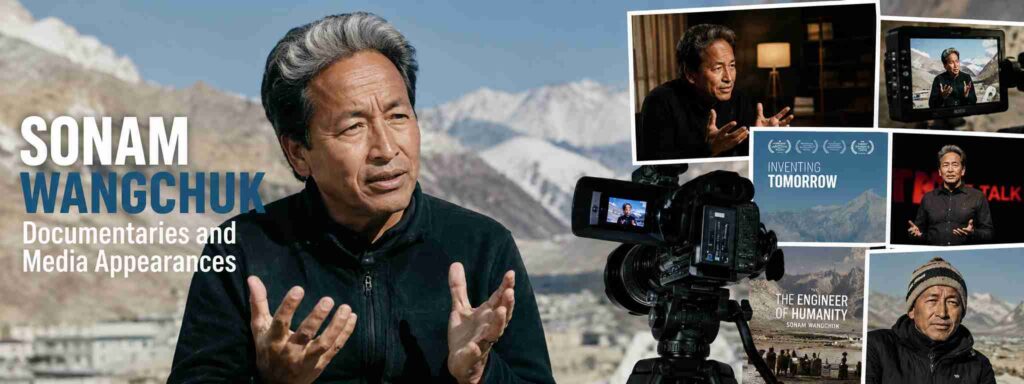
However, there is an important difference between a documentary about Sonam Wangchuk and a programme that simply features him or one of his projects.
Much of the video content associated with Wangchuk focuses on specific subjects such as:
- The Ice Stupa project
- Education reform in Ladakh
- SECMOL
- Sustainable architecture
- Climate change
- Himalayan ecology
- HIAL
- Ladakh’s political and environmental concerns
- His hunger strikes and activism
Therefore, rather than publishing an unverified “Sonam Wangchuk movies list,” it is more accurate to identify individual productions according to their actual format.
Public Talks and Digital Media
Public speaking has played an important role in spreading Wangchuk’s ideas beyond Ladakh.
His talks and interviews have introduced wider audiences to subjects that might otherwise appear highly technical or geographically distant.
A discussion about artificial glaciers can become a lesson about seasonal water management.
A sustainable building can become a lesson about using climate as part of architectural design.
A conversation about students failing examinations can become a wider criticism of education systems that measure everyone through the same narrow standards.
This ability to connect a local problem with a broader question has helped make Wangchuk a recognizable voice in discussions surrounding education and sustainability.
When adding individual videos to this article, publishers should prioritize original recordings from the event organizer, institution or verified media organization rather than reuploaded clips with misleading titles.
Sonam Wangchuk Awards: Cleaned-Up Timeline
Because online award lists contain inconsistencies, the following timeline separates major well-documented honours from older recognitions that should receive an additional primary-source check before publication.
Major Internationally Documented Honours
| Year | Recognition | Associated Work |
|---|---|---|
| 2016 | Rolex Award for Enterprise | Ice Stupa and seasonal water conservation |
| 2017 | Global Award for Sustainable Architecture | Climate-responsive and sustainable architecture |
| 2018 | Ramon Magsaysay Award | Education reform and community-based innovation |
These three awards form the strongest core of any article about Sonam Wangchuk’s international recognition.
Other Reported Awards and Recognitions
The following honours are commonly listed in established biographical accounts but should be checked against the original awarding organization whenever archival records are available:
| Reported Year | Recognition |
|---|---|
| 1996 | Governor’s Medal, Jammu and Kashmir |
| 2001 | The Week Man of the Year |
| 2002 | Ashoka Fellowship |
| 2005 | Green Teacher Award |
| 2008 | CNN-IBN Real Heroes recognition |
| 2017 | Jammu and Kashmir environmental recognition |
This structure is preferable to presenting every entry with identical certainty.
It tells readers what is strongly documented while acknowledging where historical verification is less straightforward.
Awards Versus Achievements: What Is the Difference?
Sonam Wangchuk’s awards and achievements should not be treated as interchangeable.
An award is a formal recognition given by an organization or institution.
An achievement is something accomplished through a person’s work.
For example:
Rolex Award for Enterprise = Award
Development of the Ice Stupa approach = Achievement
Ramon Magsaysay Award = Award
Helping establish SECMOL = Achievement
Global Award for Sustainable Architecture = Award
Promotion of passive-solar architecture in cold Himalayan environments = Achievement
This distinction makes the overall story clearer.
Sonam Wangchuk’s Major Achievements
Helping Establish SECMOL
Wangchuk was among the young Ladakhis involved in establishing the Students’ Educational and Cultural Movement of Ladakh in 1988.
SECMOL became associated with alternative education and efforts to address problems affecting students in the region.
Contributing to Education Reform
Through SECMOL and initiatives associated with Operation New Hope, Wangchuk participated in a broader movement seeking more effective and locally relevant education.
Promoting Experiential Learning
His educational philosophy emphasizes learning through responsibility, practical work and real-world problem-solving.
Developing the Ice Stupa Approach
Wangchuk and his collaborators developed the distinctive vertical Ice Stupa method for storing winter water as artificial ice.
The concept built upon the broader history of artificial-glacier innovation in Ladakh while introducing a different geometry and implementation method.
Promoting Sustainable Architecture
His work helped demonstrate how buildings in cold climates can make greater use of sunlight, insulation and climate-responsive design.
Helping Develop HIAL
The Himalayan Institute of Alternatives, Ladakh represents an effort to apply experiential learning principles to higher education and Himalayan development.
Bringing Attention to Himalayan Environmental Challenges
Through projects, public talks and later activism, Wangchuk helped increase public discussion around water scarcity, climate change and ecological pressures affecting mountain regions.
What Is Sonam Wangchuk Most Famous For?
The answer depends on the audience.
For people interested in innovation, he is most famous for the Ice Stupa.
For people familiar with education reform, he is strongly associated with SECMOL.
For international recognition, the Ramon Magsaysay Award is one of the most important milestones of his career.
For popular-culture audiences, he has often been compared with Phunsukh Wangdu, although Aamir Khan’s 2026 clarification indicates that the fictional character was not intentionally based on him.
For audiences following current affairs, Wangchuk has also become known for environmental and political activism.
These different identities explain why searches about him cover such an unusually wide range of topics.
Frequently Asked Questions
How many awards has Sonam Wangchuk won?
There is no authoritative fixed total covering every award, fellowship, media recognition, honorary degree and institutional honour associated with Wangchuk. It is more accurate to list individually verified major recognitions.
What is Sonam Wangchuk’s biggest award?
The Ramon Magsaysay Award, received in 2018, is generally regarded as one of the most prestigious honours of his career.
Why did Sonam Wangchuk receive the Ramon Magsaysay Award?
He was recognized for his work in educational reform and for developing practical, community-oriented approaches to challenges facing young people in Ladakh.
When did Sonam Wangchuk win the Rolex Award?
He received the Rolex Award for Enterprise in 2016 for his Ice Stupa project.
Which architecture award did Sonam Wangchuk receive?
He was among the recipients of the Global Award for Sustainable Architecture in 2017.
Did Sonam Wangchuk win a UNESCO award?
Claims about a personal UNESCO award should not be made without confirmation from an official UNESCO record. Institutional or project recognition should also not automatically be presented as an individual award.
Has Sonam Wangchuk written any books?
Sonam Wangchuk is not widely documented as the author of a large catalogue of commercially published books. Titles found online should be checked carefully because multiple authors share his name.
Where can I read Sonam Wangchuk’s ideas?
His ideas are extensively available through interviews, recorded talks, institutional materials, project documentation and public commentary concerning education, sustainability and Ladakh.
Is 3 Idiots based on Sonam Wangchuk?
No. Aamir Khan stated in July 2026 that he and the film’s makers did not know about Wangchuk when 3 Idiots was being made.
Is Phunsukh Wangdu Sonam Wangchuk?
No. Phunsukh Wangdu is a fictional character. Wangchuk became popularly compared with the character because of similarities involving Ladakh, engineering, innovation and alternative education.
Why is Sonam Wangchuk called the real-life Phunsukh Wangdu?
The nickname emerged because audiences and media outlets noticed similarities between Wangchuk’s work and characteristics of the fictional character. It should be understood as a popular comparison, not proof that the character was based on him.
Did Aamir Khan know Sonam Wangchuk before 3 Idiots?
According to Aamir Khan’s July 2026 statement, he did not know Wangchuk when the film was being made and said the director and writer did not know him either.
Has Sonam Wangchuk acted in movies?
Wangchuk is not primarily a professional actor. Searches for his movies usually relate to documentaries, interviews, media features or his popular association with 3 Idiots.
Is there a Sonam Wangchuk biopic?
There is no widely established mainstream feature film that serves as a definitive biopic covering Sonam Wangchuk’s complete life.
What is Sonam Wangchuk’s greatest achievement?
There is no single objective answer. The Ice Stupa is his most internationally recognized technological innovation, while his work in education through SECMOL represents a longer chapter of his career.
Conclusion
Sonam Wangchuk’s awards tell only part of his story.
The Rolex Award for Enterprise brought international attention to the Ice Stupa. The Global Award for Sustainable Architecture recognized his contribution to climate-responsive design. The Ramon Magsaysay Award highlighted decades of work in education and community-based innovation.
His achievements, however, extend beyond the trophies themselves.
They include helping establish SECMOL, contributing to education reform, promoting experiential learning, developing the Ice Stupa approach and supporting alternative models of higher education.
The subjects of Sonam Wangchuk’s books and movies require more careful treatment.
There is no well-established large catalogue of books authored solely by the Ladakhi innovator, and online results can easily mix his identity with other authors who share his name. Similarly, 3 Idiots is not his biopic, and Aamir Khan’s 2026 clarification indicates that Phunsukh Wangdu was not intentionally created from Wangchuk’s life.
This makes Wangchuk’s actual story more interesting, not less.
His public identity was built through decades of work that began before the famous Bollywood comparison and continued far beyond it.
From education reform and sustainable buildings to artificial ice reservoirs and Himalayan environmental advocacy, his recognition ultimately reflects a career that has repeatedly crossed the boundaries between engineering, education and social innovation.
