
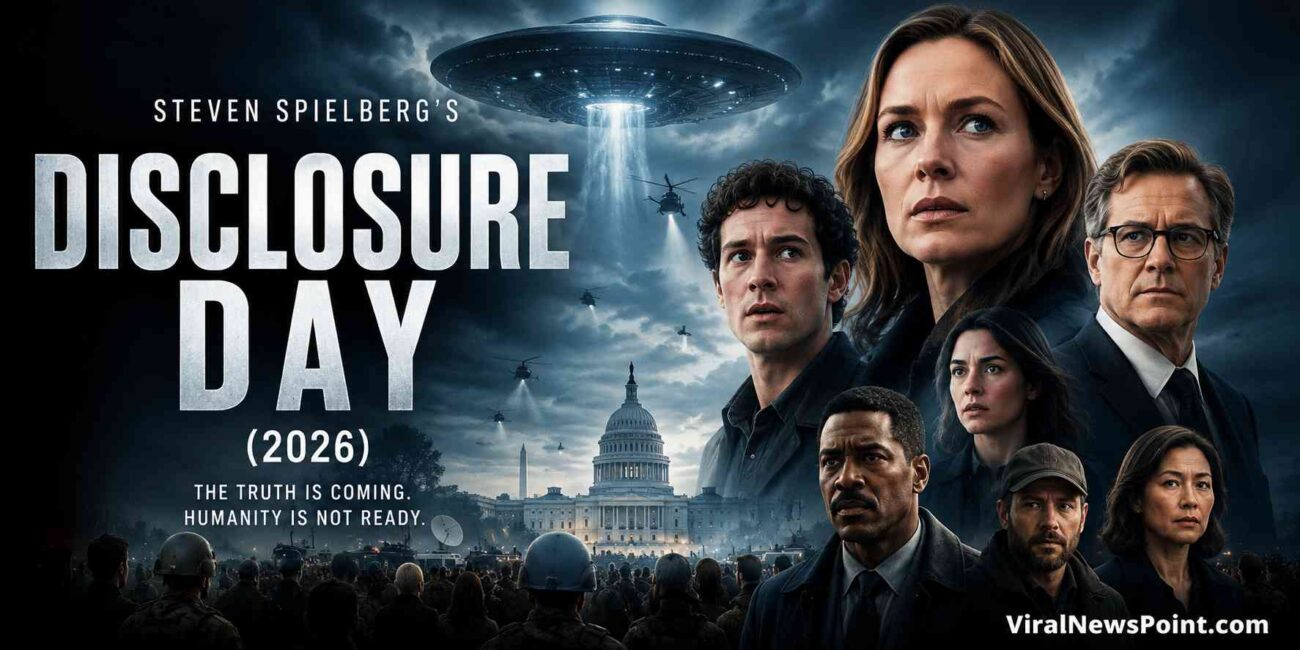
Disclosure Day (2026) Review: There is a question at the very heart of Disclosure Day, Steven Spielberg’s long-awaited return to the genre that made him a legend. It appears on marketing materials. It is spoken aloud in the film itself. And it lingers in the chest long after the credits roll: “If you found out we weren’t alone — if someone showed you, proved it to you — would that frighten you?”
For a filmmaker who has spent half a century exploring the cosmos through a lens of wonder, fear, and inescapable humanity, the question feels almost autobiographical. Spielberg at 79 is not the same director who stood in a dark field in California in 1977 and watched a mothership descend on Devil’s Tower. He is older, more ruminative, more impatient with easy awe. And Disclosure Day, his first science fiction epic since Ready Player One (2018) and his first alien film in over two decades, reflects all of that earned complexity.
The result is one of the director’s most tonally sophisticated films — a thriller built on paranoia and propulsion, anchored by the finest screen performance Emily Blunt has ever given, and suffused with the kind of moral weight that reminds you blockbusters can still mean something. It is not a perfect film. David Koepp’s screenplay occasionally buckles under its own ambitions, and the film’s alien mythology flirts with the borderline cheesy. But in its best moments — and there are many — Disclosure Day achieves something rare: a summer movie that genuinely asks something of its audience.
This Disclosure Day review will cover everything from the performances and direction to the score, the themes, the box office, and everything in between.
Quick Movie Information
| Detail | Information |
|---|---|
| Movie Title | Disclosure Day |
| Release Date | June 12, 2026 |
| Director | Steven Spielberg |
| Screenplay | David Koepp (story by Steven Spielberg) |
| Producers | Steven Spielberg, Kristie Macosko Krieger |
| Executive Producers | Adam Somner, Chris Brigham |
| Production Companies | Amblin Entertainment |
| Distributor | Universal Pictures |
| Runtime | 145 minutes (PG-13) |
| Genre | Sci-Fi / Mystery & Thriller / Drama |
| Language | English |
| Country | United States |
| Budget | $115 million |
| MPAA Rating | PG-13 |
| Filming Locations | New York, New Jersey, Atlanta |
| Cinematography | Janusz Kamiński |
| Editing | Sarah Broshar, Michael Kahn |
| Music Composer | John Williams |
| Production Designer | Adam Stockhausen |
| Costume Designer | Paul Tazewell |
| VFX Supervisor | Matthew Butler |
Plot Summary (Spoiler-Free)
Disclosure Day begins, as all the best Spielberg films do, in medias res — in the middle of something already moving too fast to stop. We meet Daniel Kellner (Josh O’Connor), a cybersecurity professional turned whistleblower, already on the run. The shadowy private security organization known as Wardex, commanded by the patrician and unblinking Noah Scanlon (Colin Firth), has Daniel’s girlfriend Jane (Eve Hewson) in custody and wants back whatever he has taken from them.
What Daniel has taken is evidence. Extraordinary evidence. Evidence that confirms what conspiracy theorists, government whistleblowers, and late-night radio hosts have long suspected: that extraterrestrial life is not only real, but that powerful institutions have gone to tremendous lengths to ensure the public never learns the truth. Daniel has been working with a team of Wardex defectors — led by Hugo Wakefield (Colman Domingo), a man of unshakeable conviction — to release this evidence to the world. They are waiting only for a sign.
That sign turns out to be Margaret Fairchild (Emily Blunt), a Kansas City television meteorologist who begins experiencing the world in ways no human being should be capable of. She speaks fluent Russian without having studied it. She can look into a stranger’s eyes and understand their entire inner life — their grief, their secrets, their longing. When she goes on air one morning, she begins speaking in what sounds like an alien language, broadcasting something that isn’t meant for human ears.
What unfolds is a breathless chase thriller with deep philosophical roots: a film about the weight of truth, the machinery of deception, and the question of whether humanity is ready to confront something that will change everything it believes about its place in the universe. Spielberg structures the film less like a traditional science fiction spectacle and more like a 1970s paranoia thriller — think The Parallax View or Three Days of the Condor — a mode that suits the material with surprising elegance.
Cast and Characters
| Actor | Character | Description | Performance |
|---|---|---|---|
| Emily Blunt | Margaret Fairchild | Kansas City TV meteorologist who begins experiencing impossible phenomena, becoming the key to Disclosure Day | Career-best; astounding physical and emotional range |
| Josh O’Connor | Daniel Kellner | Cybersecurity whistleblower on the run, carrying critical evidence of alien contact | Grounded, charismatic, a genuinely compelling lead |
| Colin Firth | Noah Scanlon | Wardex commander; the film’s primary antagonist, a man who believes he is protecting civilization | Icily magnetic; effective against-type villain turn |
| Eve Hewson | Jane Blankenship | Daniel’s girlfriend; former novitiate nun; moral compass under extreme duress | Quietly powerful; the film’s emotional soul |
| Colman Domingo | Hugo Wakefield | Leader of the Wardex defectors; the man coordinating Disclosure Day | Commanding and warm; a deeply felt performance |
| Wyatt Russell | Jackson | Margaret’s boyfriend; grounded presence amid escalating chaos | Solid support; natural chemistry with Blunt |
| Elizabeth Marvel | Supporting | Wardex operative | Sharp and understated |
| Hettienne Park | Supporting | Key government figure | Memorable in limited screen time |
| Henry Lloyd-Hughes | Boyd | Scanlon’s ruthless head of security; the film’s physical threat | Frighteningly effective |
Story Analysis
David Koepp, who gave Spielberg the Jurassic Park screenplay and collaborated with him again here, is working with a premise that feels genuinely of its moment. In an era when UAP hearings have become congressional theatre and real government officials speak openly about “non-human intelligence,” Disclosure Day doesn’t need to invent its paranoia — it only needs to dramatize it.
The script’s most elegant decision is structural. Koepp and Spielberg skip the discovery — we never see Daniel’s initial encounter with the evidence, never experience the moment of first contact that would typically anchor such a narrative. Instead, we join the story already in crisis. This creates an unusual disorientation in the opening minutes, one that gradually transforms into urgency as the film reveals its layers with precision.
The screenplay’s weakness is the same as its strength: it is extraordinarily dense. Disclosure Day has a great deal to say about government cover-ups, media complicity, the fragility of democracy, and the spiritual dimensions of cosmic contact, and Koepp’s script occasionally strains to fit all of it into a chase-thriller framework. Some supporting characters feel under-served. Certain plot mechanics, particularly in the second act, demand more patience than a summer blockbuster typically requires.
But the character work at the film’s core — the relationship between Margaret and Daniel, two people who have no reason to trust each other and every reason to run — is handled with genuine tenderness. Their arc is the film’s real disclosure: not what the aliens are, but what two frightened, ordinary people are capable of when confronted with something larger than themselves.
The film’s pacing is relentless for the first two-thirds, then deliberately slows in its final act, allowing the emotional and philosophical implications of what we’ve witnessed to settle. Not every viewer will have the patience for this shift. But those who stay with it will find that the film earns its final scenes many times over.
Direction Review
Steven Spielberg has spent nearly six decades making movies, and Disclosure Day is a film that knows exactly what it is — and who made it. His mastery of spatial storytelling, of building geography in a single camera move, of letting an actor’s face carry a scene that a lesser director would drown in exposition, is on constant display. Roger Ebert’s website’s Brian Tallerico put it well: “Right from the opening, Spielberg lays down the gauntlet and reminds you that he does this stuff better than anybody in the history of film.”
What is striking about Disclosure Day in comparison to Spielberg’s previous alien films is the shift in register. Close Encounters of the Third Kind was an act of personal faith — rapturous, wide-eyed, almost devotional. E.T. was a childhood memory given cosmic scale. War of the Worlds was a trauma film, Spielberg processing post-9/11 dread through H.G. Wells. Disclosure Day feels more like Minority Report — febrile, morally serious, shot through with a barely contained anger at institutions that manipulate and deceive.
The director’s visual language here is tighter and more kinetic than his recent work. Shot largely on 35mm film by his longtime cinematographer Janusz Kamiński, the film has a textured, tactile quality that digital cinema rarely achieves. Kamiński’s camera moves with the logic of anxiety — restless during the chase sequences, eerily still in moments of revelation. There is a high-speed sequence involving a car, a moving train, and Colin Firth’s terrifying head of security Boyd that belongs on a short list of Spielberg’s greatest action setpieces.
As Empire’s Dan Jolin observed, Disclosure Day “feels like a welcome flashback to Proper Grown-up Cinema in this era of CG drenching,” and Spielberg’s “pulse can be felt in every frame.” This is not a franchise installment engineered by committee. It is a film made by a single, irreplaceable vision — one that, at 79, remains startlingly alive.
Acting Performances
Emily Blunt — Margaret Fairchild
There are performances that win awards, and there are performances that redefine what an actor is capable of. Emily Blunt’s work in Disclosure Day belongs to the second category. She is operating at a level the film barely deserves — not because the film isn’t good, but because what she does is extraordinary by any standard.
Margaret Fairchild is a woman in the process of being taken over by something she cannot name or understand, and Blunt charts this transformation with almost unbearable precision. The scene where she goes on air and begins speaking in alien frequencies — her voice fragmenting, her face caught between terror and something approaching ecstasy — is a tour de force. What makes it devastating is the split second before it happens: Blunt’s eyes registering the wrongness of what she is about to do and the helplessness to stop it.
Multiple critics have already called this her finest performance. They are not wrong.
Josh O’Connor — Daniel Kellner
Coming off his acclaimed work in Wake Up Dead Man, O’Connor brings something unexpected to a genre role: genuine intellectual interiority. Daniel is a man who understands the magnitude of what he’s carrying, and O’Connor never lets the thriller mechanics swamp that weight. His chemistry with Blunt — tentative, unlikely, eventually profound — gives the film its emotional architecture.
Colin Firth — Noah Scanlon
Casting Colin Firth as a villain is the kind of counter-programming that rewards patience. Scanlon is not a cartoonish antagonist. He is a true believer — a man who has dedicated his career to keeping a secret he has convinced himself the world cannot survive knowing. Firth plays him with glacial conviction, and the result is arguably the most interesting villain in a Spielberg film since Minority Report‘s Lamar Burgess.
Eve Hewson — Jane Blankenship
The screenplay gives Jane the character’s richest backstory — a former nun who lost her faith, now confronting something that might return it — and Hewson finds every dimension of that complexity. Her scenes in Wardex captivity are quietly harrowing, and her final scenes with O’Connor are among the film’s most emotionally honest.
Colman Domingo — Hugo Wakefield
Colman Domingo does more with stillness than most actors do with monologues. Hugo is the moral center of the resistance, a man who has sacrificed everything for a truth he cannot share, and Domingo invests him with the kind of dignity that makes you understand exactly why people follow him.
Cinematography and Visuals
Shot on 35mm film — a choice that feels almost radical in 2026 — Disclosure Day has a visual weight and grain that immediately separates it from the flat digital blockbusters that have dominated multiplexes. Kamiński, Spielberg’s cinematographer since Schindler’s List, continues to evolve his visual vocabulary. Here he uses light as revelation: scenes of alien encounter are bathed in an overexposed whiteness that makes the familiar strange, while Wardex’s world is rendered in cool, institutional grays.
The alien designs are deliberately minimal and, at times, controversial. Spielberg has made the choice to present alien contact through the behavior of animals — creatures that seem to possess an uncanny intelligence, making eye contact with a directness that unsettles without being spectacular. This is thematically coherent (the film’s entire argument is that disclosure doesn’t look like Independence Day) but the CGI required to animate these sequences is occasionally the film’s most visually weak element, with the Hollywood Reporter’s David Rooney noting it’s “borderline cheesy” at its most conspicuous.
Where the visual effects work best is in the broader spectacle sequences — the train chase, a remarkable sequence in an open field at night that evokes Close Encounters without imitating it, and a final act reveal that is executed with breathtaking restraint.
Music and Sound Design
John Williams is 93 years old and wrote what multiple critics have called his finest score in years. That sentence alone deserves a moment.
The Disclosure Day score is not built on a single soaring theme — it is more complex than that, more interior. Rooted in French horn and woodwinds, with strings that seem to express what the film’s characters cannot say aloud, it is a score that functions as a second screenplay. When Margaret begins to change, the music changes with her, adopting harmonic structures that feel subtly wrong — familiar instruments producing sounds just slightly outside human expectation.
The sound design complements Williams beautifully. The alien language Margaret speaks on air — created by the film’s sound team — is one of the most unsettling audio achievements of recent blockbuster filmmaking: human in rhythm, utterly alien in tone.
Themes and Symbolism
Disclosure Day is, at its core, a film about truth — what it costs to keep it, what it costs to release it, and what it does to human beings when they are finally confronted with it.
The government cover-up at the film’s center is not merely a thriller mechanism. Spielberg treats it as a genuine moral argument. Noah Scanlon’s position — that the world is not ready, that disclosure would cause panic, societal collapse, civilizational fracture — is not presented as pure villainy. It is presented as a coherent, even compassionate position. The film’s counter-argument, made by Wakefield and eventually by Margaret herself, is that withholding the truth is its own form of violence.
There is also a theological dimension the film handles more gracefully than expected. Jane’s background as a former nun is not incidental: her arc asks whether the discovery of extraterrestrial life would destroy faith or fulfill it. The film’s answer, characteristically Spielbergian, is more hope-forward than the premise suggests.
The theme of humanity’s global response to disclosure — played out in televised reactions, social media, and the behavior of crowds — feels quietly prophetic in ways the film earns through restraint rather than spectacle.
What Works
Emily Blunt’s performance is the film’s undeniable centerpiece — a career-defining turn that belongs in conversation with the great genre performances of cinema history.
The 1970s thriller register is inspired. By resisting the temptation to turn Disclosure Day into an alien action spectacular, Spielberg has made a more intelligent and durable film.
John Williams’ score is a late-career masterpiece — emotionally precise, harmonically daring, and perfectly calibrated to every shift in the film’s emotional temperature.
The train chase sequence is among the great Spielberg setpieces — kinetic, spatially coherent, genuinely suspenseful.
Colin Firth’s villain is one of the film’s greatest surprises: against-type casting that generates genuine dramatic friction.
The final act, which dramatically slows in pace and expands in philosophical scope, is audacious for a summer blockbuster and, for patient viewers, enormously rewarding.
What Doesn’t Work
The second act is where the screenplay strains most visibly. The mechanics of the Wardex organization become tangled, and certain plot revelations are delivered through dialogue-heavy exposition that momentarily stalls the film’s momentum.
Supporting characters — particularly the government officials operating on the periphery of the Wardex conspiracy — are underdeveloped to the point of function rather than character. A film this interested in institutional behavior deserved richer institutional portraits.
The animal-form alien design, while thematically defensible, is the film’s most divisive creative choice. Audiences expecting the spectacular alien imagery of Spielberg’s earlier work will find these sequences more unsettling than spectacular — and that might not be the reaction all viewers are looking for.
Owen Gleiberman’s Variety observation rings true: for a film from the man who defined the cinematic close encounter, Disclosure Day “never gives you the contact high of awe that Close Encounters did.” That is partly intentional and partly a limitation.
⚠️ SPOILER SECTION — Major Plot Points & Ending Explained
Stop reading here if you have not seen the film.
The film’s central twist — revealed in the third act — is that Margaret Fairchild has not been chosen at random. She is the descendant of an individual who made contact with the alien intelligence decades earlier, an event that the U.S. government classified and erased from history. The aliens have been watching her family for generations, waiting for the moment when circumstances aligned to make disclosure possible.
The alien revelation itself is deliberately anti-climactic in the best sense: rather than a ship descending or a being emerging, the film’s “first contact” moment is a shared visual transmission — footage, beamed simultaneously into every screen on Earth, of encounters recorded over seventy years. It is Disclosure Day: not an invasion, not a greeting, but an answer to the question Spielberg has been asking his entire career.
Margaret’s ability to speak the alien language is the key that unlocks the archive — her voice, carrying the genetic memory of her ancestor’s encounter, is what the intelligence has been waiting for. The film’s final image — Margaret and Daniel watching the world react to the transmitted footage, crowds falling silent in awe rather than fear — is a deliberate inversion of War of the Worlds‘ catastrophic vision of contact. Where that film asked what alien life would do to us, Disclosure Day asks what we might be capable of when forced to see each other through the lens of something larger.
The E.T. cameo (spotted in early international screenings and confirmed in subsequent reports) is a brief, wordless appearance in the archive footage — a delicate, moving callback that had audiences in tears.
The film ends without a sequel setup. It ends, as all honest films do, with a question.
Critical Reception
Disclosure Day has received a strong critical reception, landing at 82% on Rotten Tomatoes (Certified Fresh) based on over 220 reviews, and a 74 on Metacritic, representing “generally favorable reviews.”
The Hollywood Reporter’s David Rooney declared that “no living director better understands the magic of movies,” noting the film’s “shared DNA” with Close Encounters and E.T. while praising the “deeply felt performances from Emily Blunt and Josh O’Connor.” Empire’s Dan Jolin awarded four stars, calling the film “every bit as personal to Spielberg as The Fabelmans” and praising Kamiński’s 35mm photography as a rebuke to contemporary CG excess.
At RogerEbert.com, Brian Tallerico called it “a movie that reminds viewers that blockbusters can be morally and thematically complex while they’re entertaining the hell out of you,” and singled out the final act as containing “some of the most emotionally riveting scenes of Spielberg’s career.”
Variety’s Owen Gleiberman was more measured, acknowledging the film as “a lavishly intense chase thriller” that is “a vigorous and diverting ride” scene by scene, while arguing that the film “never gives you the contact high of awe that Close Encounters did.”
Dissenting voices — represented most vocally on Letterboxd and among younger critics — found the screenplay “disjointed” and the messaging “shallow,” with the film’s density working against its emotional clarity. These are legitimate complaints that the film’s admirers will recognize as the price of ambition.
Audience reaction has been strongly positive, with a 3.8/5 average on Allocine and early verified audience scores indicating robust approval.
Comparison with Spielberg’s Previous Sci-Fi Films
| Film | Story | Emotional Impact | Visuals | Themes | Rewatch Value |
|---|---|---|---|---|---|
| Disclosure Day (2026) | Dense, paranoid thriller; politically acute | High; deliberately adult | Restrained; 35mm beauty | Truth, government deception, human unity | High for patient viewers |
| Close Encounters (1977) | Personal obsession; mystical revelation | Overwhelming; rapturous | Revolutionary for its era | Wonder, faith, the call of the unknown | Extremely high |
| E.T. (1982) | Simple, devastating; pure | Among cinema’s greatest emotional achievements | Timeless | Friendship, loss, belonging | Near-universal |
| War of the Worlds (2005) | Visceral survival horror | Intense but cold | Spectacular | Fear, survival, fractured family | Moderate |
| A.I. (2001) | Ambitious; uneven | Deeply strange and haunting | Visually stunning | Identity, longing, consciousness | Divisive; grows with time |
| Minority Report (2002) | Tightly plotted; morally rich | Strong | Near-future brilliance | Free will, surveillance, justice | Very high |
Box Office Performance
Disclosure Day opened with what sources describe as a targeted $35 million domestic opening weekend, with a global first-weekend projection of approximately $65 million — a figure Deadline reports as “boding well” given the film’s $115 million production budget.
International markets have been encouraging. The UK and Ireland opened with strong market share at #1, Korea showed notable performance on its opening day, and Brazil and Australia tracked ahead of comparable original sci-fi releases. Foreign markets targeted a $30 million-plus opening weekend, with Spain and China still to come on subsequent dates.
The film is tracking comparably to Jordan Peele’s Nope (2022), which opened to $44 million domestically and ultimately grossed $123 million in North America. Spielberg’s movies are historically known for extraordinary legs — Jurassic Park multiplied its opening 8x, Saving Private Ryan 7x — and Disclosure Day‘s strong reviews (Certified Fresh, Metacritic in the 70s) provide the foundation for a lengthy run, particularly with the older audiences who skew toward Spielberg films.
With competition from Toy Story 5 arriving in subsequent weeks, Disclosure Day will need strong word-of-mouth to build toward a meaningful total, but its commercial prospects look considerably healthier than Spielberg’s three previous misfires: The BFG, West Side Story, and The Fabelmans.
Final Verdict
Disclosure Day is not the alien spectacular its marketing occasionally implied it might be. It is something more interesting, more mature, and — if you’re prepared for it — more rewarding.
Spielberg has made a film about truth in an age of manufactured reality, about the stories powerful people tell to keep ordinary people compliant, and about what happens when those stories can no longer hold. That he has wrapped these ideas in a genuinely thrilling chase narrative, led by an extraordinary performance from Emily Blunt and underpinned by one of John Williams’ finest late-career achievements, makes Disclosure Day one of the year’s most essential cinematic experiences.
Who should see it: Adults who want their blockbusters to mean something. Fans of Spielberg’s Minority Report-era work. Anyone who has been waiting for a summer movie that takes them seriously.
Who may not connect with it: Viewers expecting alien spectacle in the mold of Independence Day or even War of the Worlds. Those put off by dense, paranoia-driven narratives. Impatient audiences who won’t give the film’s deliberate final act the time it requires.
Is it worth IMAX? The 35mm photography and Kamiński’s compositions are best experienced on the largest screen available. The sound design and Williams score, in a premium audio environment, are immersive in ways the home viewing experience won’t replicate for years. Yes — go IMAX.
Is it worth seeing in theaters? Without question. Disclosure Day is exactly the kind of film that theaters were built to show.
Rating Breakdown
| Category | Score |
|---|---|
| Story | 8/10 |
| Direction | 9/10 |
| Acting | 10/10 |
| Visual Effects | 7.5/10 |
| Cinematography | 9/10 |
| Music | 9.5/10 |
| Entertainment Value | 8.5/10 |
| Rewatch Value | 8/10 |
⭐ Final Rating: 8.5/10
⭐⭐⭐⭐½
Disclosure Day is Spielberg at his most ruminative and most alive — a thriller about humanity’s capacity for truth, powered by Emily Blunt’s greatest performance and John Williams’ most haunting late score. It doesn’t give you the awe of Close Encounters or the heartbreak of E.T., but it gives you something those films, made by a younger and more innocent filmmaker, couldn’t: the wisdom of a man who has thought about this his entire life, and who still doesn’t know the answer.
That’s as close to the stars as cinema can take us right now. It is more than enough.
Disclosure Day is now in theaters. Rated PG-13. Runtime: 145 minutes. Directed by Steven Spielberg. Written by David Koepp. Starring Emily Blunt, Josh O’Connor, Colin Firth, Eve Hewson, and Colman Domingo.
